

110
4 After the Lips: Acoustic Resonances and Radiation
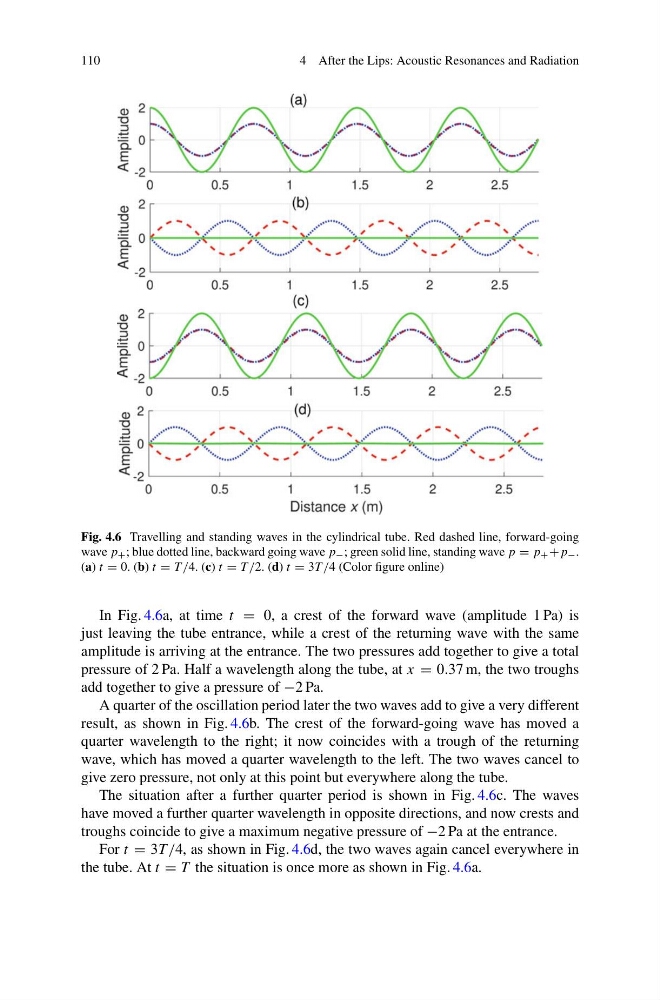
Fig. 4.6 Travelling and standing waves in the cylindrical tube. Red dashed line, forward-going
wave p + ; blue dotted line, backward going wave p − ; green solid line, standing wave p = p + +p − .
(a) t = 0. (b) t = T /4. (c) t = T /2. (d) t = 3T /4 (Color figure online)
In Fig. 4.6a, at time t = 0, a crest of the forward wave (amplitude 1 Pa) is
just leaving the tube entrance, while a crest of the returning wave with the same
amplitude is arriving at the entrance. The two pressures add together to give a total
pressure of 2 Pa. Half a wavelength along the tube, at x = 0.37 m, the two troughs
add together to give a pressure of −2 Pa.
A quarter of the oscillation period later the two waves add to give a very different
result, as shown in Fig. 4.6b. The crest of the forward-going wave has moved a
quarter wavelength to the right; it now coincides with a trough of the returning
wave, which has moved a quarter wavelength to the left. The two waves cancel to
give zero pressure, not only at this point but everywhere along the tube.
The situation after a further quarter period is shown in Fig. 4.6c. The waves
have moved a further quarter wavelength in opposite directions, and now crests and
troughs coincide to give a maximum negative pressure of −2 Pa at the entrance.
For t = 3T /4, as shown in Fig. 4.6d, the two waves again cancel everywhere in
the tube. At t = T the situation is once more as shown in Fig. 4.6a.
4 After the Lips: Acoustic Resonances and Radiation
Fig. 4.6 Travelling and standing waves in the cylindrical tube. Red dashed line, forward-going
wave p + ; blue dotted line, backward going wave p − ; green solid line, standing wave p = p + +p − .
(a) t = 0. (b) t = T /4. (c) t = T /2. (d) t = 3T /4 (Color figure online)
In Fig. 4.6a, at time t = 0, a crest of the forward wave (amplitude 1 Pa) is
just leaving the tube entrance, while a crest of the returning wave with the same
amplitude is arriving at the entrance. The two pressures add together to give a total
pressure of 2 Pa. Half a wavelength along the tube, at x = 0.37 m, the two troughs
add together to give a pressure of −2 Pa.
A quarter of the oscillation period later the two waves add to give a very different
result, as shown in Fig. 4.6b. The crest of the forward-going wave has moved a
quarter wavelength to the right; it now coincides with a trough of the returning
wave, which has moved a quarter wavelength to the left. The two waves cancel to
give zero pressure, not only at this point but everywhere along the tube.
The situation after a further quarter period is shown in Fig. 4.6c. The waves
have moved a further quarter wavelength in opposite directions, and now crests and
troughs coincide to give a maximum negative pressure of −2 Pa at the entrance.
For t = 3T /4, as shown in Fig. 4.6d, the two waves again cancel everywhere in
the tube. At t = T the situation is once more as shown in Fig. 4.6a.