

3.5 Volume Flow in Buzzing Lips
97
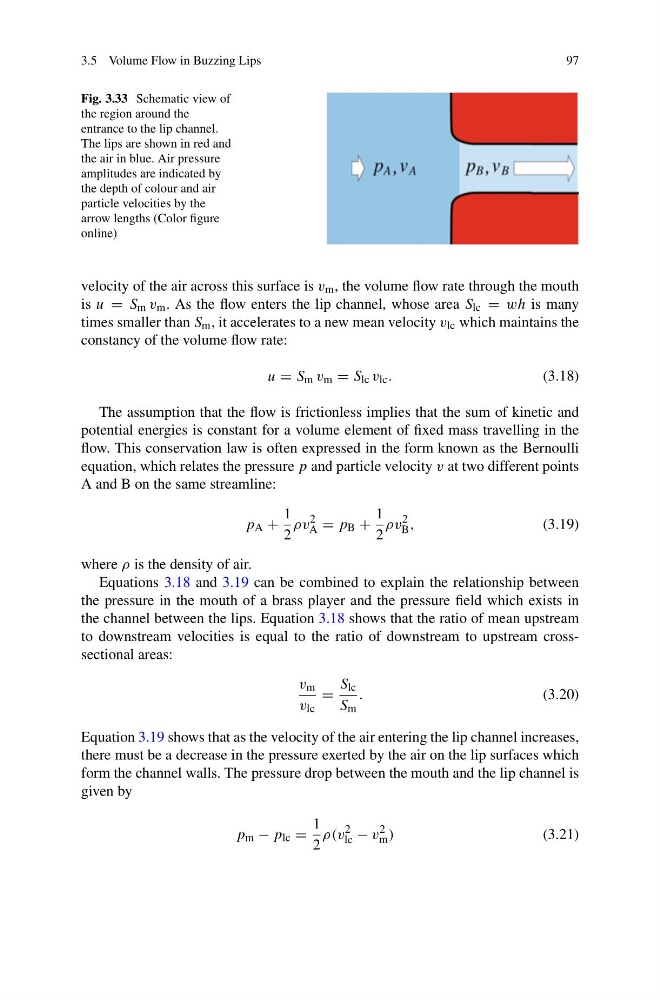
Fig. 3.33 Schematic view of
the region around the
entrance to the lip channel.
The lips are shown in red and
the air in blue. Air pressure
amplitudes are indicated by
the depth of colour and air
particle velocities by the
arrow lengths (Color figure
online)
velocity of the air across this surface is v m , the volume flow rate through the mouth
is u = S m v m . As the flow enters the lip channel, whose area S lc = wh is many
times smaller than S m , it accelerates to a new mean velocity v lc which maintains the
constancy of the volume flow rate:
u = S m v m = S lc v lc .
(3.18)
The assumption that the flow is frictionless implies that the sum of kinetic and
potential energies is constant for a volume element of fixed mass travelling in the
flow. This conservation law is often expressed in the form known as the Bernoulli
equation, which relates the pressure p and particle velocity v at two different points
A and B on the same streamline:
p A +
1
2
ρv
2
A = p B +
1
2
ρv
2
B ,
(3.19)
where ρ is the density of air.
Equations 3.18 and 3.19 can be combined to explain the relationship between
the pressure in the mouth of a brass player and the pressure field which exists in
the channel between the lips. Equation 3.18 shows that the ratio of mean upstream
to downstream velocities is equal to the ratio of downstream to upstream crosssectional areas:
v m
v lc
=
S lc
S m
.
(3.20)
Equation 3.19 shows that as the velocity of the air entering the lip channel increases,
there must be a decrease in the pressure exerted by the air on the lip surfaces which
form the channel walls. The pressure drop between the mouth and the lip channel is
given by
p m − p lc =
1
2
ρ(v
2
lc − v
2
m )
(3.21)
97
Fig. 3.33 Schematic view of
the region around the
entrance to the lip channel.
The lips are shown in red and
the air in blue. Air pressure
amplitudes are indicated by
the depth of colour and air
particle velocities by the
arrow lengths (Color figure
online)
velocity of the air across this surface is v m , the volume flow rate through the mouth
is u = S m v m . As the flow enters the lip channel, whose area S lc = wh is many
times smaller than S m , it accelerates to a new mean velocity v lc which maintains the
constancy of the volume flow rate:
u = S m v m = S lc v lc .
(3.18)
The assumption that the flow is frictionless implies that the sum of kinetic and
potential energies is constant for a volume element of fixed mass travelling in the
flow. This conservation law is often expressed in the form known as the Bernoulli
equation, which relates the pressure p and particle velocity v at two different points
A and B on the same streamline:
p A +
1
2
ρv
2
A = p B +
1
2
ρv
2
B ,
(3.19)
where ρ is the density of air.
Equations 3.18 and 3.19 can be combined to explain the relationship between
the pressure in the mouth of a brass player and the pressure field which exists in
the channel between the lips. Equation 3.18 shows that the ratio of mean upstream
to downstream velocities is equal to the ratio of downstream to upstream crosssectional areas:
v m
v lc
=
S lc
S m
.
(3.20)
Equation 3.19 shows that as the velocity of the air entering the lip channel increases,
there must be a decrease in the pressure exerted by the air on the lip surfaces which
form the channel walls. The pressure drop between the mouth and the lip channel is
given by
p m − p lc =
1
2
ρ(v
2
lc − v
2
m )
(3.21)