

3.4 Why Do the Lips Buzz?
95
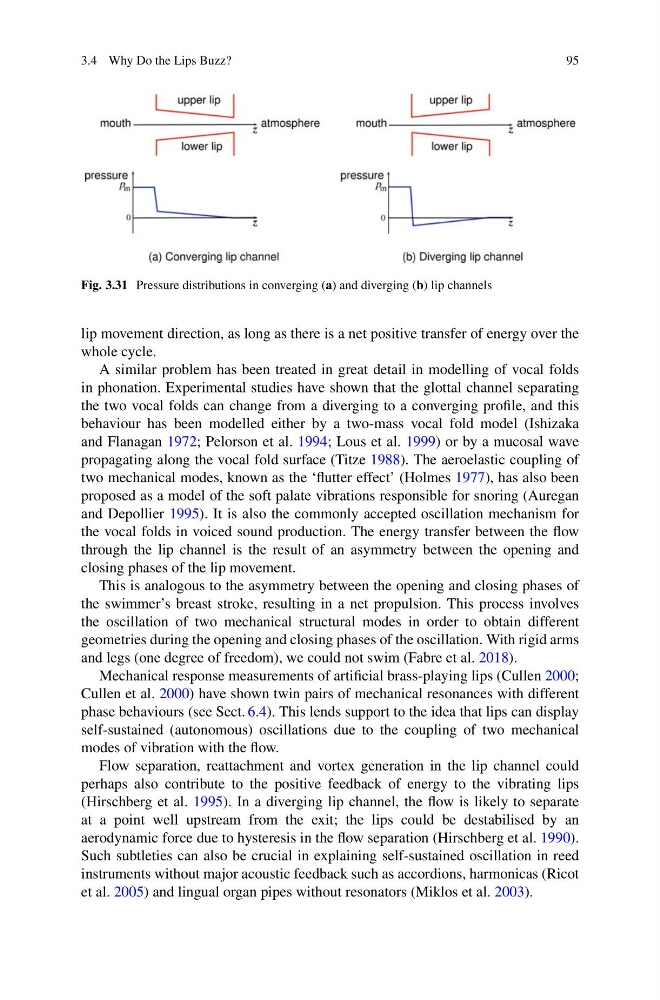
Fig. 3.31 Pressure distributions in converging (a) and diverging (b) lip channels
lip movement direction, as long as there is a net positive transfer of energy over the
whole cycle.
A similar problem has been treated in great detail in modelling of vocal folds
in phonation. Experimental studies have shown that the glottal channel separating
the two vocal folds can change from a diverging to a converging profile, and this
behaviour has been modelled either by a two-mass vocal fold model (Ishizaka
and Flanagan 1972; Pelorson et al. 1994; Lous et al. 1999) or by a mucosal wave
propagating along the vocal fold surface (Titze 1988). The aeroelastic coupling of
two mechanical modes, known as the ‘flutter effect’ (Holmes 1977), has also been
proposed as a model of the soft palate vibrations responsible for snoring (Auregan
and Depollier 1995). It is also the commonly accepted oscillation mechanism for
the vocal folds in voiced sound production. The energy transfer between the flow
through the lip channel is the result of an asymmetry between the opening and
closing phases of the lip movement.
This is analogous to the asymmetry between the opening and closing phases of
the swimmer’s breast stroke, resulting in a net propulsion. This process involves
the oscillation of two mechanical structural modes in order to obtain different
geometries during the opening and closing phases of the oscillation. With rigid arms
and legs (one degree of freedom), we could not swim (Fabre et al. 2018).
Mechanical response measurements of artificial brass-playing lips (Cullen 2000;
Cullen et al. 2000) have shown twin pairs of mechanical resonances with different
phase behaviours (see Sect. 6.4). This lends support to the idea that lips can display
self-sustained (autonomous) oscillations due to the coupling of two mechanical
modes of vibration with the flow.
Flow separation, reattachment and vortex generation in the lip channel could
perhaps also contribute to the positive feedback of energy to the vibrating lips
(Hirschberg et al. 1995). In a diverging lip channel, the flow is likely to separate
at a point well upstream from the exit; the lips could be destabilised by an
aerodynamic force due to hysteresis in the flow separation (Hirschberg et al. 1990).
Such subtleties can also be crucial in explaining self-sustained oscillation in reed
instruments without major acoustic feedback such as accordions, harmonicas (Ricot
et al. 2005) and lingual organ pipes without resonators (Miklos et al. 2003).
95
Fig. 3.31 Pressure distributions in converging (a) and diverging (b) lip channels
lip movement direction, as long as there is a net positive transfer of energy over the
whole cycle.
A similar problem has been treated in great detail in modelling of vocal folds
in phonation. Experimental studies have shown that the glottal channel separating
the two vocal folds can change from a diverging to a converging profile, and this
behaviour has been modelled either by a two-mass vocal fold model (Ishizaka
and Flanagan 1972; Pelorson et al. 1994; Lous et al. 1999) or by a mucosal wave
propagating along the vocal fold surface (Titze 1988). The aeroelastic coupling of
two mechanical modes, known as the ‘flutter effect’ (Holmes 1977), has also been
proposed as a model of the soft palate vibrations responsible for snoring (Auregan
and Depollier 1995). It is also the commonly accepted oscillation mechanism for
the vocal folds in voiced sound production. The energy transfer between the flow
through the lip channel is the result of an asymmetry between the opening and
closing phases of the lip movement.
This is analogous to the asymmetry between the opening and closing phases of
the swimmer’s breast stroke, resulting in a net propulsion. This process involves
the oscillation of two mechanical structural modes in order to obtain different
geometries during the opening and closing phases of the oscillation. With rigid arms
and legs (one degree of freedom), we could not swim (Fabre et al. 2018).
Mechanical response measurements of artificial brass-playing lips (Cullen 2000;
Cullen et al. 2000) have shown twin pairs of mechanical resonances with different
phase behaviours (see Sect. 6.4). This lends support to the idea that lips can display
self-sustained (autonomous) oscillations due to the coupling of two mechanical
modes of vibration with the flow.
Flow separation, reattachment and vortex generation in the lip channel could
perhaps also contribute to the positive feedback of energy to the vibrating lips
(Hirschberg et al. 1995). In a diverging lip channel, the flow is likely to separate
at a point well upstream from the exit; the lips could be destabilised by an
aerodynamic force due to hysteresis in the flow separation (Hirschberg et al. 1990).
Such subtleties can also be crucial in explaining self-sustained oscillation in reed
instruments without major acoustic feedback such as accordions, harmonicas (Ricot
et al. 2005) and lingual organ pipes without resonators (Miklos et al. 2003).