

92
3 Buzzing Lips: Sound Generation in Brass Instruments
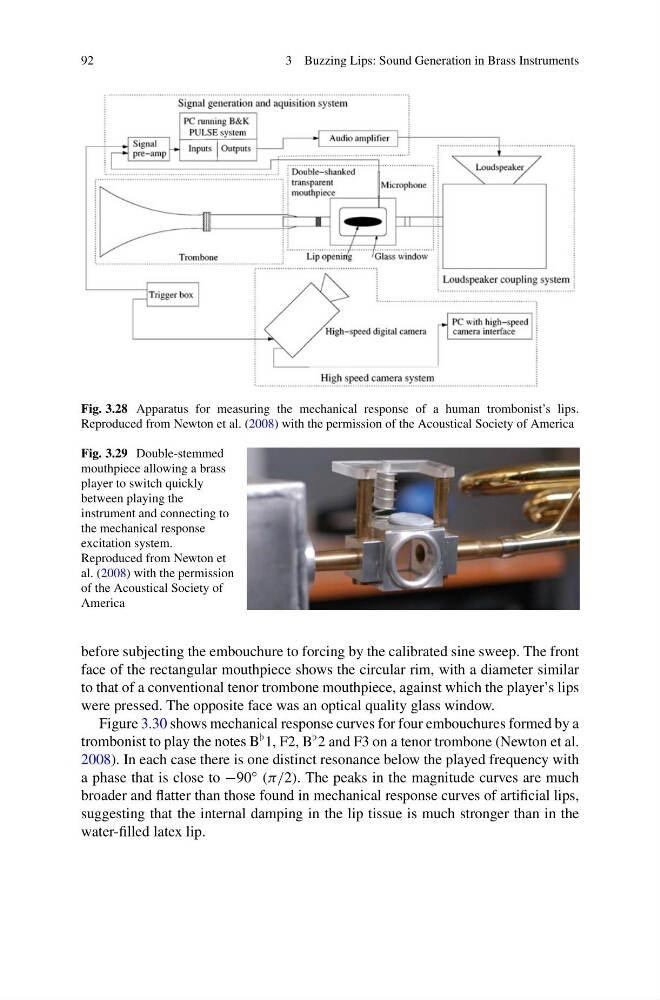
Fig. 3.28 Apparatus for measuring the mechanical response of a human trombonist’s lips.
Reproduced from Newton et al. (2008) with the permission of the Acoustical Society of America
Fig. 3.29 Double-stemmed
mouthpiece allowing a brass
player to switch quickly
between playing the
instrument and connecting to
the mechanical response
excitation system.
Reproduced from Newton et
al. (2008) with the permission
of the Acoustical Society of
America
before subjecting the embouchure to forcing by the calibrated sine sweep. The front
face of the rectangular mouthpiece shows the circular rim, with a diameter similar
to that of a conventional tenor trombone mouthpiece, against which the player’s lips
were pressed. The opposite face was an optical quality glass window.
Figure 3.30 shows mechanical response curves for four embouchures formed by a
trombonist to play the notes B 1, F2, B 2 and F3 on a tenor trombone (Newton et al.
2008). In each case there is one distinct resonance below the played frequency with
a phase that is close to −90 ◦ (π/2). The peaks in the magnitude curves are much
broader and flatter than those found in mechanical response curves of artificial lips,
suggesting that the internal damping in the lip tissue is much stronger than in the
water-filled latex lip.
3 Buzzing Lips: Sound Generation in Brass Instruments
Fig. 3.28 Apparatus for measuring the mechanical response of a human trombonist’s lips.
Reproduced from Newton et al. (2008) with the permission of the Acoustical Society of America
Fig. 3.29 Double-stemmed
mouthpiece allowing a brass
player to switch quickly
between playing the
instrument and connecting to
the mechanical response
excitation system.
Reproduced from Newton et
al. (2008) with the permission
of the Acoustical Society of
America
before subjecting the embouchure to forcing by the calibrated sine sweep. The front
face of the rectangular mouthpiece shows the circular rim, with a diameter similar
to that of a conventional tenor trombone mouthpiece, against which the player’s lips
were pressed. The opposite face was an optical quality glass window.
Figure 3.30 shows mechanical response curves for four embouchures formed by a
trombonist to play the notes B 1, F2, B 2 and F3 on a tenor trombone (Newton et al.
2008). In each case there is one distinct resonance below the played frequency with
a phase that is close to −90 ◦ (π/2). The peaks in the magnitude curves are much
broader and flatter than those found in mechanical response curves of artificial lips,
suggesting that the internal damping in the lip tissue is much stronger than in the
water-filled latex lip.