

84
S. Sharma et al.
7.2 Results and Discussion
For the present work, we have simulated various reactions with
124 Sn and
197 Au
targets at semi-central geometries. Several thousand events are simulated for the
reactions of
197 Au +
197 Au (E lab = 50–120 MeV/nucleon),
112 Sn +
197 Au (E lab =
45–145 MeV/nucleon),
72 Ge +
197 Au (E lab = 45–195 MeV/nucleon),
44 Ca +
197 Au
(E lab = 55–330 MeV/nucleon),
124 Sn +
124 Sn (E lab = 40–140 MeV/nucleon),
112 Sn
+
124 Sn (E lab = 40–160 MeV/nucleon),
72 Ge +
124 Sn (E lab = 45–195 MeV/nucleon)
and
44 Ca +
124 Sn (E lab = 60–225 MeV/nucleon). Here, we have used soft equation
of state and isospin-dependent nucleon-nucleon (nn) cross-section.
We observe proper rise and fall in the multiplicity of IMFs with incident energy
for various projectiles on
124 Sn and
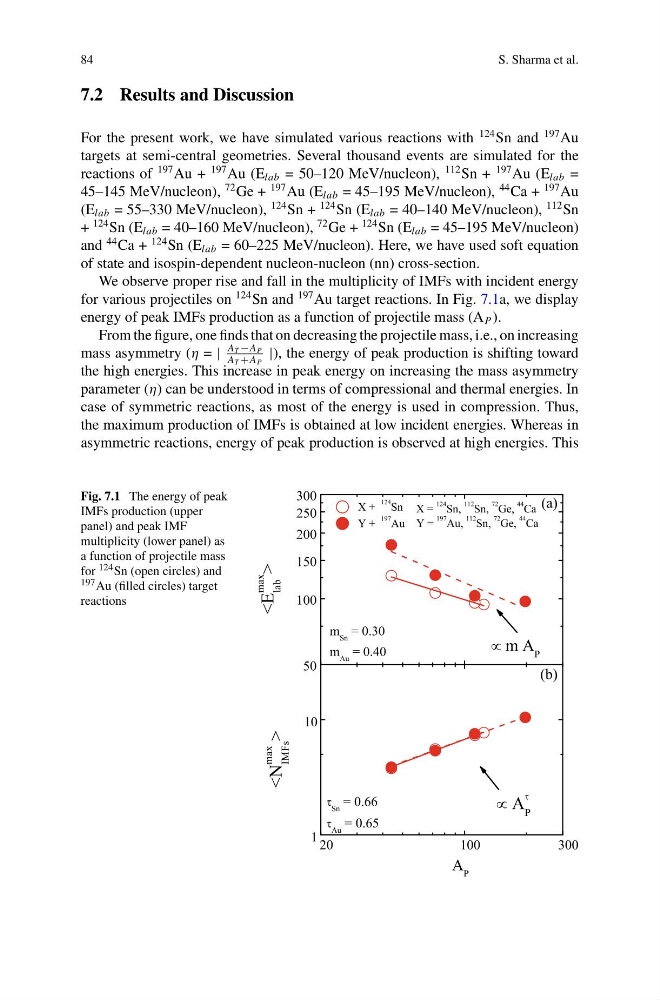
197 Au target reactions. In Fig. 7.1a, we display
energy of peak IMFs production as a function of projectile mass (A P ).
From the figure, one finds that on decreasing the projectile mass, i.e., on increasing
mass asymmetry (η = |
A T −A P
A T +A P
|), the energy of peak production is shifting toward
the high energies. This increase in peak energy on increasing the mass asymmetry
parameter (η) can be understood in terms of compressional and thermal energies. In
case of symmetric reactions, as most of the energy is used in compression. Thus,
the maximum production of IMFs is obtained at low incident energies. Whereas in
asymmetric reactions, energy of peak production is observed at high energies. This
Fig. 7.1 The energy of peak
IMFs production (upper
panel) and peak IMF
multiplicity (lower panel) as
a function of projectile mass
for 124 Sn (open circles) and
197 Au (filled circles) target
reactions
S. Sharma et al.
7.2 Results and Discussion
For the present work, we have simulated various reactions with
124 Sn and
197 Au
targets at semi-central geometries. Several thousand events are simulated for the
reactions of
197 Au +
197 Au (E lab = 50–120 MeV/nucleon),
112 Sn +
197 Au (E lab =
45–145 MeV/nucleon),
72 Ge +
197 Au (E lab = 45–195 MeV/nucleon),
44 Ca +
197 Au
(E lab = 55–330 MeV/nucleon),
124 Sn +
124 Sn (E lab = 40–140 MeV/nucleon),
112 Sn
+
124 Sn (E lab = 40–160 MeV/nucleon),
72 Ge +
124 Sn (E lab = 45–195 MeV/nucleon)
and
44 Ca +
124 Sn (E lab = 60–225 MeV/nucleon). Here, we have used soft equation
of state and isospin-dependent nucleon-nucleon (nn) cross-section.
We observe proper rise and fall in the multiplicity of IMFs with incident energy
for various projectiles on
124 Sn and
197 Au target reactions. In Fig. 7.1a, we display
energy of peak IMFs production as a function of projectile mass (A P ).
From the figure, one finds that on decreasing the projectile mass, i.e., on increasing
mass asymmetry (η = |
A T −A P
A T +A P
|), the energy of peak production is shifting toward
the high energies. This increase in peak energy on increasing the mass asymmetry
parameter (η) can be understood in terms of compressional and thermal energies. In
case of symmetric reactions, as most of the energy is used in compression. Thus,
the maximum production of IMFs is obtained at low incident energies. Whereas in
asymmetric reactions, energy of peak production is observed at high energies. This
Fig. 7.1 The energy of peak
IMFs production (upper
panel) and peak IMF
multiplicity (lower panel) as
a function of projectile mass
for 124 Sn (open circles) and
197 Au (filled circles) target
reactions