

7 Role of Mass Asymmetry on the Energy of Peak …
85
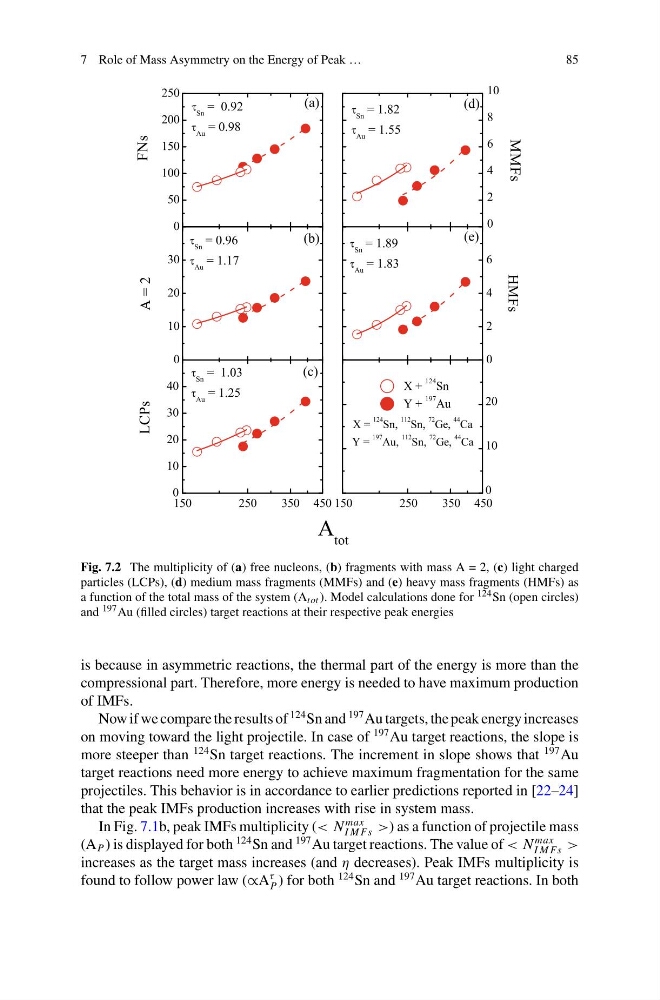
Fig. 7.2 The multiplicity of (a) free nucleons, (b) fragments with mass A = 2, (c) light charged
particles (LCPs), (d) medium mass fragments (MMFs) and (e) heavy mass fragments (HMFs) as
a function of the total mass of the system (A tot ). Model calculations done for 124 Sn (open circles)
and 197 Au (filled circles) target reactions at their respective peak energies
is because in asymmetric reactions, the thermal part of the energy is more than the
compressional part. Therefore, more energy is needed to have maximum production
of IMFs.
Now if we compare the results of
124 Sn and
197 Au targets, the peak energy increases
on moving toward the light projectile. In case of
197 Au target reactions, the slope is
more steeper than
124 Sn target reactions. The increment in slope shows that
197 Au
target reactions need more energy to achieve maximum fragmentation for the same
projectiles. This behavior is in accordance to earlier predictions reported in [22–24]
that the peak IMFs production increases with rise in system mass.
In Fig. 7.1b, peak IMFs multiplicity (< N
max
I M Fs >) as a function of projectile mass
(A P ) is displayed for both
124 Sn and
197 Au target reactions. The value of < N
max
I M Fs >
increases as the target mass increases (and η decreases). Peak IMFs multiplicity is
found to follow power law (∝A
τ
P ) for both
124 Sn and
197 Au target reactions. In both
85
Fig. 7.2 The multiplicity of (a) free nucleons, (b) fragments with mass A = 2, (c) light charged
particles (LCPs), (d) medium mass fragments (MMFs) and (e) heavy mass fragments (HMFs) as
a function of the total mass of the system (A tot ). Model calculations done for 124 Sn (open circles)
and 197 Au (filled circles) target reactions at their respective peak energies
is because in asymmetric reactions, the thermal part of the energy is more than the
compressional part. Therefore, more energy is needed to have maximum production
of IMFs.
Now if we compare the results of
124 Sn and
197 Au targets, the peak energy increases
on moving toward the light projectile. In case of
197 Au target reactions, the slope is
more steeper than
124 Sn target reactions. The increment in slope shows that
197 Au
target reactions need more energy to achieve maximum fragmentation for the same
projectiles. This behavior is in accordance to earlier predictions reported in [22–24]
that the peak IMFs production increases with rise in system mass.
In Fig. 7.1b, peak IMFs multiplicity (< N
max
I M Fs >) as a function of projectile mass
(A P ) is displayed for both
124 Sn and
197 Au target reactions. The value of < N
max
I M Fs >
increases as the target mass increases (and η decreases). Peak IMFs multiplicity is
found to follow power law (∝A
τ
P ) for both
124 Sn and
197 Au target reactions. In both