

3 Statistical and Dynamical Bimodality in Multifragmentation Reactions
33
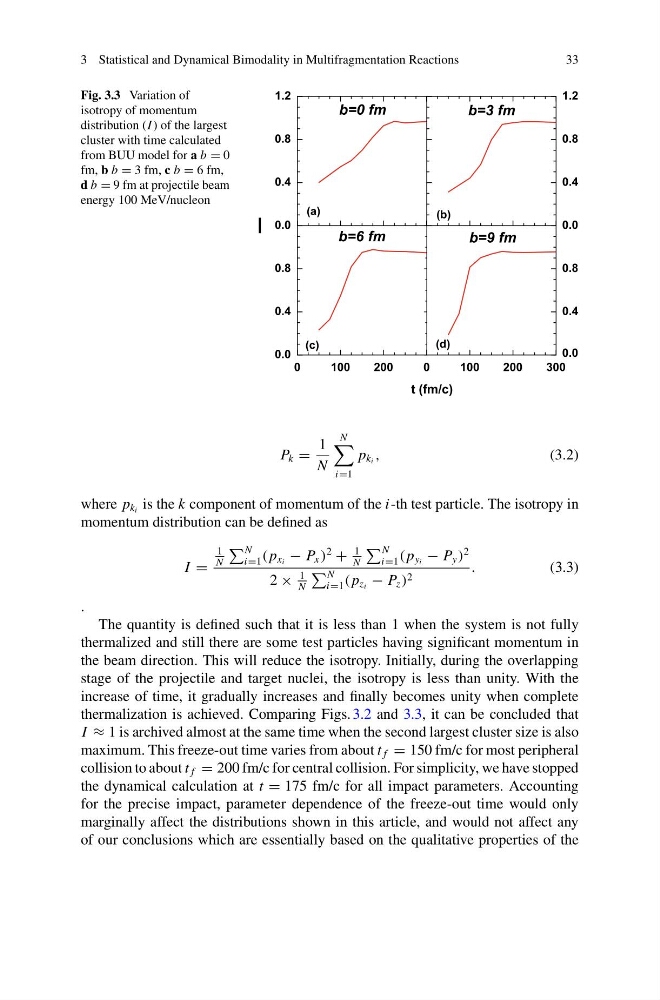
Fig. 3.3 Variation of
isotropy of momentum
distribution (I ) of the largest
cluster with time calculated
from BUU model for a b = 0
fm, b b = 3 fm, c b = 6 fm,
d b = 9 fm at projectile beam
energy 100 MeV/nucleon
P k =
1
N
N
i=1
p k i ,
(3.2)
where p k i is the k component of momentum of the i-th test particle. The isotropy in
momentum distribution can be defined as
I =
1
N
N
i=1 ( p x i − P x )
2
+
1
N
N
i=1 ( p y i − P y )
2
2 ×
1
N
N
i=1 ( p z i − P z ) 2
.
(3.3)
.
The quantity is defined such that it is less than 1 when the system is not fully
thermalized and still there are some test particles having significant momentum in
the beam direction. This will reduce the isotropy. Initially, during the overlapping
stage of the projectile and target nuclei, the isotropy is less than unity. With the
increase of time, it gradually increases and finally becomes unity when complete
thermalization is achieved. Comparing Figs. 3.2 and 3.3, it can be concluded that
I ≈ 1 is archived almost at the same time when the second largest cluster size is also
maximum. This freeze-out time varies from about t f = 150 fm/c for most peripheral
collision to about t f = 200 fm/c for central collision. For simplicity, we have stopped
the dynamical calculation at t = 175 fm/c for all impact parameters. Accounting
for the precise impact, parameter dependence of the freeze-out time would only
marginally affect the distributions shown in this article, and would not affect any
of our conclusions which are essentially based on the qualitative properties of the
33
Fig. 3.3 Variation of
isotropy of momentum
distribution (I ) of the largest
cluster with time calculated
from BUU model for a b = 0
fm, b b = 3 fm, c b = 6 fm,
d b = 9 fm at projectile beam
energy 100 MeV/nucleon
P k =
1
N
N
i=1
p k i ,
(3.2)
where p k i is the k component of momentum of the i-th test particle. The isotropy in
momentum distribution can be defined as
I =
1
N
N
i=1 ( p x i − P x )
2
+
1
N
N
i=1 ( p y i − P y )
2
2 ×
1
N
N
i=1 ( p z i − P z ) 2
.
(3.3)
.
The quantity is defined such that it is less than 1 when the system is not fully
thermalized and still there are some test particles having significant momentum in
the beam direction. This will reduce the isotropy. Initially, during the overlapping
stage of the projectile and target nuclei, the isotropy is less than unity. With the
increase of time, it gradually increases and finally becomes unity when complete
thermalization is achieved. Comparing Figs. 3.2 and 3.3, it can be concluded that
I ≈ 1 is archived almost at the same time when the second largest cluster size is also
maximum. This freeze-out time varies from about t f = 150 fm/c for most peripheral
collision to about t f = 200 fm/c for central collision. For simplicity, we have stopped
the dynamical calculation at t = 175 fm/c for all impact parameters. Accounting
for the precise impact, parameter dependence of the freeze-out time would only
marginally affect the distributions shown in this article, and would not affect any
of our conclusions which are essentially based on the qualitative properties of the