

16
G. Chaudhuri et al.
2.3 Results
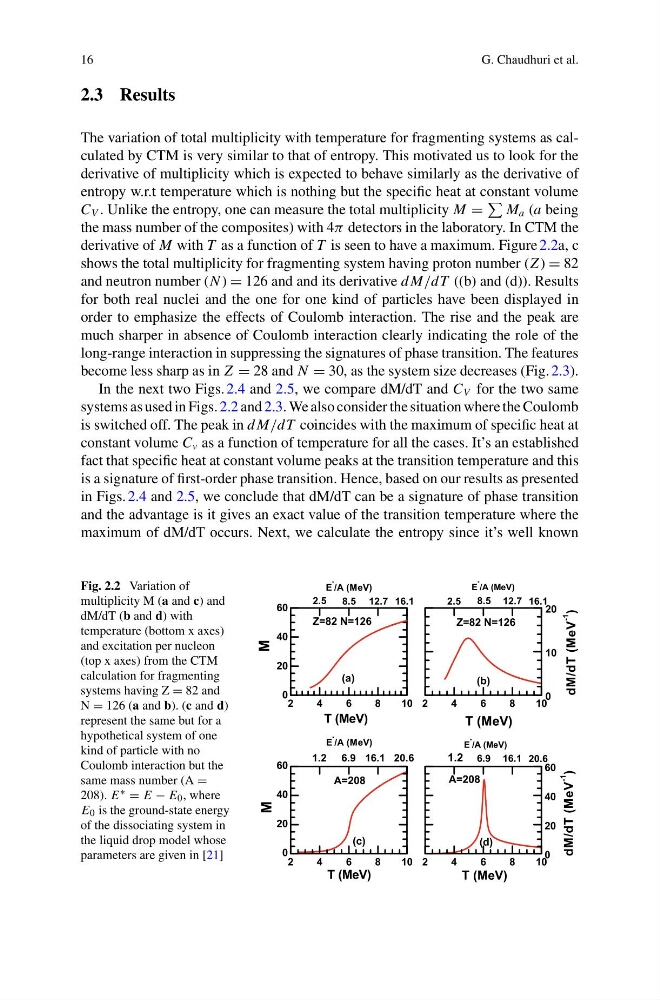
The variation of total multiplicity with temperature for fragmenting systems as calculated by CTM is very similar to that of entropy. This motivated us to look for the
derivative of multiplicity which is expected to behave similarly as the derivative of
entropy w.r.t temperature which is nothing but the specific heat at constant volume
C V . Unlike the entropy, one can measure the total multiplicity M =
M a (a being
the mass number of the composites) with 4π detectors in the laboratory. In CTM the
derivative of M with T as a function of T is seen to have a maximum. Figure 2.2a, c
shows the total multiplicity for fragmenting system having proton number (Z ) = 82
and neutron number (N ) = 126 and and its derivative d M/dT ((b) and (d)). Results
for both real nuclei and the one for one kind of particles have been displayed in
order to emphasize the effects of Coulomb interaction. The rise and the peak are
much sharper in absence of Coulomb interaction clearly indicating the role of the
long-range interaction in suppressing the signatures of phase transition. The features
become less sharp as in Z = 28 and N = 30, as the system size decreases (Fig. 2.3).
In the next two Figs. 2.4 and 2.5, we compare dM/dT and C V for the two same
systems as used in Figs. 2.2 and 2.3. We also consider the situation where the Coulomb
is switched off. The peak in d M/dT coincides with the maximum of specific heat at
constant volume C v as a function of temperature for all the cases. It’s an established
fact that specific heat at constant volume peaks at the transition temperature and this
is a signature of first-order phase transition. Hence, based on our results as presented
in Figs. 2.4 and 2.5, we conclude that dM/dT can be a signature of phase transition
and the advantage is it gives an exact value of the transition temperature where the
maximum of dM/dT occurs. Next, we calculate the entropy since it’s well known
Fig. 2.2 Variation of
multiplicity M (a and c) and
dM/dT (b and d) with
temperature (bottom x axes)
and excitation per nucleon
(top x axes) from the CTM
calculation for fragmenting
systems having Z = 82 and
N = 126 (a and b). (c and d)
represent the same but for a
hypothetical system of one
kind of particle with no
Coulomb interaction but the
same mass number (A =
208). E ∗ = E − E 0 , where
E 0 is the ground-state energy
of the dissociating system in
the liquid drop model whose
parameters are given in [21]
G. Chaudhuri et al.
2.3 Results
The variation of total multiplicity with temperature for fragmenting systems as calculated by CTM is very similar to that of entropy. This motivated us to look for the
derivative of multiplicity which is expected to behave similarly as the derivative of
entropy w.r.t temperature which is nothing but the specific heat at constant volume
C V . Unlike the entropy, one can measure the total multiplicity M =
M a (a being
the mass number of the composites) with 4π detectors in the laboratory. In CTM the
derivative of M with T as a function of T is seen to have a maximum. Figure 2.2a, c
shows the total multiplicity for fragmenting system having proton number (Z ) = 82
and neutron number (N ) = 126 and and its derivative d M/dT ((b) and (d)). Results
for both real nuclei and the one for one kind of particles have been displayed in
order to emphasize the effects of Coulomb interaction. The rise and the peak are
much sharper in absence of Coulomb interaction clearly indicating the role of the
long-range interaction in suppressing the signatures of phase transition. The features
become less sharp as in Z = 28 and N = 30, as the system size decreases (Fig. 2.3).
In the next two Figs. 2.4 and 2.5, we compare dM/dT and C V for the two same
systems as used in Figs. 2.2 and 2.3. We also consider the situation where the Coulomb
is switched off. The peak in d M/dT coincides with the maximum of specific heat at
constant volume C v as a function of temperature for all the cases. It’s an established
fact that specific heat at constant volume peaks at the transition temperature and this
is a signature of first-order phase transition. Hence, based on our results as presented
in Figs. 2.4 and 2.5, we conclude that dM/dT can be a signature of phase transition
and the advantage is it gives an exact value of the transition temperature where the
maximum of dM/dT occurs. Next, we calculate the entropy since it’s well known
Fig. 2.2 Variation of
multiplicity M (a and c) and
dM/dT (b and d) with
temperature (bottom x axes)
and excitation per nucleon
(top x axes) from the CTM
calculation for fragmenting
systems having Z = 82 and
N = 126 (a and b). (c and d)
represent the same but for a
hypothetical system of one
kind of particle with no
Coulomb interaction but the
same mass number (A =
208). E ∗ = E − E 0 , where
E 0 is the ground-state energy
of the dissociating system in
the liquid drop model whose
parameters are given in [21]