

18 Effective Surface Properties of Light and Medium Mass Exotic-Nuclei
271
23
24
25
26
-2.0
-1.5
-1.0
-0.5
10
15
20
-320
-300
-280
-260
N
ΔK (MeV)
P (MeV.fm
-3
)
S (MeV)
O
(a)
25
26
27
28
29
NL3
IOPB-I
-0.8
-0.4
0.0
0.4
20
30
40
-340
-320
-300
-280
-260
N
ΔK (MeV)
P (MeV.fm
-3
)
S (MeV)
(b)
Ca
27
28
29
30
31
-0.5
0.0
0.5
1.0
30
40
50
60
-360
-340
-320
-300
-280
-260
N
ΔK (MeV)
P (MeV.fm
-3
)
S (MeV)
Ni
(c)
28
29
30
0.0
0.5
1.0
1.5
2.0
30
40
50
60
70
80
-300
-280
-260
-240
N
ΔK (MeV)
P (MeV.fm
-3
)
S (MeV)
(d)
Zr
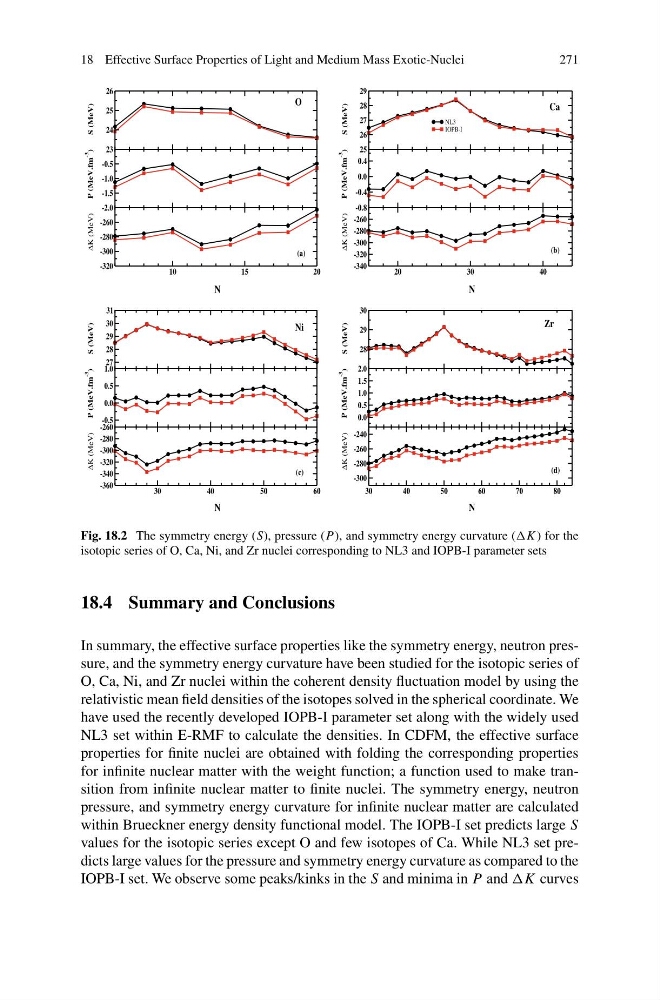
Fig. 18.2 The symmetry energy (S), pressure (P), and symmetry energy curvature ( ) for the
isotopic series of O, Ca, Ni, and Zr nuclei corresponding to NL3 and IOPB-I parameter sets
18.4 Summary and Conclusions
In summary, the effective surface properties like the symmetry energy, neutron pressure, and the symmetry energy curvature have been studied for the isotopic series of
O, Ca, Ni, and Zr nuclei within the coherent density fluctuation model by using the
relativistic mean field densities of the isotopes solved in the spherical coordinate. We
have used the recently developed IOPB-I parameter set along with the widely used
NL3 set within E-RMF to calculate the densities. In CDFM, the effective surface
properties for finite nuclei are obtained with folding the corresponding properties
for infinite nuclear matter with the weight function; a function used to make transition from infinite nuclear matter to finite nuclei. The symmetry energy, neutron
pressure, and symmetry energy curvature for infinite nuclear matter are calculated
within Brueckner energy density functional model. The IOPB-I set predicts large S
values for the isotopic series except O and few isotopes of Ca. While NL3 set predicts large values for the pressure and symmetry energy curvature as compared to the
IOPB-I set. We observe some peaks/kinks in the S and minima in P and curves
271
23
24
25
26
-2.0
-1.5
-1.0
-0.5
10
15
20
-320
-300
-280
-260
N
ΔK (MeV)
P (MeV.fm
-3
)
S (MeV)
O
(a)
25
26
27
28
29
NL3
IOPB-I
-0.8
-0.4
0.0
0.4
20
30
40
-340
-320
-300
-280
-260
N
ΔK (MeV)
P (MeV.fm
-3
)
S (MeV)
(b)
Ca
27
28
29
30
31
-0.5
0.0
0.5
1.0
30
40
50
60
-360
-340
-320
-300
-280
-260
N
ΔK (MeV)
P (MeV.fm
-3
)
S (MeV)
Ni
(c)
28
29
30
0.0
0.5
1.0
1.5
2.0
30
40
50
60
70
80
-300
-280
-260
-240
N
ΔK (MeV)
P (MeV.fm
-3
)
S (MeV)
(d)
Zr
Fig. 18.2 The symmetry energy (S), pressure (P), and symmetry energy curvature ( ) for the
isotopic series of O, Ca, Ni, and Zr nuclei corresponding to NL3 and IOPB-I parameter sets
18.4 Summary and Conclusions
In summary, the effective surface properties like the symmetry energy, neutron pressure, and the symmetry energy curvature have been studied for the isotopic series of
O, Ca, Ni, and Zr nuclei within the coherent density fluctuation model by using the
relativistic mean field densities of the isotopes solved in the spherical coordinate. We
have used the recently developed IOPB-I parameter set along with the widely used
NL3 set within E-RMF to calculate the densities. In CDFM, the effective surface
properties for finite nuclei are obtained with folding the corresponding properties
for infinite nuclear matter with the weight function; a function used to make transition from infinite nuclear matter to finite nuclei. The symmetry energy, neutron
pressure, and symmetry energy curvature for infinite nuclear matter are calculated
within Brueckner energy density functional model. The IOPB-I set predicts large S
values for the isotopic series except O and few isotopes of Ca. While NL3 set predicts large values for the pressure and symmetry energy curvature as compared to the
IOPB-I set. We observe some peaks/kinks in the S and minima in P and curves