

17 Momentum and Density Dependence of the Nuclear Mean Field …
259
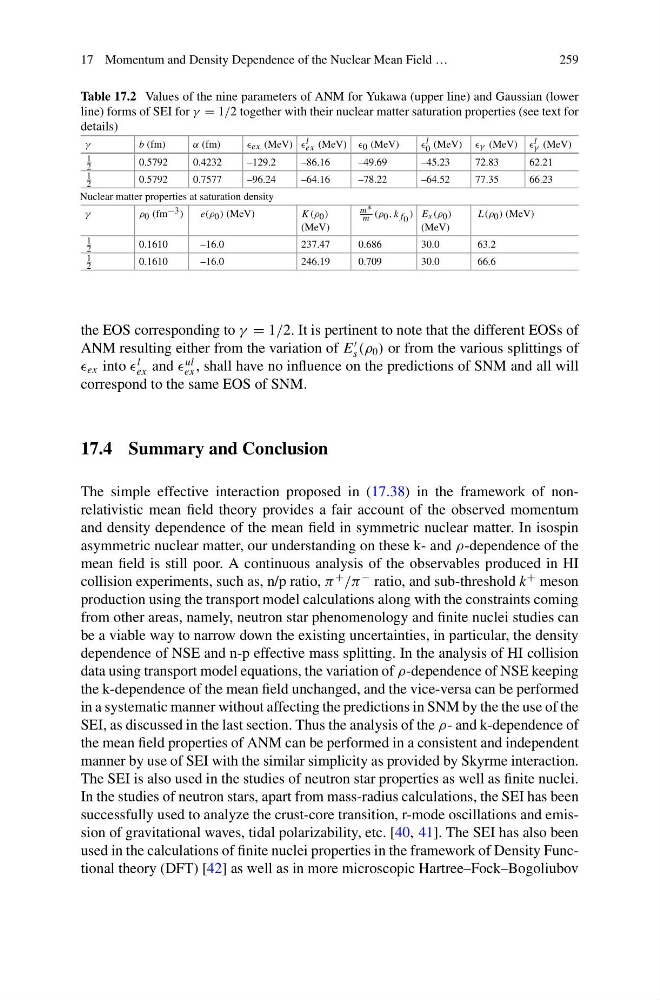
Table 17.2 Values of the nine parameters of ANM for Yukawa (upper line) and Gaussian (lower
line) forms of SEI for γ = 1/2 together with their nuclear matter saturation properties (see text for
details)
γ
b (fm)
α (fm)
ex (MeV) l
ex (MeV) 0 (MeV)
l
0 (MeV) γ (MeV) l
γ (MeV)
1
2
0.5792
0.4232
–129.2
–86.16
–49.69
–45.23
72.83
62.21
1
2
0.5792
0.7577
–96.24
–64.16
–78.22
–64.52
77.35
66.23
Nuclear matter properties at saturation density
γ
ρ 0 (fm −3 )
e(ρ 0 ) (MeV)
K (ρ 0 )
(MeV)
m ∗
m (ρ 0 , k f 0 ) E s (ρ 0 )
(MeV)
L(ρ 0 ) (MeV)
1
2
0.1610
–16.0
237.47
0.686
30.0
63.2
1
2
0.1610
–16.0
246.19
0.709
30.0
66.6
the EOS corresponding to γ = 1/2. It is pertinent to note that the different EOSs of
ANM resulting either from the variation of E
s (ρ 0 ) or from the various splittings of
ex into
l
ex and
ul
ex , shall have no influence on the predictions of SNM and all will
correspond to the same EOS of SNM.
17.4 Summary and Conclusion
The simple effective interaction proposed in (17.38) in the framework of nonrelativistic mean field theory provides a fair account of the observed momentum
and density dependence of the mean field in symmetric nuclear matter. In isospin
asymmetric nuclear matter, our understanding on these k- and ρ-dependence of the
mean field is still poor. A continuous analysis of the observables produced in HI
collision experiments, such as, n/p ratio, π
+
/π
− ratio, and sub-threshold k
+ meson
production using the transport model calculations along with the constraints coming
from other areas, namely, neutron star phenomenology and finite nuclei studies can
be a viable way to narrow down the existing uncertainties, in particular, the density
dependence of NSE and n-p effective mass splitting. In the analysis of HI collision
data using transport model equations, the variation of ρ-dependence of NSE keeping
the k-dependence of the mean field unchanged, and the vice-versa can be performed
in a systematic manner without affecting the predictions in SNM by the the use of the
SEI, as discussed in the last section. Thus the analysis of the ρ- and k-dependence of
the mean field properties of ANM can be performed in a consistent and independent
manner by use of SEI with the similar simplicity as provided by Skyrme interaction.
The SEI is also used in the studies of neutron star properties as well as finite nuclei.
In the studies of neutron stars, apart from mass-radius calculations, the SEI has been
successfully used to analyze the crust-core transition, r-mode oscillations and emission of gravitational waves, tidal polarizability, etc. [40, 41]. The SEI has also been
used in the calculations of finite nuclei properties in the framework of Density Functional theory (DFT) [42] as well as in more microscopic Hartree–Fock–Bogoliubov
259
Table 17.2 Values of the nine parameters of ANM for Yukawa (upper line) and Gaussian (lower
line) forms of SEI for γ = 1/2 together with their nuclear matter saturation properties (see text for
details)
γ
b (fm)
α (fm)
ex (MeV) l
ex (MeV) 0 (MeV)
l
0 (MeV) γ (MeV) l
γ (MeV)
1
2
0.5792
0.4232
–129.2
–86.16
–49.69
–45.23
72.83
62.21
1
2
0.5792
0.7577
–96.24
–64.16
–78.22
–64.52
77.35
66.23
Nuclear matter properties at saturation density
γ
ρ 0 (fm −3 )
e(ρ 0 ) (MeV)
K (ρ 0 )
(MeV)
m ∗
m (ρ 0 , k f 0 ) E s (ρ 0 )
(MeV)
L(ρ 0 ) (MeV)
1
2
0.1610
–16.0
237.47
0.686
30.0
63.2
1
2
0.1610
–16.0
246.19
0.709
30.0
66.6
the EOS corresponding to γ = 1/2. It is pertinent to note that the different EOSs of
ANM resulting either from the variation of E
s (ρ 0 ) or from the various splittings of
ex into
l
ex and
ul
ex , shall have no influence on the predictions of SNM and all will
correspond to the same EOS of SNM.
17.4 Summary and Conclusion
The simple effective interaction proposed in (17.38) in the framework of nonrelativistic mean field theory provides a fair account of the observed momentum
and density dependence of the mean field in symmetric nuclear matter. In isospin
asymmetric nuclear matter, our understanding on these k- and ρ-dependence of the
mean field is still poor. A continuous analysis of the observables produced in HI
collision experiments, such as, n/p ratio, π
+
/π
− ratio, and sub-threshold k
+ meson
production using the transport model calculations along with the constraints coming
from other areas, namely, neutron star phenomenology and finite nuclei studies can
be a viable way to narrow down the existing uncertainties, in particular, the density
dependence of NSE and n-p effective mass splitting. In the analysis of HI collision
data using transport model equations, the variation of ρ-dependence of NSE keeping
the k-dependence of the mean field unchanged, and the vice-versa can be performed
in a systematic manner without affecting the predictions in SNM by the the use of the
SEI, as discussed in the last section. Thus the analysis of the ρ- and k-dependence of
the mean field properties of ANM can be performed in a consistent and independent
manner by use of SEI with the similar simplicity as provided by Skyrme interaction.
The SEI is also used in the studies of neutron star properties as well as finite nuclei.
In the studies of neutron stars, apart from mass-radius calculations, the SEI has been
successfully used to analyze the crust-core transition, r-mode oscillations and emission of gravitational waves, tidal polarizability, etc. [40, 41]. The SEI has also been
used in the calculations of finite nuclei properties in the framework of Density Functional theory (DFT) [42] as well as in more microscopic Hartree–Fock–Bogoliubov