

258
T. R. Routray et al.
0
0.5
1
1.5
ρ ( fm
-3 )
0
25
50
75
100
125
150
175
E
s
(ρ)
(MeV)
0
0.5
1
1.5
ρ (fm
-3 )
0
0.05
0.1
0.15
0.2
0.25
Y
p
0
0.5
1
1.5
ρ (fm
-3 )
0
10
20
30
40
50
60
70
80
90
S
NSM
(ρ)
E s
′ =17
E s
′ =17
19
21
24
19
21
24
24
19
E s
′ =17
21
E s ( ρ 0 ) = 30 MeV
E s ( ρ 0 ) = 30 MeV
E s ( ρ 0 ) = 30 MeV
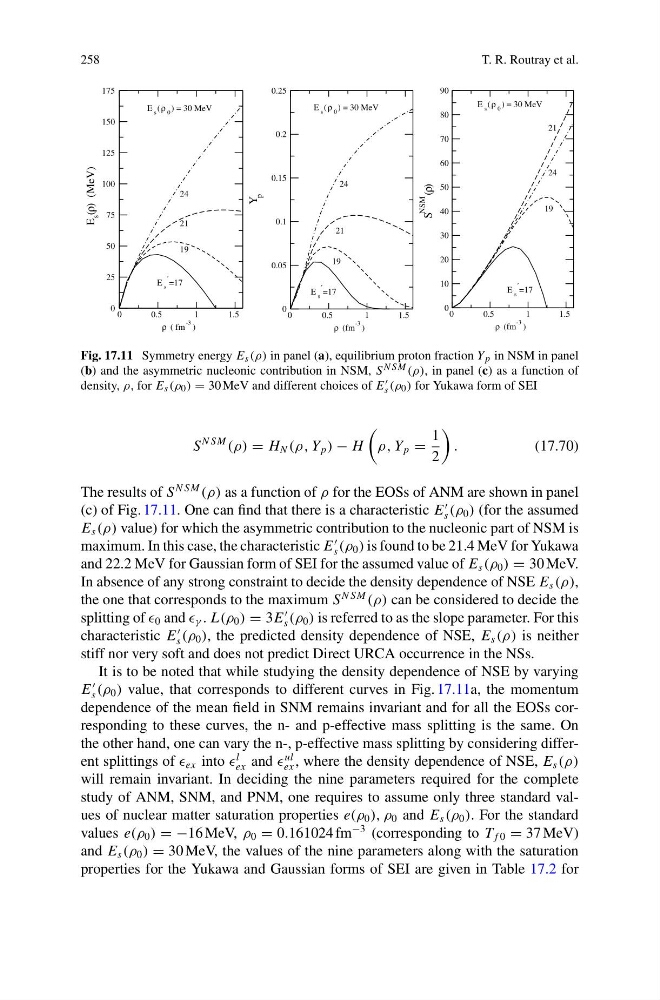
Fig. 17.11 Symmetry energy E s (ρ) in panel (a), equilibrium proton fraction Y p in NSM in panel
(b) and the asymmetric nucleonic contribution in NSM, S N SM (ρ), in panel (c) as a function of
density, ρ, for E s (ρ 0 ) = 30 MeV and different choices of E
s (ρ 0 ) for Yukawa form of SEI
S
N SM
(ρ) = H N (ρ, Y p ) − H
ρ, Y p =
1
2
.
(17.70)
The results of S
N SM
(ρ) as a function of ρ for the EOSs of ANM are shown in panel
(c) of Fig. 17.11. One can find that there is a characteristic E
s (ρ 0 ) (for the assumed
E s (ρ) value) for which the asymmetric contribution to the nucleonic part of NSM is
maximum. In this case, the characteristic E
s (ρ 0 ) is found to be 21.4 MeV for Yukawa
and 22.2 MeV for Gaussian form of SEI for the assumed value of E s (ρ 0 ) = 30 MeV.
In absence of any strong constraint to decide the density dependence of NSE E s (ρ),
the one that corresponds to the maximum S
N SM
(ρ) can be considered to decide the
splitting of 0 and γ . L(ρ 0 ) = 3E
s (ρ 0 ) is referred to as the slope parameter. For this
characteristic E
s (ρ 0 ), the predicted density dependence of NSE, E s (ρ) is neither
stiff nor very soft and does not predict Direct URCA occurrence in the NSs.
It is to be noted that while studying the density dependence of NSE by varying
E
s (ρ 0 ) value, that corresponds to different curves in Fig. 17.11a, the momentum
dependence of the mean field in SNM remains invariant and for all the EOSs corresponding to these curves, the n- and p-effective mass splitting is the same. On
the other hand, one can vary the n-, p-effective mass splitting by considering different splittings of ex into
l
ex and
ul
ex , where the density dependence of NSE, E s (ρ)
will remain invariant. In deciding the nine parameters required for the complete
study of ANM, SNM, and PNM, one requires to assume only three standard values of nuclear matter saturation properties e(ρ 0 ), ρ 0 and E s (ρ 0 ). For the standard
values e(ρ 0 ) = −16 MeV, ρ 0 = 0.161024 fm
−3 (corresponding to T f 0 = 37 MeV)
and E s (ρ 0 ) = 30 MeV, the values of the nine parameters along with the saturation
properties for the Yukawa and Gaussian forms of SEI are given in Table 17.2 for
T. R. Routray et al.
0
0.5
1
1.5
ρ ( fm
-3 )
0
25
50
75
100
125
150
175
E
s
(ρ)
(MeV)
0
0.5
1
1.5
ρ (fm
-3 )
0
0.05
0.1
0.15
0.2
0.25
Y
p
0
0.5
1
1.5
ρ (fm
-3 )
0
10
20
30
40
50
60
70
80
90
S
NSM
(ρ)
E s
′ =17
E s
′ =17
19
21
24
19
21
24
24
19
E s
′ =17
21
E s ( ρ 0 ) = 30 MeV
E s ( ρ 0 ) = 30 MeV
E s ( ρ 0 ) = 30 MeV
Fig. 17.11 Symmetry energy E s (ρ) in panel (a), equilibrium proton fraction Y p in NSM in panel
(b) and the asymmetric nucleonic contribution in NSM, S N SM (ρ), in panel (c) as a function of
density, ρ, for E s (ρ 0 ) = 30 MeV and different choices of E
s (ρ 0 ) for Yukawa form of SEI
S
N SM
(ρ) = H N (ρ, Y p ) − H
ρ, Y p =
1
2
.
(17.70)
The results of S
N SM
(ρ) as a function of ρ for the EOSs of ANM are shown in panel
(c) of Fig. 17.11. One can find that there is a characteristic E
s (ρ 0 ) (for the assumed
E s (ρ) value) for which the asymmetric contribution to the nucleonic part of NSM is
maximum. In this case, the characteristic E
s (ρ 0 ) is found to be 21.4 MeV for Yukawa
and 22.2 MeV for Gaussian form of SEI for the assumed value of E s (ρ 0 ) = 30 MeV.
In absence of any strong constraint to decide the density dependence of NSE E s (ρ),
the one that corresponds to the maximum S
N SM
(ρ) can be considered to decide the
splitting of 0 and γ . L(ρ 0 ) = 3E
s (ρ 0 ) is referred to as the slope parameter. For this
characteristic E
s (ρ 0 ), the predicted density dependence of NSE, E s (ρ) is neither
stiff nor very soft and does not predict Direct URCA occurrence in the NSs.
It is to be noted that while studying the density dependence of NSE by varying
E
s (ρ 0 ) value, that corresponds to different curves in Fig. 17.11a, the momentum
dependence of the mean field in SNM remains invariant and for all the EOSs corresponding to these curves, the n- and p-effective mass splitting is the same. On
the other hand, one can vary the n-, p-effective mass splitting by considering different splittings of ex into
l
ex and
ul
ex , where the density dependence of NSE, E s (ρ)
will remain invariant. In deciding the nine parameters required for the complete
study of ANM, SNM, and PNM, one requires to assume only three standard values of nuclear matter saturation properties e(ρ 0 ), ρ 0 and E s (ρ 0 ). For the standard
values e(ρ 0 ) = −16 MeV, ρ 0 = 0.161024 fm
−3 (corresponding to T f 0 = 37 MeV)
and E s (ρ 0 ) = 30 MeV, the values of the nine parameters along with the saturation
properties for the Yukawa and Gaussian forms of SEI are given in Table 17.2 for