

17 Momentum and Density Dependence of the Nuclear Mean Field …
249
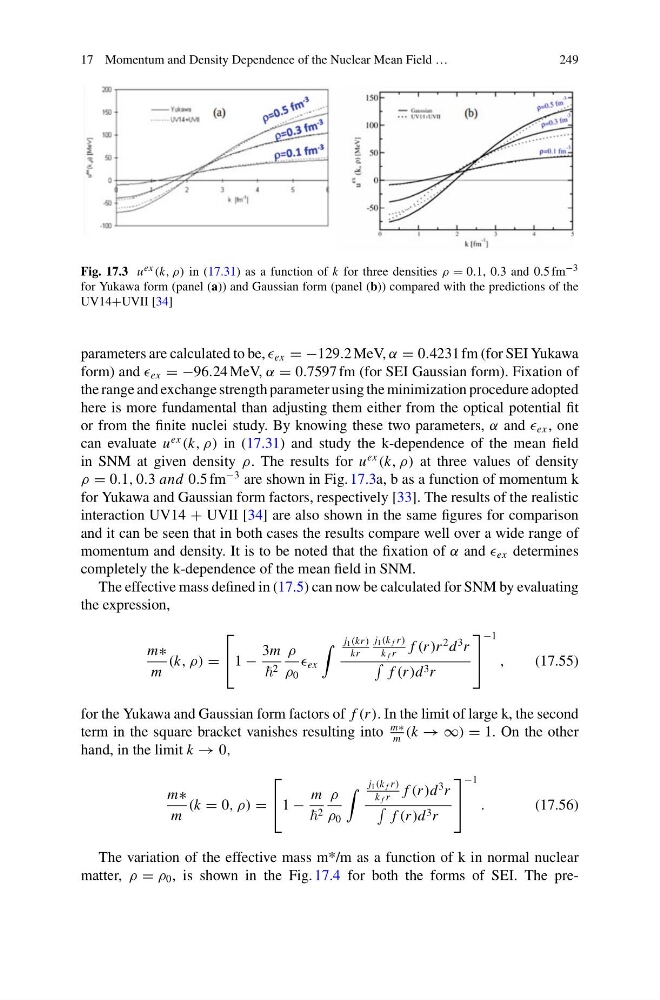
Fig. 17.3 u ex (k, ρ) in (17.31) as a function of k for three densities ρ = 0.1, 0.3 and 0.5 fm −3
for Yukawa form (panel (a)) and Gaussian form (panel (b)) compared with the predictions of the
UV14+UVII [34]
parameters are calculated to be, ex = −129.2 MeV, α = 0.4231 fm (for SEI Yukawa
form) and ex = −96.24 MeV, α = 0.7597 fm (for SEI Gaussian form). Fixation of
the range and exchange strength parameter using the minimization procedure adopted
here is more fundamental than adjusting them either from the optical potential fit
or from the finite nuclei study. By knowing these two parameters, α and ex , one
can evaluate u
ex
(k, ρ) in (17.31) and study the k-dependence of the mean field
in SNM at given density ρ. The results for u
ex
(k, ρ) at three values of density
ρ = 0.1, 0.3 and 0.5 fm
−3 are shown in Fig. 17.3a, b as a function of momentum k
for Yukawa and Gaussian form factors, respectively [33]. The results of the realistic
interaction UV14 + UVII [34] are also shown in the same figures for comparison
and it can be seen that in both cases the results compare well over a wide range of
momentum and density. It is to be noted that the fixation of α and ex determines
completely the k-dependence of the mean field in SNM.
The effective mass defined in (17.5) can now be calculated for SNM by evaluating
the expression,
m∗
m
(k, ρ) =
⎡
⎣ 1 −
3m
2
ρ
ρ 0
ex
j 1 (kr)
kr
j 1 (k f r )
k f r
f (r )r
2 d
3 r
f (r )d 3 r
⎤
⎦
−1
,
(17.55)
for the Yukawa and Gaussian form factors of f (r ). In the limit of large k, the second
term in the square bracket vanishes resulting into
m∗
m
(k → ∞) = 1. On the other
hand, in the limit k → 0,
m∗
m
(k = 0, ρ) =
⎡
⎣ 1 −
m
2
ρ
ρ 0
j 1 (k f r )
k f r
f (r )d
3 r
f (r )d 3 r
⎤
⎦
−1
.
(17.56)
The variation of the effective mass m*/m as a function of k in normal nuclear
matter, ρ = ρ 0 , is shown in the Fig. 17.4 for both the forms of SEI. The pre-
249
Fig. 17.3 u ex (k, ρ) in (17.31) as a function of k for three densities ρ = 0.1, 0.3 and 0.5 fm −3
for Yukawa form (panel (a)) and Gaussian form (panel (b)) compared with the predictions of the
UV14+UVII [34]
parameters are calculated to be, ex = −129.2 MeV, α = 0.4231 fm (for SEI Yukawa
form) and ex = −96.24 MeV, α = 0.7597 fm (for SEI Gaussian form). Fixation of
the range and exchange strength parameter using the minimization procedure adopted
here is more fundamental than adjusting them either from the optical potential fit
or from the finite nuclei study. By knowing these two parameters, α and ex , one
can evaluate u
ex
(k, ρ) in (17.31) and study the k-dependence of the mean field
in SNM at given density ρ. The results for u
ex
(k, ρ) at three values of density
ρ = 0.1, 0.3 and 0.5 fm
−3 are shown in Fig. 17.3a, b as a function of momentum k
for Yukawa and Gaussian form factors, respectively [33]. The results of the realistic
interaction UV14 + UVII [34] are also shown in the same figures for comparison
and it can be seen that in both cases the results compare well over a wide range of
momentum and density. It is to be noted that the fixation of α and ex determines
completely the k-dependence of the mean field in SNM.
The effective mass defined in (17.5) can now be calculated for SNM by evaluating
the expression,
m∗
m
(k, ρ) =
⎡
⎣ 1 −
3m
2
ρ
ρ 0
ex
j 1 (kr)
kr
j 1 (k f r )
k f r
f (r )r
2 d
3 r
f (r )d 3 r
⎤
⎦
−1
,
(17.55)
for the Yukawa and Gaussian form factors of f (r ). In the limit of large k, the second
term in the square bracket vanishes resulting into
m∗
m
(k → ∞) = 1. On the other
hand, in the limit k → 0,
m∗
m
(k = 0, ρ) =
⎡
⎣ 1 −
m
2
ρ
ρ 0
j 1 (k f r )
k f r
f (r )d
3 r
f (r )d 3 r
⎤
⎦
−1
.
(17.56)
The variation of the effective mass m*/m as a function of k in normal nuclear
matter, ρ = ρ 0 , is shown in the Fig. 17.4 for both the forms of SEI. The pre-