

248
T. R. Routray et al.
17.3.1 Parameter Determination in SNM
Out of the six parameters in SNM, α, γ , b, , ex , , 0 , , γ , the range α and the exchange
strength ex are associated with the exchange contribution of the mean field expression given in (17.37) that is responsible for simulating the k-dependence. Thus, these
two parameters need to be determined so as to give a proper account of u
ex
(k, ρ)
over a wide range of density and momentum. An important feature of N-nucleus
potential obtained from the analysis of transverse momentum flow data at intermediate energies reveals that u(k, ρ 0 ) turns out to be repulsive for kinetic energy of
nucleon
2 k
2
2m
> 300 MeV [7–10]. By using (17.28) and the HV theorem, u(k, ρ 0 )
can be expressed as
u(k, ρ 0 ) = [e(ρ 0 ) − T f 0 ] + ex [I (k, ρ 0 ) − I (k = k f 0 , ρ 0 )],
(17.53)
where T f 0 =
2 k
2
f 0
2m
is the Fermi energy at saturation density ρ 0 . By exploiting the
condition u(k = k 300 , ρ 0 ) = 0 where k 300 corresponds to the momentum for kinetic
energy 300 MeV of the nucleon, one can write from (17.53),
[I (k 300 , ρ 0 ) − I (k = k f 0 , ρ 0 )] =
T f 0 − e(ρ 0 )
ex
,
(17.54)
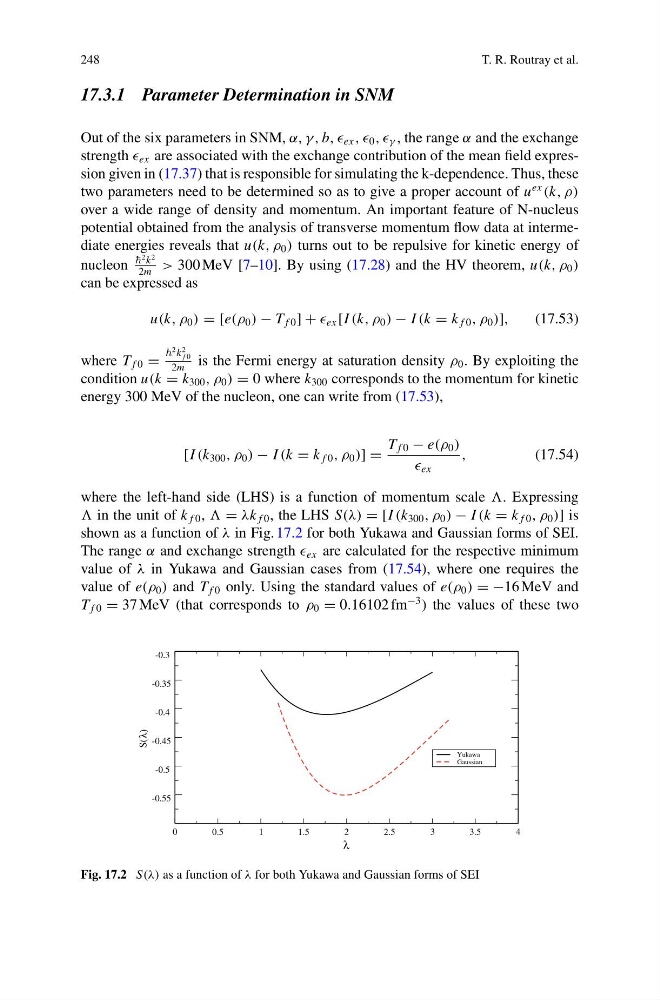
where the left-hand side (LHS) is a function of momentum scale . Expressing
in the unit of k f 0 , = λk f 0 , the LHS S(λ) = [I (k 300 , ρ 0 ) − I (k = k f 0 , ρ 0 )] is
shown as a function of λ in Fig. 17.2 for both Yukawa and Gaussian forms of SEI.
The range α and exchange strength ex are calculated for the respective minimum
value of λ in Yukawa and Gaussian cases from (17.54), where one requires the
value of e(ρ 0 ) and T f 0 only. Using the standard values of e(ρ 0 ) = −16 MeV and
T f 0 = 37 MeV (that corresponds to ρ 0 = 0.16102 fm
−3 ) the values of these two
0
0.5
1
1.5
2
2.5
3
3.5
4
λ
-0.55
-0.5
-0.45
-0.4
-0.35
-0.3
S(λ)
Yukawa
Gaussian
Fig. 17.2 S(λ) as a function of λ for both Yukawa and Gaussian forms of SEI
T. R. Routray et al.
17.3.1 Parameter Determination in SNM
Out of the six parameters in SNM, α, γ , b, , ex , , 0 , , γ , the range α and the exchange
strength ex are associated with the exchange contribution of the mean field expression given in (17.37) that is responsible for simulating the k-dependence. Thus, these
two parameters need to be determined so as to give a proper account of u
ex
(k, ρ)
over a wide range of density and momentum. An important feature of N-nucleus
potential obtained from the analysis of transverse momentum flow data at intermediate energies reveals that u(k, ρ 0 ) turns out to be repulsive for kinetic energy of
nucleon
2 k
2
2m
> 300 MeV [7–10]. By using (17.28) and the HV theorem, u(k, ρ 0 )
can be expressed as
u(k, ρ 0 ) = [e(ρ 0 ) − T f 0 ] + ex [I (k, ρ 0 ) − I (k = k f 0 , ρ 0 )],
(17.53)
where T f 0 =
2 k
2
f 0
2m
is the Fermi energy at saturation density ρ 0 . By exploiting the
condition u(k = k 300 , ρ 0 ) = 0 where k 300 corresponds to the momentum for kinetic
energy 300 MeV of the nucleon, one can write from (17.53),
[I (k 300 , ρ 0 ) − I (k = k f 0 , ρ 0 )] =
T f 0 − e(ρ 0 )
ex
,
(17.54)
where the left-hand side (LHS) is a function of momentum scale . Expressing
in the unit of k f 0 , = λk f 0 , the LHS S(λ) = [I (k 300 , ρ 0 ) − I (k = k f 0 , ρ 0 )] is
shown as a function of λ in Fig. 17.2 for both Yukawa and Gaussian forms of SEI.
The range α and exchange strength ex are calculated for the respective minimum
value of λ in Yukawa and Gaussian cases from (17.54), where one requires the
value of e(ρ 0 ) and T f 0 only. Using the standard values of e(ρ 0 ) = −16 MeV and
T f 0 = 37 MeV (that corresponds to ρ 0 = 0.16102 fm
−3 ) the values of these two
0
0.5
1
1.5
2
2.5
3
3.5
4
λ
-0.55
-0.5
-0.45
-0.4
-0.35
-0.3
S(λ)
Yukawa
Gaussian
Fig. 17.2 S(λ) as a function of λ for both Yukawa and Gaussian forms of SEI