

242
T. R. Routray et al.
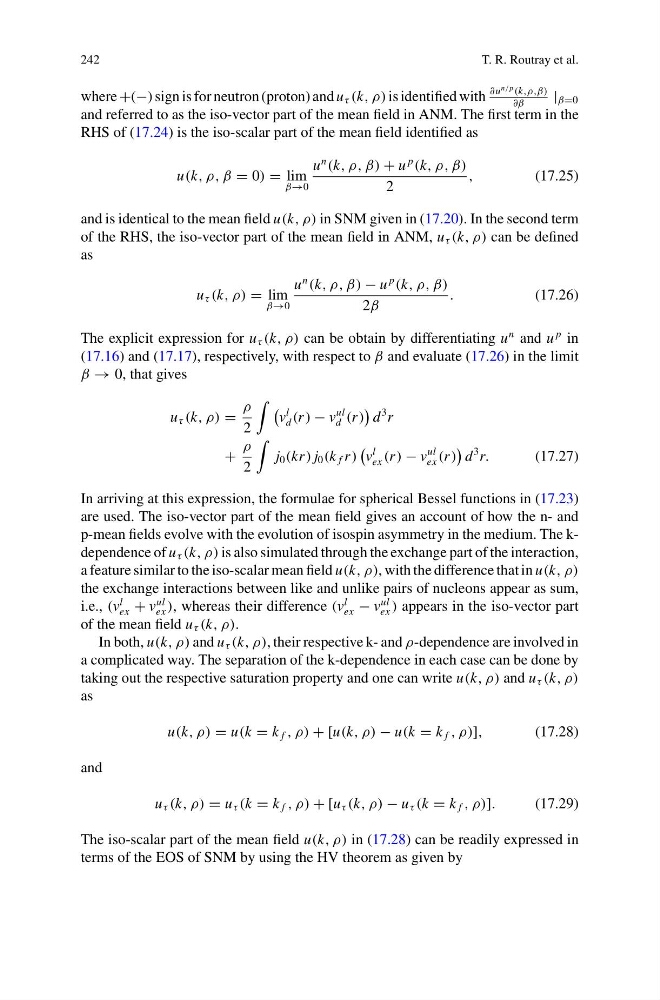
where +(−) sign is for neutron (proton) and u τ (k, ρ) is identified with
∂u
n/ p (k,ρ,β)
∂β
| β=0
and referred to as the iso-vector part of the mean field in ANM. The first term in the
RHS of (17.24) is the iso-scalar part of the mean field identified as
u(k, ρ, β = 0) = lim
β→0
u
n
(k, ρ, β) + u
p
(k, ρ, β)
2
,
(17.25)
and is identical to the mean field u(k, ρ) in SNM given in (17.20). In the second term
of the RHS, the iso-vector part of the mean field in ANM, u τ (k, ρ) can be defined
as
u τ (k, ρ) = lim
β→0
u
n
(k, ρ, β) − u
p
(k, ρ, β)
2β
.
(17.26)
The explicit expression for u τ (k, ρ) can be obtain by differentiating u
n and u
p in
(17.16) and (17.17), respectively, with respect to β and evaluate (17.26) in the limit
β → 0, that gives
u τ (k, ρ) =
ρ
2
v
l
d (r ) − v
ul
d (r )
d
3 r
+
ρ
2
j 0 (kr) j 0 (k f r )
v
l
ex (r ) − v
ul
ex (r )
d
3 r.
(17.27)
In arriving at this expression, the formulae for spherical Bessel functions in (17.23)
are used. The iso-vector part of the mean field gives an account of how the n- and
p-mean fields evolve with the evolution of isospin asymmetry in the medium. The kdependence of u τ (k, ρ) is also simulated through the exchange part of the interaction,
a feature similar to the iso-scalar mean field u(k, ρ), with the difference that in u(k, ρ)
the exchange interactions between like and unlike pairs of nucleons appear as sum,
i.e., (v
l
ex + v
ul
ex ), whereas their difference (v
l
ex − v
ul
ex ) appears in the iso-vector part
of the mean field u τ (k, ρ).
In both, u(k, ρ) and u τ (k, ρ), their respective k- and ρ-dependence are involved in
a complicated way. The separation of the k-dependence in each case can be done by
taking out the respective saturation property and one can write u(k, ρ) and u τ (k, ρ)
as
u(k, ρ) = u(k = k f , ρ) + [u(k, ρ) − u(k = k f , ρ)],
(17.28)
and
u τ (k, ρ) = u τ (k = k f , ρ) + [u τ (k, ρ) − u τ (k = k f , ρ)].
(17.29)
The iso-scalar part of the mean field u(k, ρ) in (17.28) can be readily expressed in
terms of the EOS of SNM by using the HV theorem as given by
T. R. Routray et al.
where +(−) sign is for neutron (proton) and u τ (k, ρ) is identified with
∂u
n/ p (k,ρ,β)
∂β
| β=0
and referred to as the iso-vector part of the mean field in ANM. The first term in the
RHS of (17.24) is the iso-scalar part of the mean field identified as
u(k, ρ, β = 0) = lim
β→0
u
n
(k, ρ, β) + u
p
(k, ρ, β)
2
,
(17.25)
and is identical to the mean field u(k, ρ) in SNM given in (17.20). In the second term
of the RHS, the iso-vector part of the mean field in ANM, u τ (k, ρ) can be defined
as
u τ (k, ρ) = lim
β→0
u
n
(k, ρ, β) − u
p
(k, ρ, β)
2β
.
(17.26)
The explicit expression for u τ (k, ρ) can be obtain by differentiating u
n and u
p in
(17.16) and (17.17), respectively, with respect to β and evaluate (17.26) in the limit
β → 0, that gives
u τ (k, ρ) =
ρ
2
v
l
d (r ) − v
ul
d (r )
d
3 r
+
ρ
2
j 0 (kr) j 0 (k f r )
v
l
ex (r ) − v
ul
ex (r )
d
3 r.
(17.27)
In arriving at this expression, the formulae for spherical Bessel functions in (17.23)
are used. The iso-vector part of the mean field gives an account of how the n- and
p-mean fields evolve with the evolution of isospin asymmetry in the medium. The kdependence of u τ (k, ρ) is also simulated through the exchange part of the interaction,
a feature similar to the iso-scalar mean field u(k, ρ), with the difference that in u(k, ρ)
the exchange interactions between like and unlike pairs of nucleons appear as sum,
i.e., (v
l
ex + v
ul
ex ), whereas their difference (v
l
ex − v
ul
ex ) appears in the iso-vector part
of the mean field u τ (k, ρ).
In both, u(k, ρ) and u τ (k, ρ), their respective k- and ρ-dependence are involved in
a complicated way. The separation of the k-dependence in each case can be done by
taking out the respective saturation property and one can write u(k, ρ) and u τ (k, ρ)
as
u(k, ρ) = u(k = k f , ρ) + [u(k, ρ) − u(k = k f , ρ)],
(17.28)
and
u τ (k, ρ) = u τ (k = k f , ρ) + [u τ (k, ρ) − u τ (k = k f , ρ)].
(17.29)
The iso-scalar part of the mean field u(k, ρ) in (17.28) can be readily expressed in
terms of the EOS of SNM by using the HV theorem as given by