

17 Momentum and Density Dependence of the Nuclear Mean Field …
241
u(k, ρ) =
ρ
2
(v
l
d (r ) + v
ul
d (r ))d
3 r
+
ρ
2
3 j 1 (k f r )
k f r
(v
l
ex (r ) + v
ul
ex (r )) j 0 (kr)d
3 r + u R (ρ),
(17.20)
where the rearrangement term u R (ρ) is
u R (ρ) =
ρ
4
ρ
∂v
l
d
∂ρ
+
∂v
ul
d
∂ρ
d
3 r +
ρ
4
3 j 1 (k f r )
k f r
2
ρ
∂v
l
ex
∂ρ
+
∂v
ul
ex
∂ρ
d
3 r.
(17.21)
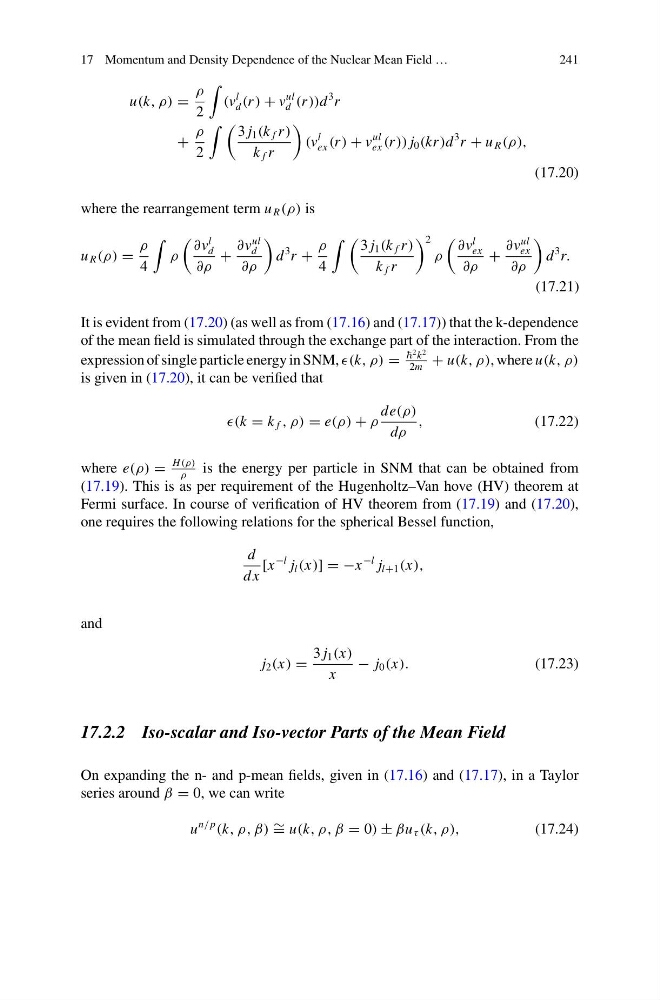
It is evident from (17.20) (as well as from (17.16) and (17.17)) that the k-dependence
of the mean field is simulated through the exchange part of the interaction. From the
expression of single particle energy in SNM, (k, ρ) =
2 k
2
2m
+ u(k, ρ), where u(k, ρ)
is given in (17.20), it can be verified that
(k = k f , ρ) = e(ρ) + ρ
de(ρ)
dρ
,
(17.22)
where e(ρ) =
H (ρ)
ρ
is the energy per particle in SNM that can be obtained from
(17.19). This is as per requirement of the Hugenholtz–Van hove (HV) theorem at
Fermi surface. In course of verification of HV theorem from (17.19) and (17.20),
one requires the following relations for the spherical Bessel function,
d
dx
[x
−l j l (x)] = −x
−l j l+1 (x),
and
j 2 (x) =
3 j 1 (x)
x
− j 0 (x).
(17.23)
17.2.2 Iso-scalar and Iso-vector Parts of the Mean Field
On expanding the n- and p-mean fields, given in (17.16) and (17.17), in a Taylor
series around β = 0, we can write
u
n/ p
(k, ρ, β) ∼ = u(k, ρ, β = 0) ± βu τ (k, ρ),
(17.24)
241
u(k, ρ) =
ρ
2
(v
l
d (r ) + v
ul
d (r ))d
3 r
+
ρ
2
3 j 1 (k f r )
k f r
(v
l
ex (r ) + v
ul
ex (r )) j 0 (kr)d
3 r + u R (ρ),
(17.20)
where the rearrangement term u R (ρ) is
u R (ρ) =
ρ
4
ρ
∂v
l
d
∂ρ
+
∂v
ul
d
∂ρ
d
3 r +
ρ
4
3 j 1 (k f r )
k f r
2
ρ
∂v
l
ex
∂ρ
+
∂v
ul
ex
∂ρ
d
3 r.
(17.21)
It is evident from (17.20) (as well as from (17.16) and (17.17)) that the k-dependence
of the mean field is simulated through the exchange part of the interaction. From the
expression of single particle energy in SNM, (k, ρ) =
2 k
2
2m
+ u(k, ρ), where u(k, ρ)
is given in (17.20), it can be verified that
(k = k f , ρ) = e(ρ) + ρ
de(ρ)
dρ
,
(17.22)
where e(ρ) =
H (ρ)
ρ
is the energy per particle in SNM that can be obtained from
(17.19). This is as per requirement of the Hugenholtz–Van hove (HV) theorem at
Fermi surface. In course of verification of HV theorem from (17.19) and (17.20),
one requires the following relations for the spherical Bessel function,
d
dx
[x
−l j l (x)] = −x
−l j l+1 (x),
and
j 2 (x) =
3 j 1 (x)
x
− j 0 (x).
(17.23)
17.2.2 Iso-scalar and Iso-vector Parts of the Mean Field
On expanding the n- and p-mean fields, given in (17.16) and (17.17), in a Taylor
series around β = 0, we can write
u
n/ p
(k, ρ, β) ∼ = u(k, ρ, β = 0) ± βu τ (k, ρ),
(17.24)