

17 Momentum and Density Dependence of the Nuclear Mean Field …
239
and
u
p
T (k, ρ, Y p ) = ρ p
v
l
d (r )d
3 r + ρ n
v
ul
d (r )d
3 r
+
f
p
T (
→
k
)g
l
ex (|
→
k −
→
k
|)d
3 k
+
f
n
T (
→
k
)g
ul
ex (|
→
k −
→
k
|)d
3 k
.
(17.12)
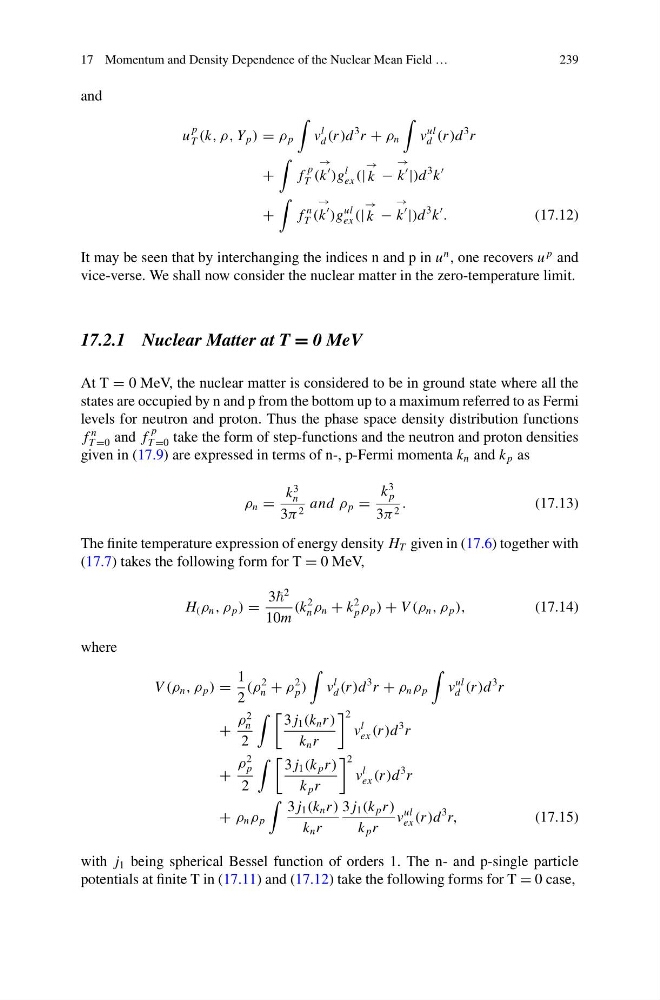
It may be seen that by interchanging the indices n and p in u
n , one recovers u
p and
vice-verse. We shall now consider the nuclear matter in the zero-temperature limit.
17.2.1 Nuclear Matter at T = 0 MeV
At T = 0 MeV, the nuclear matter is considered to be in ground state where all the
states are occupied by n and p from the bottom up to a maximum referred to as Fermi
levels for neutron and proton. Thus the phase space density distribution functions
f
n
T =0 and f
p
T =0 take the form of step-functions and the neutron and proton densities
given in (17.9) are expressed in terms of n-, p-Fermi momenta k n and k p as
ρ n =
k
3
n
3π 2 and ρ p =
k
3
p
3π 2 .
(17.13)
The finite temperature expression of energy density H T given in (17.6) together with
(17.7) takes the following form for T = 0 MeV,
H ( ρ n , ρ p ) =
3
2
10m
(k
2
n ρ n + k
2
p ρ p ) + V (ρ n , ρ p ),
(17.14)
where
V (ρ n , ρ p ) =
1
2
(ρ
2
n + ρ
2
p )
v
l
d (r )d
3 r + ρ n ρ p
v
ul
d (r )d
3 r
+
ρ
2
n
2
3 j 1 (k n r )
k n r
2
v
l
ex (r )d
3 r
+
ρ
2
p
2
3 j 1 (k p r )
k p r
2
v
l
ex (r )d
3 r
+ ρ n ρ p
3 j 1 (k n r )
k n r
3 j 1 (k p r )
k p r
v
ul
ex (r )d
3 r,
(17.15)
with j 1 being spherical Bessel function of orders 1. The n- and p-single particle
potentials at finite T in (17.11) and (17.12) take the following forms for T = 0 case,
239
and
u
p
T (k, ρ, Y p ) = ρ p
v
l
d (r )d
3 r + ρ n
v
ul
d (r )d
3 r
+
f
p
T (
→
k
)g
l
ex (|
→
k −
→
k
|)d
3 k
+
f
n
T (
→
k
)g
ul
ex (|
→
k −
→
k
|)d
3 k
.
(17.12)
It may be seen that by interchanging the indices n and p in u
n , one recovers u
p and
vice-verse. We shall now consider the nuclear matter in the zero-temperature limit.
17.2.1 Nuclear Matter at T = 0 MeV
At T = 0 MeV, the nuclear matter is considered to be in ground state where all the
states are occupied by n and p from the bottom up to a maximum referred to as Fermi
levels for neutron and proton. Thus the phase space density distribution functions
f
n
T =0 and f
p
T =0 take the form of step-functions and the neutron and proton densities
given in (17.9) are expressed in terms of n-, p-Fermi momenta k n and k p as
ρ n =
k
3
n
3π 2 and ρ p =
k
3
p
3π 2 .
(17.13)
The finite temperature expression of energy density H T given in (17.6) together with
(17.7) takes the following form for T = 0 MeV,
H ( ρ n , ρ p ) =
3
2
10m
(k
2
n ρ n + k
2
p ρ p ) + V (ρ n , ρ p ),
(17.14)
where
V (ρ n , ρ p ) =
1
2
(ρ
2
n + ρ
2
p )
v
l
d (r )d
3 r + ρ n ρ p
v
ul
d (r )d
3 r
+
ρ
2
n
2
3 j 1 (k n r )
k n r
2
v
l
ex (r )d
3 r
+
ρ
2
p
2
3 j 1 (k p r )
k p r
2
v
l
ex (r )d
3 r
+ ρ n ρ p
3 j 1 (k n r )
k n r
3 j 1 (k p r )
k p r
v
ul
ex (r )d
3 r,
(17.15)
with j 1 being spherical Bessel function of orders 1. The n- and p-single particle
potentials at finite T in (17.11) and (17.12) take the following forms for T = 0 case,