

238
T. R. Routray et al.
v
T
(ρ n , ρ p ) =
1
2
(ρ
2
n + ρ
2
p )
v
l
d (r )d
3 r + ρ n ρ p
v
(ul)
d (r )d
3 r
+
1
2
[ f
n
T (
→
k ) f
n
T (
→
k
) + f
p
T (
→
k ) f
p
T (
→
k
)]g
l
ex (|
→
k −
→
k
|)d
3 kd
3 k
+
1
2
[ f
n
T (
→
k ) f
p
T (
→
k
) + f
p
T (
→
k ) f
n
T (
→
k
)]g
ul
ex (|
→
k −
→
k
|)d
3 kd
3 k
,
f
n( p)
T
(
→
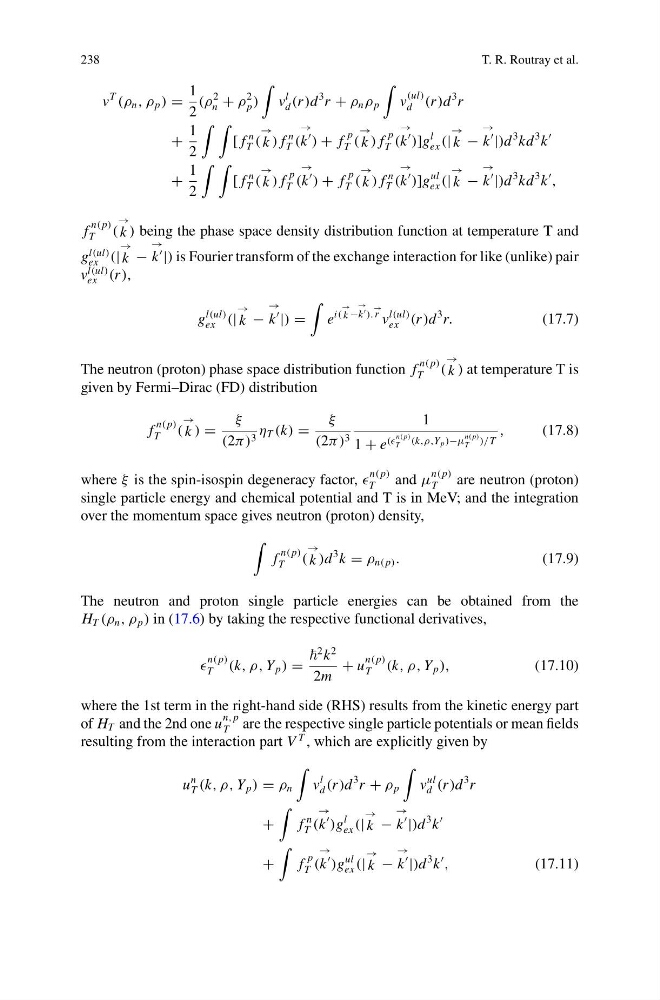
k ) being the phase space density distribution function at temperature T and
g
l(ul)
ex (|
→
k −
→
k
|) is Fourier transform of the exchange interaction for like (unlike) pair
v
l(ul)
ex (r ),
g
l(ul)
ex (|
→
k −
→
k
|) =
e
i(
→
k −
→
k
).
→
r v
l(ul)
ex (r )d
3 r.
(17.7)
The neutron (proton) phase space distribution function f
n( p)
T
(
→
k ) at temperature T is
given by Fermi–Dirac (FD) distribution
f
n( p)
T
(
→
k ) =
ξ
(2π) 3 η T (k) =
ξ
(2π) 3
1
1 + e ((
n( p)
T
(k,ρ,Y p )−μ
n( p)
T )/T
,
(17.8)
where ξ is the spin-isospin degeneracy factor,
n( p)
T
and μ
n( p)
T
are neutron (proton)
single particle energy and chemical potential and T is in MeV; and the integration
over the momentum space gives neutron (proton) density,
f
n( p)
T
(
→
k )d
3 k = ρ n( p) .
(17.9)
The neutron and proton single particle energies can be obtained from the
H T (ρ n , ρ p ) in (17.6) by taking the respective functional derivatives,
n( p)
T
(k, ρ, Y p ) =
2 k
2
2m
+ u
n( p)
T (k, ρ, Y p ),
(17.10)
where the 1st term in the right-hand side (RHS) results from the kinetic energy part
of H T and the 2nd one u
n, p
T are the respective single particle potentials or mean fields
resulting from the interaction part V
T , which are explicitly given by
u
n
T (k, ρ, Y p ) = ρ n
v
l
d (r )d
3 r + ρ p
v
ul
d (r )d
3 r
+
f
n
T (
→
k
)g
l
ex (|
→
k −
→
k
|)d
3 k
+
f
p
T (
→
k
)g
ul
ex (|
→
k −
→
k
|)d
3 k
,
(17.11)
T. R. Routray et al.
v
T
(ρ n , ρ p ) =
1
2
(ρ
2
n + ρ
2
p )
v
l
d (r )d
3 r + ρ n ρ p
v
(ul)
d (r )d
3 r
+
1
2
[ f
n
T (
→
k ) f
n
T (
→
k
) + f
p
T (
→
k ) f
p
T (
→
k
)]g
l
ex (|
→
k −
→
k
|)d
3 kd
3 k
+
1
2
[ f
n
T (
→
k ) f
p
T (
→
k
) + f
p
T (
→
k ) f
n
T (
→
k
)]g
ul
ex (|
→
k −
→
k
|)d
3 kd
3 k
,
f
n( p)
T
(
→
k ) being the phase space density distribution function at temperature T and
g
l(ul)
ex (|
→
k −
→
k
|) is Fourier transform of the exchange interaction for like (unlike) pair
v
l(ul)
ex (r ),
g
l(ul)
ex (|
→
k −
→
k
|) =
e
i(
→
k −
→
k
).
→
r v
l(ul)
ex (r )d
3 r.
(17.7)
The neutron (proton) phase space distribution function f
n( p)
T
(
→
k ) at temperature T is
given by Fermi–Dirac (FD) distribution
f
n( p)
T
(
→
k ) =
ξ
(2π) 3 η T (k) =
ξ
(2π) 3
1
1 + e ((
n( p)
T
(k,ρ,Y p )−μ
n( p)
T )/T
,
(17.8)
where ξ is the spin-isospin degeneracy factor,
n( p)
T
and μ
n( p)
T
are neutron (proton)
single particle energy and chemical potential and T is in MeV; and the integration
over the momentum space gives neutron (proton) density,
f
n( p)
T
(
→
k )d
3 k = ρ n( p) .
(17.9)
The neutron and proton single particle energies can be obtained from the
H T (ρ n , ρ p ) in (17.6) by taking the respective functional derivatives,
n( p)
T
(k, ρ, Y p ) =
2 k
2
2m
+ u
n( p)
T (k, ρ, Y p ),
(17.10)
where the 1st term in the right-hand side (RHS) results from the kinetic energy part
of H T and the 2nd one u
n, p
T are the respective single particle potentials or mean fields
resulting from the interaction part V
T , which are explicitly given by
u
n
T (k, ρ, Y p ) = ρ n
v
l
d (r )d
3 r + ρ p
v
ul
d (r )d
3 r
+
f
n
T (
→
k
)g
l
ex (|
→
k −
→
k
|)d
3 k
+
f
p
T (
→
k
)g
ul
ex (|
→
k −
→
k
|)d
3 k
,
(17.11)