

178
M. M. Aggarwal
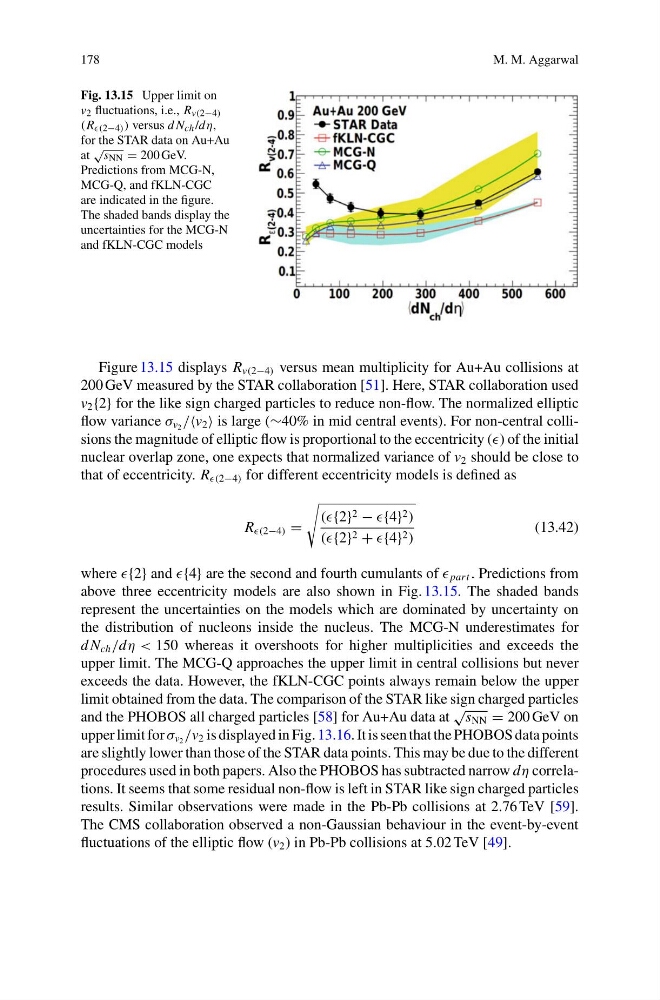
Fig. 13.15 Upper limit on
v 2 fluctuations, i.e., R v(2−4)
(R (2−4) ) versus d N ch /dη,
for the STAR data on Au+Au
at
√
s NN = 200 GeV.
Predictions from MCG-N,
MCG-Q, and fKLN-CGC
are indicated in the figure.
The shaded bands display the
uncertainties for the MCG-N
and fKLN-CGC models
Figure 13.15 displays R v(2−4) versus mean multiplicity for Au+Au collisions at
200 GeV measured by the STAR collaboration [51]. Here, STAR collaboration used
v 2 {2} for the like sign charged particles to reduce non-flow. The normalized elliptic
flow variance σ v 2 /v 2 is large (∼40% in mid central events). For non-central collisions the magnitude of elliptic flow is proportional to the eccentricity () of the initial
nuclear overlap zone, one expects that normalized variance of v 2 should be close to
that of eccentricity. R (2−4) for different eccentricity models is defined as
R (2−4) =
(({2} 2 − {4} 2 )
(({2} 2 + {4} 2 )
(13.42)
where {2} and {4} are the second and fourth cumulants of part . Predictions from
above three eccentricity models are also shown in Fig. 13.15. The shaded bands
represent the uncertainties on the models which are dominated by uncertainty on
the distribution of nucleons inside the nucleus. The MCG-N underestimates for
d N ch /dη < 150 whereas it overshoots for higher multiplicities and exceeds the
upper limit. The MCG-Q approaches the upper limit in central collisions but never
exceeds the data. However, the fKLN-CGC points always remain below the upper
limit obtained from the data. The comparison of the STAR like sign charged particles
and the PHOBOS all charged particles [58] for Au+Au data at
√ s NN = 200 GeV on
upper limit for σ v 2 /v 2 is displayed in Fig. 13.16. It is seen that the PHOBOS data points
are slightly lower than those of the STAR data points. This may be due to the different
procedures used in both papers. Also the PHOBOS has subtracted narrow dη correlations. It seems that some residual non-flow is left in STAR like sign charged particles
results. Similar observations were made in the Pb-Pb collisions at 2.76 TeV [59].
The CMS collaboration observed a non-Gaussian behaviour in the event-by-event
fluctuations of the elliptic flow (v 2 ) in Pb-Pb collisions at 5.02 TeV [49].
M. M. Aggarwal
Fig. 13.15 Upper limit on
v 2 fluctuations, i.e., R v(2−4)
(R (2−4) ) versus d N ch /dη,
for the STAR data on Au+Au
at
√
s NN = 200 GeV.
Predictions from MCG-N,
MCG-Q, and fKLN-CGC
are indicated in the figure.
The shaded bands display the
uncertainties for the MCG-N
and fKLN-CGC models
Figure 13.15 displays R v(2−4) versus mean multiplicity for Au+Au collisions at
200 GeV measured by the STAR collaboration [51]. Here, STAR collaboration used
v 2 {2} for the like sign charged particles to reduce non-flow. The normalized elliptic
flow variance σ v 2 /v 2 is large (∼40% in mid central events). For non-central collisions the magnitude of elliptic flow is proportional to the eccentricity () of the initial
nuclear overlap zone, one expects that normalized variance of v 2 should be close to
that of eccentricity. R (2−4) for different eccentricity models is defined as
R (2−4) =
(({2} 2 − {4} 2 )
(({2} 2 + {4} 2 )
(13.42)
where {2} and {4} are the second and fourth cumulants of part . Predictions from
above three eccentricity models are also shown in Fig. 13.15. The shaded bands
represent the uncertainties on the models which are dominated by uncertainty on
the distribution of nucleons inside the nucleus. The MCG-N underestimates for
d N ch /dη < 150 whereas it overshoots for higher multiplicities and exceeds the
upper limit. The MCG-Q approaches the upper limit in central collisions but never
exceeds the data. However, the fKLN-CGC points always remain below the upper
limit obtained from the data. The comparison of the STAR like sign charged particles
and the PHOBOS all charged particles [58] for Au+Au data at
√ s NN = 200 GeV on
upper limit for σ v 2 /v 2 is displayed in Fig. 13.16. It is seen that the PHOBOS data points
are slightly lower than those of the STAR data points. This may be due to the different
procedures used in both papers. Also the PHOBOS has subtracted narrow dη correlations. It seems that some residual non-flow is left in STAR like sign charged particles
results. Similar observations were made in the Pb-Pb collisions at 2.76 TeV [59].
The CMS collaboration observed a non-Gaussian behaviour in the event-by-event
fluctuations of the elliptic flow (v 2 ) in Pb-Pb collisions at 5.02 TeV [49].