

13 Elliptic Flow in Relativistic Heavy-Ion Collisions
169
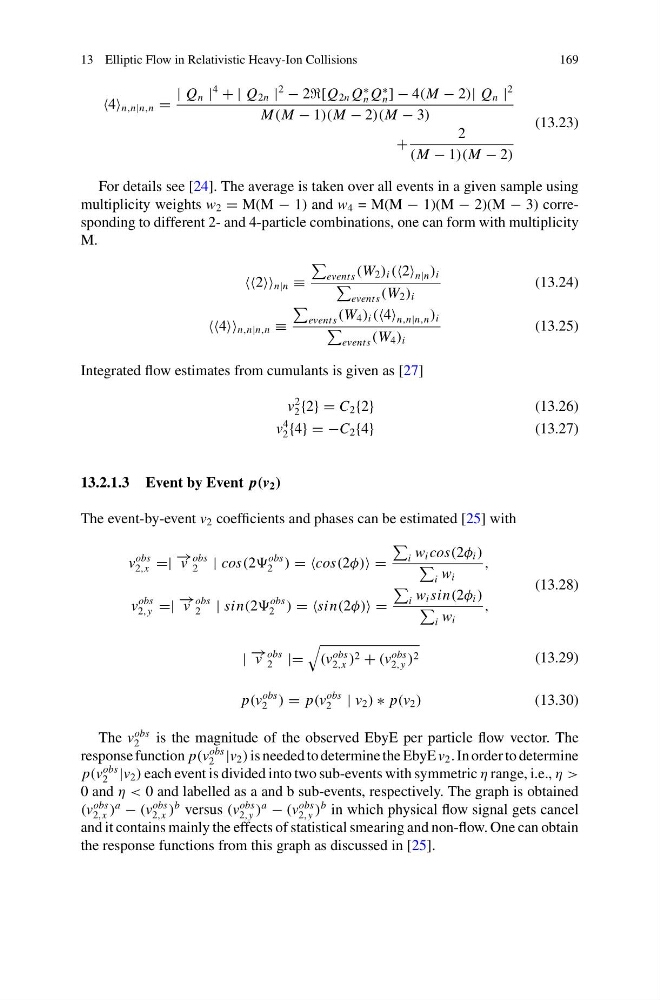
4 n,n|n,n =
| Q n |
4
+ | Q 2n |
2
− 2[Q 2n Q
∗
n Q
∗
n ] − 4(M − 2)| Q n |
2
M(M − 1)(M − 2)(M − 3)
+
2
(M − 1)(M − 2)
(13.23)
For details see [24]. The average is taken over all events in a given sample using
multiplicity weights w 2 = M(M − 1) and w 4 = M(M − 1)(M − 2)(M − 3) corresponding to different 2- and 4-particle combinations, one can form with multiplicity
M.
2 n|n ≡
events (W 2 ) i (2 n|n ) i
events (W 2 ) i
(13.24)
4 n,n|n,n ≡
events (W 4 ) i (4 n,n|n,n ) i
events (W 4 ) i
(13.25)
Integrated flow estimates from cumulants is given as [27]
v
2
2 {2} = C 2 {2}
(13.26)
v
4
2 {4} = −C 2 {4}
(13.27)
13.2.1.3 Event by Event p(v 2 )
The event-by-event v 2 coefficients and phases can be estimated [25] with
v
obs
2,x =| − → v
obs
2 | cos(2
obs
2 ) = =cos(2φ) =
i w i cos(2φ i )
i w i
,
v
obs
2,y =| − → v
obs
2 | sin(2
obs
2 ) = =sin(2φ) =
i w i sin(2φ i )
i w i
,
(13.28)
| − → v
obs
2 |=
(v
obs
2,x ) 2 + (v
obs
2,y ) 2
(13.29)
p(v
obs
2 ) = p(v
obs
2 | v 2 ) ∗ p(v 2 )
(13.30)
The v
obs
2
is the magnitude of the observed EbyE per particle flow vector. The
response function p(v
obs
2 |v 2 ) is needed to determine the EbyE v 2 . In order to determine
p(v
obs
2 |v 2 ) each event is divided into two sub-events with symmetric η range, i.e., η >
0 and η < 0 and labelled as a and b sub-events, respectively. The graph is obtained
(v
obs
2,x )
a
− (v
obs
2,x )
b versus (v
obs
2,y )
a
− (v
obs
2,y )
b in which physical flow signal gets cancel
and it contains mainly the effects of statistical smearing and non-flow. One can obtain
the response functions from this graph as discussed in [25].
169
4 n,n|n,n =
| Q n |
4
+ | Q 2n |
2
− 2[Q 2n Q
∗
n Q
∗
n ] − 4(M − 2)| Q n |
2
M(M − 1)(M − 2)(M − 3)
+
2
(M − 1)(M − 2)
(13.23)
For details see [24]. The average is taken over all events in a given sample using
multiplicity weights w 2 = M(M − 1) and w 4 = M(M − 1)(M − 2)(M − 3) corresponding to different 2- and 4-particle combinations, one can form with multiplicity
M.
2 n|n ≡
events (W 2 ) i (2 n|n ) i
events (W 2 ) i
(13.24)
4 n,n|n,n ≡
events (W 4 ) i (4 n,n|n,n ) i
events (W 4 ) i
(13.25)
Integrated flow estimates from cumulants is given as [27]
v
2
2 {2} = C 2 {2}
(13.26)
v
4
2 {4} = −C 2 {4}
(13.27)
13.2.1.3 Event by Event p(v 2 )
The event-by-event v 2 coefficients and phases can be estimated [25] with
v
obs
2,x =| − → v
obs
2 | cos(2
obs
2 ) = =cos(2φ) =
i w i cos(2φ i )
i w i
,
v
obs
2,y =| − → v
obs
2 | sin(2
obs
2 ) = =sin(2φ) =
i w i sin(2φ i )
i w i
,
(13.28)
| − → v
obs
2 |=
(v
obs
2,x ) 2 + (v
obs
2,y ) 2
(13.29)
p(v
obs
2 ) = p(v
obs
2 | v 2 ) ∗ p(v 2 )
(13.30)
The v
obs
2
is the magnitude of the observed EbyE per particle flow vector. The
response function p(v
obs
2 |v 2 ) is needed to determine the EbyE v 2 . In order to determine
p(v
obs
2 |v 2 ) each event is divided into two sub-events with symmetric η range, i.e., η >
0 and η < 0 and labelled as a and b sub-events, respectively. The graph is obtained
(v
obs
2,x )
a
− (v
obs
2,x )
b versus (v
obs
2,y )
a
− (v
obs
2,y )
b in which physical flow signal gets cancel
and it contains mainly the effects of statistical smearing and non-flow. One can obtain
the response functions from this graph as discussed in [25].