

146
C. Hartnack et al.
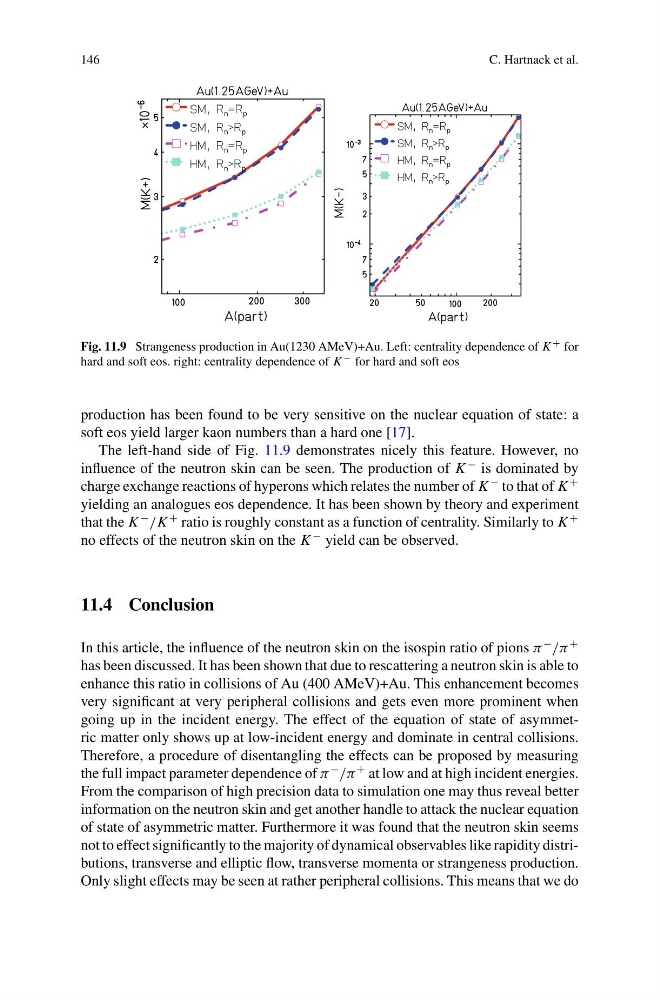
Fig. 11.9 Strangeness production in Au(1230 AMeV)+Au. Left: centrality dependence of K + for
hard and soft eos. right: centrality dependence of K − for hard and soft eos
production has been found to be very sensitive on the nuclear equation of state: a
soft eos yield larger kaon numbers than a hard one [17].
The left-hand side of Fig. 11.9 demonstrates nicely this feature. However, no
influence of the neutron skin can be seen. The production of K
− is dominated by
charge exchange reactions of hyperons which relates the number of K
− to that of K
+
yielding an analogues eos dependence. It has been shown by theory and experiment
that the K
−
/K
+ ratio is roughly constant as a function of centrality. Similarly to K
+
no effects of the neutron skin on the K
− yield can be observed.
11.4 Conclusion
In this article, the influence of the neutron skin on the isospin ratio of pions π
−
/π
+
has been discussed. It has been shown that due to rescattering a neutron skin is able to
enhance this ratio in collisions of Au (400 AMeV)+Au. This enhancement becomes
very significant at very peripheral collisions and gets even more prominent when
going up in the incident energy. The effect of the equation of state of asymmetric matter only shows up at low-incident energy and dominate in central collisions.
Therefore, a procedure of disentangling the effects can be proposed by measuring
the full impact parameter dependence of π
−
/π
+ at low and at high incident energies.
From the comparison of high precision data to simulation one may thus reveal better
information on the neutron skin and get another handle to attack the nuclear equation
of state of asymmetric matter. Furthermore it was found that the neutron skin seems
not to effect significantly to the majority of dynamical observables like rapidity distributions, transverse and elliptic flow, transverse momenta or strangeness production.
Only slight effects may be seen at rather peripheral collisions. This means that we do
C. Hartnack et al.
Fig. 11.9 Strangeness production in Au(1230 AMeV)+Au. Left: centrality dependence of K + for
hard and soft eos. right: centrality dependence of K − for hard and soft eos
production has been found to be very sensitive on the nuclear equation of state: a
soft eos yield larger kaon numbers than a hard one [17].
The left-hand side of Fig. 11.9 demonstrates nicely this feature. However, no
influence of the neutron skin can be seen. The production of K
− is dominated by
charge exchange reactions of hyperons which relates the number of K
− to that of K
+
yielding an analogues eos dependence. It has been shown by theory and experiment
that the K
−
/K
+ ratio is roughly constant as a function of centrality. Similarly to K
+
no effects of the neutron skin on the K
− yield can be observed.
11.4 Conclusion
In this article, the influence of the neutron skin on the isospin ratio of pions π
−
/π
+
has been discussed. It has been shown that due to rescattering a neutron skin is able to
enhance this ratio in collisions of Au (400 AMeV)+Au. This enhancement becomes
very significant at very peripheral collisions and gets even more prominent when
going up in the incident energy. The effect of the equation of state of asymmetric matter only shows up at low-incident energy and dominate in central collisions.
Therefore, a procedure of disentangling the effects can be proposed by measuring
the full impact parameter dependence of π
−
/π
+ at low and at high incident energies.
From the comparison of high precision data to simulation one may thus reveal better
information on the neutron skin and get another handle to attack the nuclear equation
of state of asymmetric matter. Furthermore it was found that the neutron skin seems
not to effect significantly to the majority of dynamical observables like rapidity distributions, transverse and elliptic flow, transverse momenta or strangeness production.
Only slight effects may be seen at rather peripheral collisions. This means that we do