

126
E. L. Bratkovskaya et al.
next timestep) and conserves the four-momentum as well as the flavor currents. We
note, however, that the initial phase in PHSD is dominated by quark and antiquark
degrees of freedom [35].
Apart from proton-proton, proton-nucleus or nucleus-nucleus collisions the PHSD
approach can also be employed to study the properties of the interacting hadron/parton
system in a finite box with periodic boundary conditions [36]. To this aim the system is initialized by a homogeneous distribution of test particles in a finite box with
a momentum distribution close to a thermal one. Note that in PHSD the system
cannot directly be initialized by a temperature and chemical potential since these
Lagrange parameters can only be determined when the system has reached a thermal
and chemical equilibrium, i.e., when all forward and backward reaction rates have
become equal; this is easy to check in the transport simulations.
10.2.3 Partonic Cross Sections
On the partonic side the following elastic and inelastic interactions are included
in PHSD qq ↔ qq, ¯
q ¯
q ↔ ¯
q ¯
q, gg ↔ gg, gg ↔ g, q ¯
q ↔ g, qg ↔ qg, g ¯
q ↔ g ¯
q
exploiting detailed-balance with cross sections calculated from the leading Feynman
diagrams employing the effective propagators and couplings g
2
(T /T c ) from the
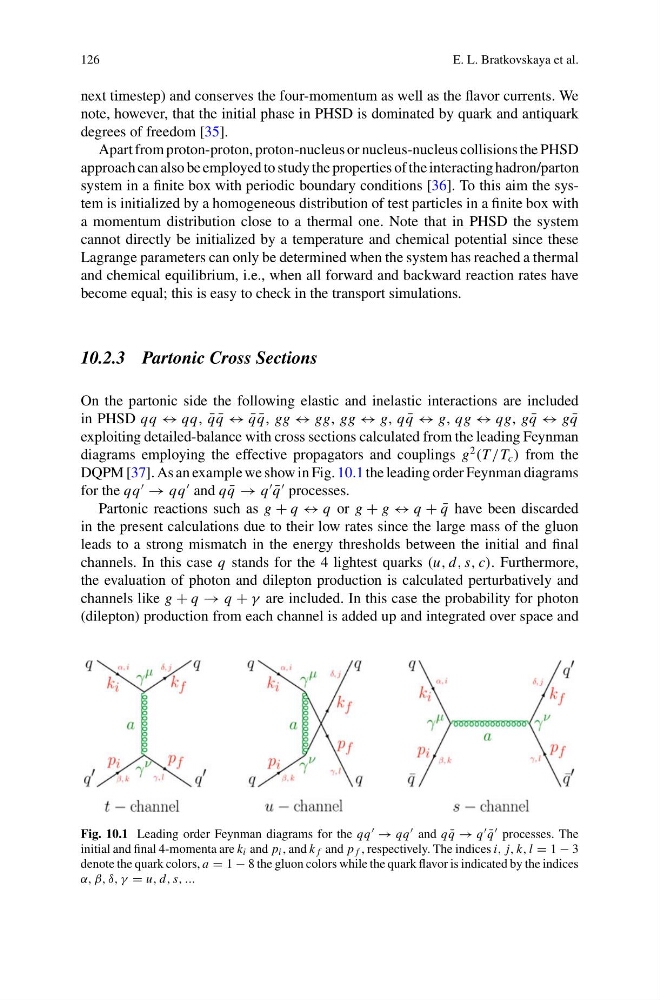
DQPM [37]. As an example we show in Fig. 10.1 the leading order Feynman diagrams
for the qq
→ qq
and q ¯
q → q
¯
q
processes.
Partonic reactions such as g + q ↔ q or g + g ↔ q + ¯
q have been discarded
in the present calculations due to their low rates since the large mass of the gluon
leads to a strong mismatch in the energy thresholds between the initial and final
channels. In this case q stands for the 4 lightest quarks (u, d, s, c). Furthermore,
the evaluation of photon and dilepton production is calculated perturbatively and
channels like g + q → q + γ are included. In this case the probability for photon
(dilepton) production from each channel is added up and integrated over space and
Fig. 10.1 Leading order Feynman diagrams for the qq → qq and q ¯
q → q ¯
q processes. The
initial and final 4-momenta are k i and p i , and k f and p f , respectively. The indices i, j, k, l = 1 − 3
denote the quark colors, a = 1 − 8 the gluon colors while the quark flavor is indicated by the indices
α, β, δ, γ = u, d, s, ...
E. L. Bratkovskaya et al.
next timestep) and conserves the four-momentum as well as the flavor currents. We
note, however, that the initial phase in PHSD is dominated by quark and antiquark
degrees of freedom [35].
Apart from proton-proton, proton-nucleus or nucleus-nucleus collisions the PHSD
approach can also be employed to study the properties of the interacting hadron/parton
system in a finite box with periodic boundary conditions [36]. To this aim the system is initialized by a homogeneous distribution of test particles in a finite box with
a momentum distribution close to a thermal one. Note that in PHSD the system
cannot directly be initialized by a temperature and chemical potential since these
Lagrange parameters can only be determined when the system has reached a thermal
and chemical equilibrium, i.e., when all forward and backward reaction rates have
become equal; this is easy to check in the transport simulations.
10.2.3 Partonic Cross Sections
On the partonic side the following elastic and inelastic interactions are included
in PHSD qq ↔ qq, ¯
q ¯
q ↔ ¯
q ¯
q, gg ↔ gg, gg ↔ g, q ¯
q ↔ g, qg ↔ qg, g ¯
q ↔ g ¯
q
exploiting detailed-balance with cross sections calculated from the leading Feynman
diagrams employing the effective propagators and couplings g
2
(T /T c ) from the
DQPM [37]. As an example we show in Fig. 10.1 the leading order Feynman diagrams
for the qq
and q ¯
q → q
¯
q
processes.
Partonic reactions such as g + q ↔ q or g + g ↔ q + ¯
q have been discarded
in the present calculations due to their low rates since the large mass of the gluon
leads to a strong mismatch in the energy thresholds between the initial and final
channels. In this case q stands for the 4 lightest quarks (u, d, s, c). Furthermore,
the evaluation of photon and dilepton production is calculated perturbatively and
channels like g + q → q + γ are included. In this case the probability for photon
(dilepton) production from each channel is added up and integrated over space and
Fig. 10.1 Leading order Feynman diagrams for the qq → qq and q ¯
q → q ¯
q processes. The
initial and final 4-momenta are k i and p i , and k f and p f , respectively. The indices i, j, k, l = 1 − 3
denote the quark colors, a = 1 − 8 the gluon colors while the quark flavor is indicated by the indices
α, β, δ, γ = u, d, s, ...