

9 PHQMD—A Microscopic Transport Approach for Heavy-Ion …
111
Table 9.1 Parameter sets for the nuclear equation of state used in the PHQMD model
EoS
Soft (S)
Hard (H)
Soft Momentum (SM)
α (MeV)
−383.5
−125.3
−478.87
β (MeV)
329.5
71.0
413.76
γ
1.15
2.0
1.10
K (MeV)
200
380
200
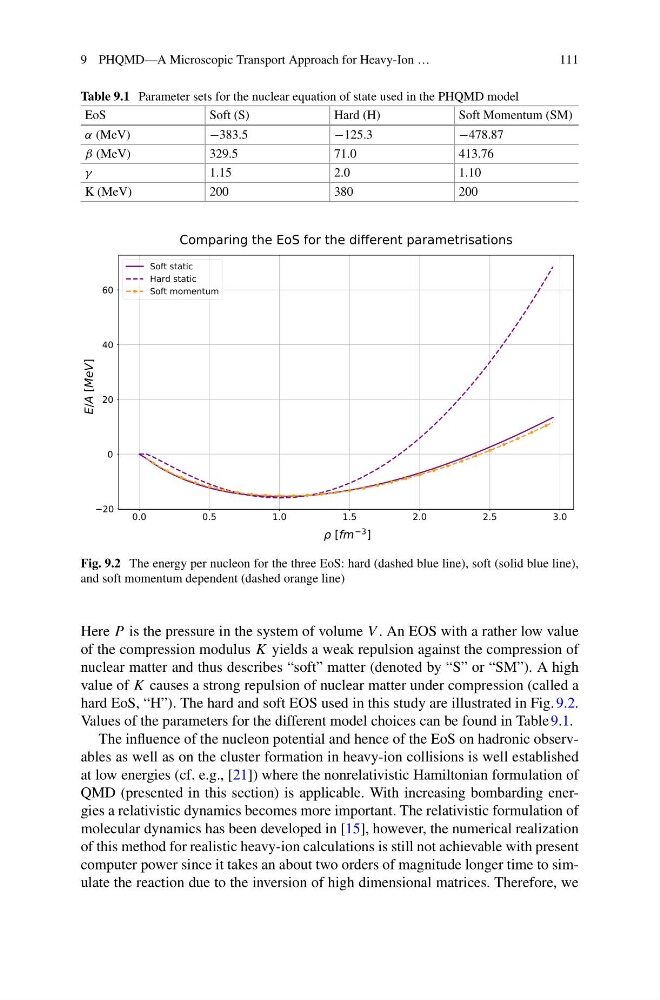
Fig. 9.2 The energy per nucleon for the three EoS: hard (dashed blue line), soft (solid blue line),
and soft momentum dependent (dashed orange line)
Here P is the pressure in the system of volume V . An EOS with a rather low value
of the compression modulus K yields a weak repulsion against the compression of
nuclear matter and thus describes “soft” matter (denoted by “S” or “SM”). A high
value of K causes a strong repulsion of nuclear matter under compression (called a
hard EoS, “H”). The hard and soft EOS used in this study are illustrated in Fig. 9.2.
Values of the parameters for the different model choices can be found in Table 9.1.
The influence of the nucleon potential and hence of the EoS on hadronic observables as well as on the cluster formation in heavy-ion collisions is well established
at low energies (cf. e.g., [21]) where the nonrelativistic Hamiltonian formulation of
QMD (presented in this section) is applicable. With increasing bombarding energies a relativistic dynamics becomes more important. The relativistic formulation of
molecular dynamics has been developed in [15], however, the numerical realization
of this method for realistic heavy-ion calculations is still not achievable with present
computer power since it takes an about two orders of magnitude longer time to simulate the reaction due to the inversion of high dimensional matrices. Therefore, we
111
Table 9.1 Parameter sets for the nuclear equation of state used in the PHQMD model
EoS
Soft (S)
Hard (H)
Soft Momentum (SM)
α (MeV)
−383.5
−125.3
−478.87
β (MeV)
329.5
71.0
413.76
γ
1.15
2.0
1.10
K (MeV)
200
380
200
Fig. 9.2 The energy per nucleon for the three EoS: hard (dashed blue line), soft (solid blue line),
and soft momentum dependent (dashed orange line)
Here P is the pressure in the system of volume V . An EOS with a rather low value
of the compression modulus K yields a weak repulsion against the compression of
nuclear matter and thus describes “soft” matter (denoted by “S” or “SM”). A high
value of K causes a strong repulsion of nuclear matter under compression (called a
hard EoS, “H”). The hard and soft EOS used in this study are illustrated in Fig. 9.2.
Values of the parameters for the different model choices can be found in Table 9.1.
The influence of the nucleon potential and hence of the EoS on hadronic observables as well as on the cluster formation in heavy-ion collisions is well established
at low energies (cf. e.g., [21]) where the nonrelativistic Hamiltonian formulation of
QMD (presented in this section) is applicable. With increasing bombarding energies a relativistic dynamics becomes more important. The relativistic formulation of
molecular dynamics has been developed in [15], however, the numerical realization
of this method for realistic heavy-ion calculations is still not achievable with present
computer power since it takes an about two orders of magnitude longer time to simulate the reaction due to the inversion of high dimensional matrices. Therefore, we