

110
J. Aichelin et al.
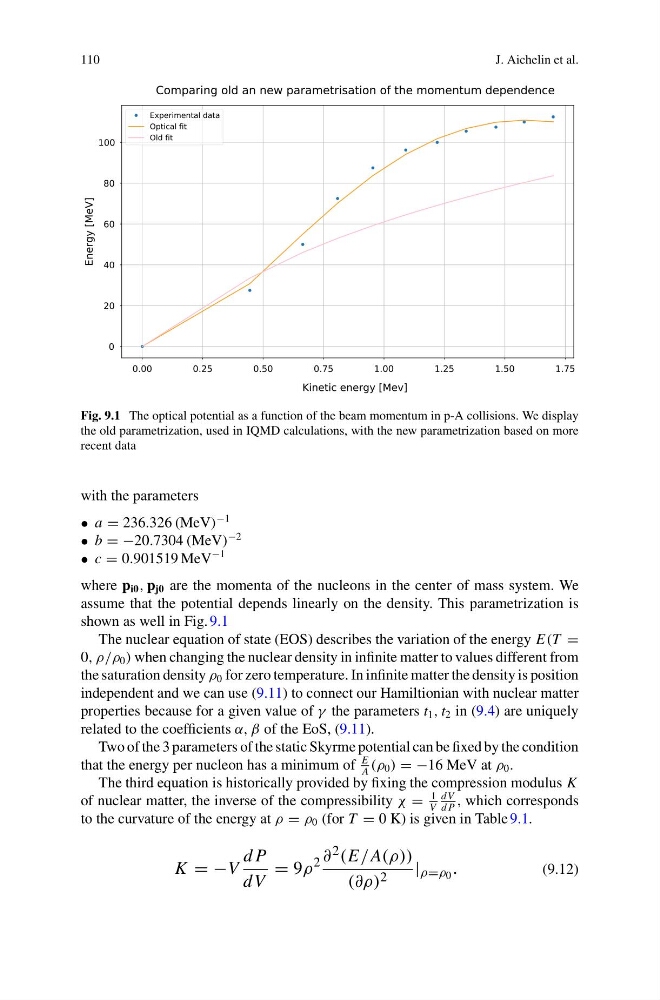
Fig. 9.1 The optical potential as a function of the beam momentum in p-A collisions. We display
the old parametrization, used in IQMD calculations, with the new parametrization based on more
recent data
with the parameters
• a = 236.326 (MeV)
−1
• b = −20.7304 (MeV)
−2
• c = 0.901519 MeV
−1
where p i0 , p j0 are the momenta of the nucleons in the center of mass system. We
assume that the potential depends linearly on the density. This parametrization is
shown as well in Fig. 9.1
The nuclear equation of state (EOS) describes the variation of the energy E(T =
0, ρ/ρ 0 ) when changing the nuclear density in infinite matter to values different from
the saturation density ρ 0 for zero temperature. In infinite matter the density is position
independent and we can use (9.11) to connect our Hamiltionian with nuclear matter
properties because for a given value of γ the parameters t 1 , t 2 in (9.4) are uniquely
related to the coefficients α, β of the EoS, (9.11).
Two of the 3 parameters of the static Skyrme potential can be fixed by the condition
that the energy per nucleon has a minimum of
E
A
(ρ 0 ) = −16 MeV at ρ 0 .
The third equation is historically provided by fixing the compression modulus K
of nuclear matter, the inverse of the compressibility χ =
1
V
dV
d P
, which corresponds
to the curvature of the energy at ρ = ρ 0 (for T = 0 K) is given in Table 9.1.
K = −V
d P
dV
= 9ρ
2 ∂ 2 (E/A(ρ))
(∂ρ) 2
| ρ=ρ 0 .
(9.12)
J. Aichelin et al.
Fig. 9.1 The optical potential as a function of the beam momentum in p-A collisions. We display
the old parametrization, used in IQMD calculations, with the new parametrization based on more
recent data
with the parameters
• a = 236.326 (MeV)
−1
• b = −20.7304 (MeV)
−2
• c = 0.901519 MeV
−1
where p i0 , p j0 are the momenta of the nucleons in the center of mass system. We
assume that the potential depends linearly on the density. This parametrization is
shown as well in Fig. 9.1
The nuclear equation of state (EOS) describes the variation of the energy E(T =
0, ρ/ρ 0 ) when changing the nuclear density in infinite matter to values different from
the saturation density ρ 0 for zero temperature. In infinite matter the density is position
independent and we can use (9.11) to connect our Hamiltionian with nuclear matter
properties because for a given value of γ the parameters t 1 , t 2 in (9.4) are uniquely
related to the coefficients α, β of the EoS, (9.11).
Two of the 3 parameters of the static Skyrme potential can be fixed by the condition
that the energy per nucleon has a minimum of
E
A
(ρ 0 ) = −16 MeV at ρ 0 .
The third equation is historically provided by fixing the compression modulus K
of nuclear matter, the inverse of the compressibility χ =
1
V
dV
d P
, which corresponds
to the curvature of the energy at ρ = ρ 0 (for T = 0 K) is given in Table 9.1.
K = −V
d P
dV
= 9ρ
2 ∂ 2 (E/A(ρ))
(∂ρ) 2
| ρ=ρ 0 .
(9.12)