

3.3 Mission Analysis
59
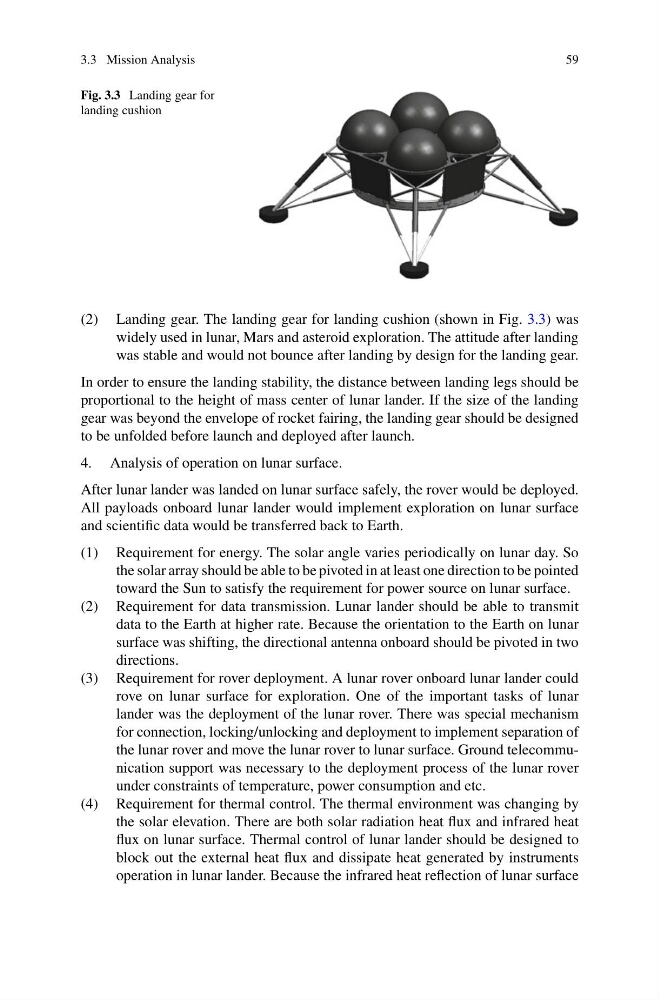
Fig. 3.3 Landing gear for
landing cushion
(2) Landing gear. The landing gear for landing cushion (shown in Fig. 3.3) was
widely used in lunar, Mars and asteroid exploration. The attitude after landing
was stable and would not bounce after landing by design for the landing gear.
In order to ensure the landing stability, the distance between landing legs should be
proportional to the height of mass center of lunar lander. If the size of the landing
gear was beyond the envelope of rocket fairing, the landing gear should be designed
to be unfolded before launch and deployed after launch.
4. Analysis of operation on lunar surface.
After lunar lander was landed on lunar surface safely, the rover would be deployed.
All payloads onboard lunar lander would implement exploration on lunar surface
and scientific data would be transferred back to Earth.
(1) Requirement for energy. The solar angle varies periodically on lunar day. So
the solar array should be able to be pivoted in at least one direction to be pointed
toward the Sun to satisfy the requirement for power source on lunar surface.
(2) Requirement for data transmission. Lunar lander should be able to transmit
data to the Earth at higher rate. Because the orientation to the Earth on lunar
surface was shifting, the directional antenna onboard should be pivoted in two
directions.
(3) Requirement for rover deployment. A lunar rover onboard lunar lander could
rove on lunar surface for exploration. One of the important tasks of lunar
lander was the deployment of the lunar rover. There was special mechanism
for connection, locking/unlocking and deployment to implement separation of
the lunar rover and move the lunar rover to lunar surface. Ground telecommunication support was necessary to the deployment process of the lunar rover
under constraints of temperature, power consumption and etc.
(4) Requirement for thermal control. The thermal environment was changing by
the solar elevation. There are both solar radiation heat flux and infrared heat
flux on lunar surface. Thermal control of lunar lander should be designed to
block out the external heat flux and dissipate heat generated by instruments
operation in lunar lander. Because the infrared heat reflection of lunar surface
59
Fig. 3.3 Landing gear for
landing cushion
(2) Landing gear. The landing gear for landing cushion (shown in Fig. 3.3) was
widely used in lunar, Mars and asteroid exploration. The attitude after landing
was stable and would not bounce after landing by design for the landing gear.
In order to ensure the landing stability, the distance between landing legs should be
proportional to the height of mass center of lunar lander. If the size of the landing
gear was beyond the envelope of rocket fairing, the landing gear should be designed
to be unfolded before launch and deployed after launch.
4. Analysis of operation on lunar surface.
After lunar lander was landed on lunar surface safely, the rover would be deployed.
All payloads onboard lunar lander would implement exploration on lunar surface
and scientific data would be transferred back to Earth.
(1) Requirement for energy. The solar angle varies periodically on lunar day. So
the solar array should be able to be pivoted in at least one direction to be pointed
toward the Sun to satisfy the requirement for power source on lunar surface.
(2) Requirement for data transmission. Lunar lander should be able to transmit
data to the Earth at higher rate. Because the orientation to the Earth on lunar
surface was shifting, the directional antenna onboard should be pivoted in two
directions.
(3) Requirement for rover deployment. A lunar rover onboard lunar lander could
rove on lunar surface for exploration. One of the important tasks of lunar
lander was the deployment of the lunar rover. There was special mechanism
for connection, locking/unlocking and deployment to implement separation of
the lunar rover and move the lunar rover to lunar surface. Ground telecommunication support was necessary to the deployment process of the lunar rover
under constraints of temperature, power consumption and etc.
(4) Requirement for thermal control. The thermal environment was changing by
the solar elevation. There are both solar radiation heat flux and infrared heat
flux on lunar surface. Thermal control of lunar lander should be designed to
block out the external heat flux and dissipate heat generated by instruments
operation in lunar lander. Because the infrared heat reflection of lunar surface