

58
3 System Design of Lunar Lander
(2) Requirements for propulsion. The propulsion subsystem of lunar lander should
provide near 1.7 km/s Delta-V during soft landing process. The thrust weight
ratio should be higher to lower the gravity loss. The thrust of main engine should
be throttlable at a specific range to ensure the stability of powered descent
because the mass of lunar lander was changing during powered descent. If the
thrust weight ratio was higher, the time of powered descent would be shorter
and the gravity loss was smaller. But the overload would be higher and the
dynamics would be worse for the powered descent. Thus the total impulse
of the propulsion subsystem, thrust and throttlable range of the main engine
should be synthetically traded off.
(3) Requirements for landing cushion. The landing cushion absorbing impact load
was necessary although the relative velocity was small when lunar lander
touches lunar surface finally. The landing cushion subsystem would avoid
damage to instruments onboard lunar lander due to the final impact and ensure
that lunar lander would not turn over and sink. It could also provide solid
support for subsequent operation of lunar lander on lunar surface.
3. Selection of landing cushion.
There were two types of landing cushion for lunar soft landing: airbag and landing
gear. For the airbag, gas in the airbag was used to absorb landing impact. For the
landing gear, different types of absorbing energy mechanisms inside the legs were
used to absorb landing impact.
(1) Airbag. There might be one single airbag or multiple airbags complex for the
airbag. Lunar lander was packed inside the airbag. The airbags were used for
Luna 9 and Luna 13. The advantage of airbag was strong cushion capability
and not sensitive to lunar terrain. The disadvantage of airbag was that airbag
could only be used in small scale lander. The bouncing time after landing was
long and the landing site could not be controlled precisely for the airbag. The
airbag was usually used in Mars landing. The airbag used in the U.S. Mars
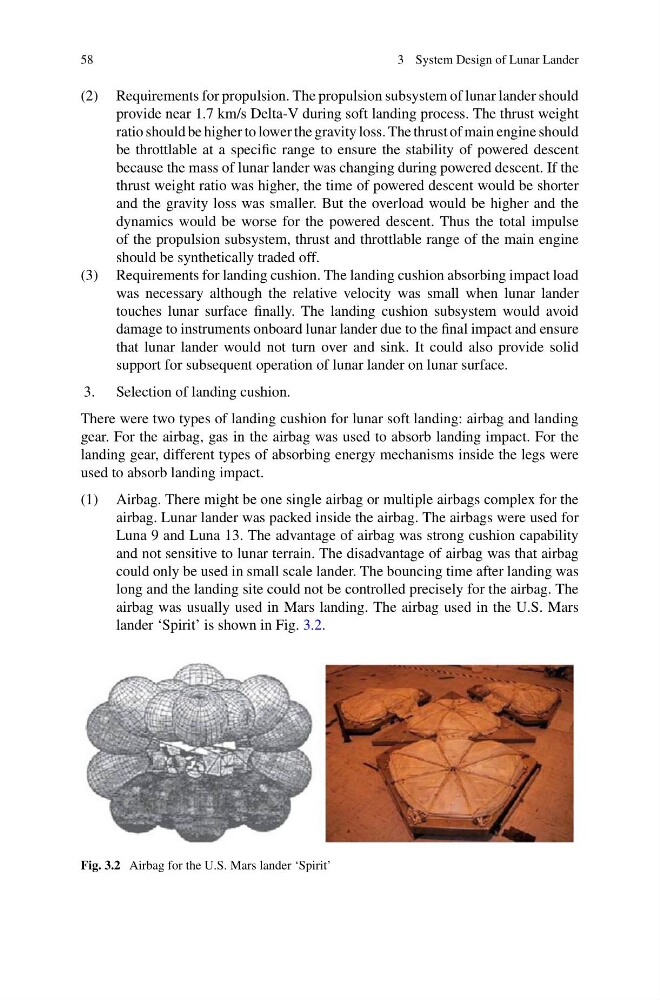
lander ‘Spirit’ is shown in Fig. 3.2.
Fig. 3.2 Airbag for the U.S. Mars lander ‘Spirit’
3 System Design of Lunar Lander
(2) Requirements for propulsion. The propulsion subsystem of lunar lander should
provide near 1.7 km/s Delta-V during soft landing process. The thrust weight
ratio should be higher to lower the gravity loss. The thrust of main engine should
be throttlable at a specific range to ensure the stability of powered descent
because the mass of lunar lander was changing during powered descent. If the
thrust weight ratio was higher, the time of powered descent would be shorter
and the gravity loss was smaller. But the overload would be higher and the
dynamics would be worse for the powered descent. Thus the total impulse
of the propulsion subsystem, thrust and throttlable range of the main engine
should be synthetically traded off.
(3) Requirements for landing cushion. The landing cushion absorbing impact load
was necessary although the relative velocity was small when lunar lander
touches lunar surface finally. The landing cushion subsystem would avoid
damage to instruments onboard lunar lander due to the final impact and ensure
that lunar lander would not turn over and sink. It could also provide solid
support for subsequent operation of lunar lander on lunar surface.
3. Selection of landing cushion.
There were two types of landing cushion for lunar soft landing: airbag and landing
gear. For the airbag, gas in the airbag was used to absorb landing impact. For the
landing gear, different types of absorbing energy mechanisms inside the legs were
used to absorb landing impact.
(1) Airbag. There might be one single airbag or multiple airbags complex for the
airbag. Lunar lander was packed inside the airbag. The airbags were used for
Luna 9 and Luna 13. The advantage of airbag was strong cushion capability
and not sensitive to lunar terrain. The disadvantage of airbag was that airbag
could only be used in small scale lander. The bouncing time after landing was
long and the landing site could not be controlled precisely for the airbag. The
airbag was usually used in Mars landing. The airbag used in the U.S. Mars
lander ‘Spirit’ is shown in Fig. 3.2.
Fig. 3.2 Airbag for the U.S. Mars lander ‘Spirit’