

44
2 Environment Analysis of Lunar Soft Landing Exploration
V =
G M
r
1 +
∞
n=1
n
m=0
R
r
n
P nm (sin ϕ)
C nm cos(mλ) + S nm sin(mλ)
(2.17)
where ¯
C nm and S nm are the normalized potential coefficient; P nm is the standardized
Legendre adjoint function; R = 1738 km is the average radius of lunar equator; M =
7.353 × 10
22 kg is the mass of Moon; r, λ and ϕ are the Moon-center distance, the
longitude and the latitude of space flow point, respectively.
The fairly precise lunar gravitational field model is the Konopliv method. This
method analyzes all the measurement data obtained by lunar probes and achieves the
LP165P model. Its effective order is 110 for the near side of the moon and 60 for the
far side of the moon.
2.6.2 Near Vacuum Environment of the Moon
The atmospheric pressure at lunar surface is 10
−10 ~10
−6 Pa. The molecular number
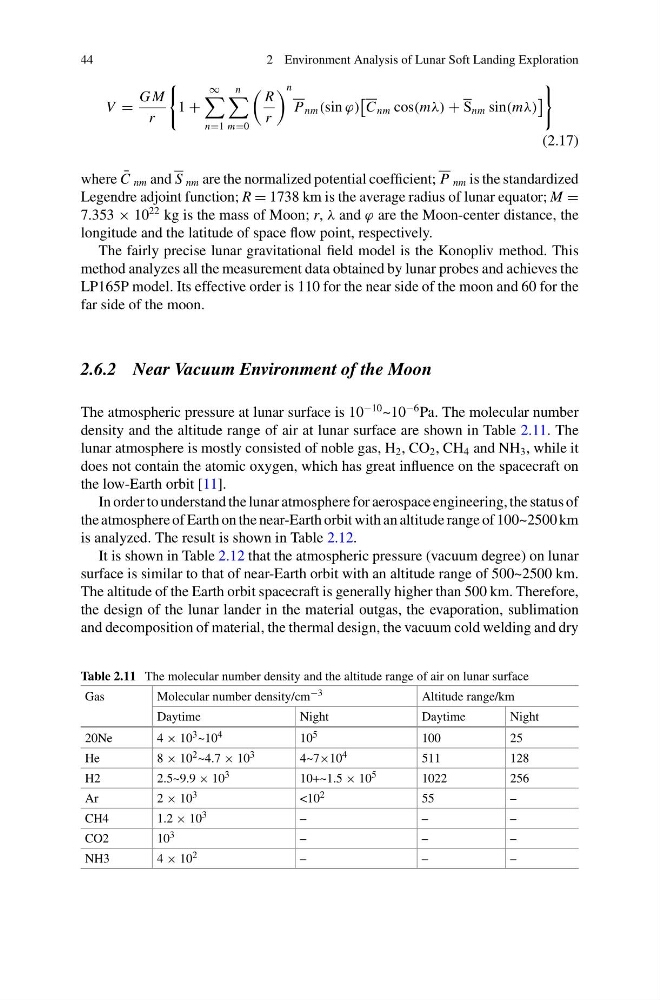
density and the altitude range of air at lunar surface are shown in Table 2.11. The
lunar atmosphere is mostly consisted of noble gas, H 2 , CO 2 , CH 4 and NH 3 , while it
does not contain the atomic oxygen, which has great influence on the spacecraft on
the low-Earth orbit [11].
In order to understand the lunar atmosphere for aerospace engineering, the status of
the atmosphere of Earth on the near-Earth orbit with an altitude range of 100~2500 km
is analyzed. The result is shown in Table 2.12.
It is shown in Table 2.12 that the atmospheric pressure (vacuum degree) on lunar
surface is similar to that of near-Earth orbit with an altitude range of 500~2500 km.
The altitude of the Earth orbit spacecraft is generally higher than 500 km. Therefore,
the design of the lunar lander in the material outgas, the evaporation, sublimation
and decomposition of material, the thermal design, the vacuum cold welding and dry
Table 2.11 The molecular number density and the altitude range of air on lunar surface
Gas
Molecular number density/cm −3
Altitude range/km
Daytime
Night
Daytime
Night
20Ne
4 × 10 3 ~10 4
10 5
100
25
He
8 × 10 2 ~4.7 × 10 3
4~7×10 4
511
128
H2
2.5~9.9 × 10 3
10+~1.5 × 10 5
1022
256
Ar
2 × 10 3
<10 2
55
–
CH4
1.2 × 10 3
–
–
–
CO2
10 3
–
–
–
NH3
4 × 10 2
–
–
–
2 Environment Analysis of Lunar Soft Landing Exploration
V =
G M
r
1 +
∞
n=1
n
m=0
R
r
n
P nm (sin ϕ)
C nm cos(mλ) + S nm sin(mλ)
(2.17)
where ¯
C nm and S nm are the normalized potential coefficient; P nm is the standardized
Legendre adjoint function; R = 1738 km is the average radius of lunar equator; M =
7.353 × 10
22 kg is the mass of Moon; r, λ and ϕ are the Moon-center distance, the
longitude and the latitude of space flow point, respectively.
The fairly precise lunar gravitational field model is the Konopliv method. This
method analyzes all the measurement data obtained by lunar probes and achieves the
LP165P model. Its effective order is 110 for the near side of the moon and 60 for the
far side of the moon.
2.6.2 Near Vacuum Environment of the Moon
The atmospheric pressure at lunar surface is 10
−10 ~10
−6 Pa. The molecular number
density and the altitude range of air at lunar surface are shown in Table 2.11. The
lunar atmosphere is mostly consisted of noble gas, H 2 , CO 2 , CH 4 and NH 3 , while it
does not contain the atomic oxygen, which has great influence on the spacecraft on
the low-Earth orbit [11].
In order to understand the lunar atmosphere for aerospace engineering, the status of
the atmosphere of Earth on the near-Earth orbit with an altitude range of 100~2500 km
is analyzed. The result is shown in Table 2.12.
It is shown in Table 2.12 that the atmospheric pressure (vacuum degree) on lunar
surface is similar to that of near-Earth orbit with an altitude range of 500~2500 km.
The altitude of the Earth orbit spacecraft is generally higher than 500 km. Therefore,
the design of the lunar lander in the material outgas, the evaporation, sublimation
and decomposition of material, the thermal design, the vacuum cold welding and dry
Table 2.11 The molecular number density and the altitude range of air on lunar surface
Gas
Molecular number density/cm −3
Altitude range/km
Daytime
Night
Daytime
Night
20Ne
4 × 10 3 ~10 4
10 5
100
25
He
8 × 10 2 ~4.7 × 10 3
4~7×10 4
511
128
H2
2.5~9.9 × 10 3
10+~1.5 × 10 5
1022
256
Ar
2 × 10 3
<10 2
55
–
CH4
1.2 × 10 3
–
–
–
CO2
10 3
–
–
–
NH3
4 × 10 2
–
–
–