

2.5 Lunar Soil and Dust
43
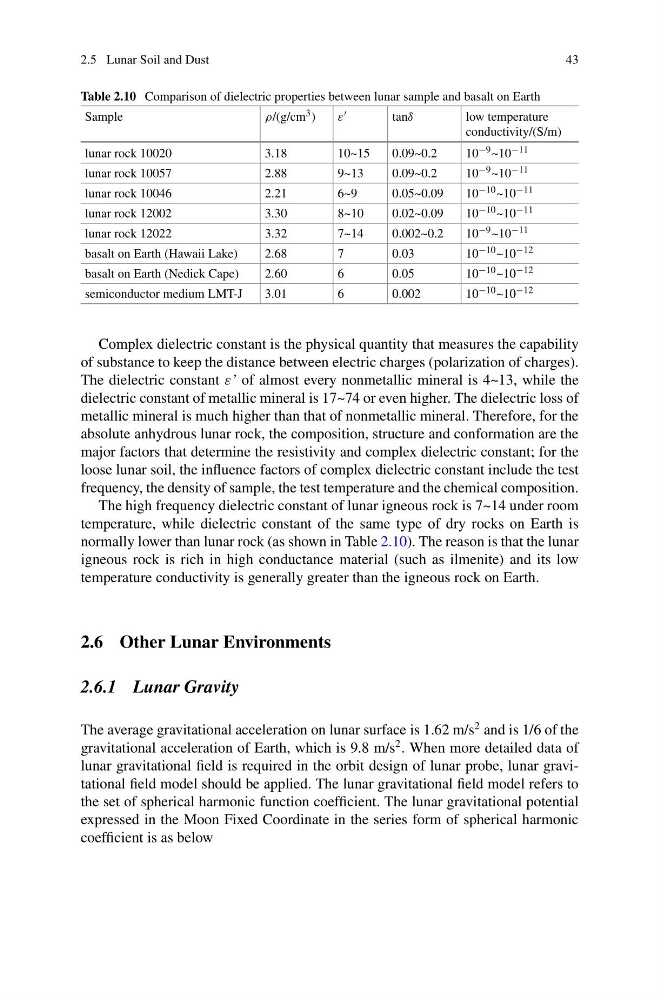
Table 2.10 Comparison of dielectric properties between lunar sample and basalt on Earth
Sample
ρ/(g/cm 3 )
ε
tanδ
low temperature
conductivity/(S/m)
lunar rock 10020
3.18
10~15
0.09~0.2
10 −9 ~10 −11
lunar rock 10057
2.88
9~13
0.09~0.2
10 −9 ~10 −11
lunar rock 10046
2.21
6~9
0.05~0.09
10 −10 ~10 −11
lunar rock 12002
3.30
8~10
0.02~0.09
10 −10 ~10 −11
lunar rock 12022
3.32
7~14
0.002~0.2
10 −9 ~10 −11
basalt on Earth (Hawaii Lake)
2.68
7
0.03
10 −10 ~10 −12
basalt on Earth (Nedick Cape)
2.60
6
0.05
10 −10 ~10 −12
semiconductor medium LMT-J
3.01
6
0.002
10 −10 ~10 −12
Complex dielectric constant is the physical quantity that measures the capability
of substance to keep the distance between electric charges (polarization of charges).
The dielectric constant ε’ of almost every nonmetallic mineral is 4~13, while the
dielectric constant of metallic mineral is 17~74 or even higher. The dielectric loss of
metallic mineral is much higher than that of nonmetallic mineral. Therefore, for the
absolute anhydrous lunar rock, the composition, structure and conformation are the
major factors that determine the resistivity and complex dielectric constant; for the
loose lunar soil, the influence factors of complex dielectric constant include the test
frequency, the density of sample, the test temperature and the chemical composition.
The high frequency dielectric constant of lunar igneous rock is 7~14 under room
temperature, while dielectric constant of the same type of dry rocks on Earth is
normally lower than lunar rock (as shown in Table 2.10). The reason is that the lunar
igneous rock is rich in high conductance material (such as ilmenite) and its low
temperature conductivity is generally greater than the igneous rock on Earth.
2.6 Other Lunar Environments
2.6.1 Lunar Gravity
The average gravitational acceleration on lunar surface is 1.62 m/s
2 and is 1/6 of the
gravitational acceleration of Earth, which is 9.8 m/s
2 . When more detailed data of
lunar gravitational field is required in the orbit design of lunar probe, lunar gravitational field model should be applied. The lunar gravitational field model refers to
the set of spherical harmonic function coefficient. The lunar gravitational potential
expressed in the Moon Fixed Coordinate in the series form of spherical harmonic
coefficient is as below
43
Table 2.10 Comparison of dielectric properties between lunar sample and basalt on Earth
Sample
ρ/(g/cm 3 )
ε
tanδ
low temperature
conductivity/(S/m)
lunar rock 10020
3.18
10~15
0.09~0.2
10 −9 ~10 −11
lunar rock 10057
2.88
9~13
0.09~0.2
10 −9 ~10 −11
lunar rock 10046
2.21
6~9
0.05~0.09
10 −10 ~10 −11
lunar rock 12002
3.30
8~10
0.02~0.09
10 −10 ~10 −11
lunar rock 12022
3.32
7~14
0.002~0.2
10 −9 ~10 −11
basalt on Earth (Hawaii Lake)
2.68
7
0.03
10 −10 ~10 −12
basalt on Earth (Nedick Cape)
2.60
6
0.05
10 −10 ~10 −12
semiconductor medium LMT-J
3.01
6
0.002
10 −10 ~10 −12
Complex dielectric constant is the physical quantity that measures the capability
of substance to keep the distance between electric charges (polarization of charges).
The dielectric constant ε’ of almost every nonmetallic mineral is 4~13, while the
dielectric constant of metallic mineral is 17~74 or even higher. The dielectric loss of
metallic mineral is much higher than that of nonmetallic mineral. Therefore, for the
absolute anhydrous lunar rock, the composition, structure and conformation are the
major factors that determine the resistivity and complex dielectric constant; for the
loose lunar soil, the influence factors of complex dielectric constant include the test
frequency, the density of sample, the test temperature and the chemical composition.
The high frequency dielectric constant of lunar igneous rock is 7~14 under room
temperature, while dielectric constant of the same type of dry rocks on Earth is
normally lower than lunar rock (as shown in Table 2.10). The reason is that the lunar
igneous rock is rich in high conductance material (such as ilmenite) and its low
temperature conductivity is generally greater than the igneous rock on Earth.
2.6 Other Lunar Environments
2.6.1 Lunar Gravity
The average gravitational acceleration on lunar surface is 1.62 m/s
2 and is 1/6 of the
gravitational acceleration of Earth, which is 9.8 m/s
2 . When more detailed data of
lunar gravitational field is required in the orbit design of lunar probe, lunar gravitational field model should be applied. The lunar gravitational field model refers to
the set of spherical harmonic function coefficient. The lunar gravitational potential
expressed in the Moon Fixed Coordinate in the series form of spherical harmonic
coefficient is as below