

36
2 Environment Analysis of Lunar Soft Landing Exploration
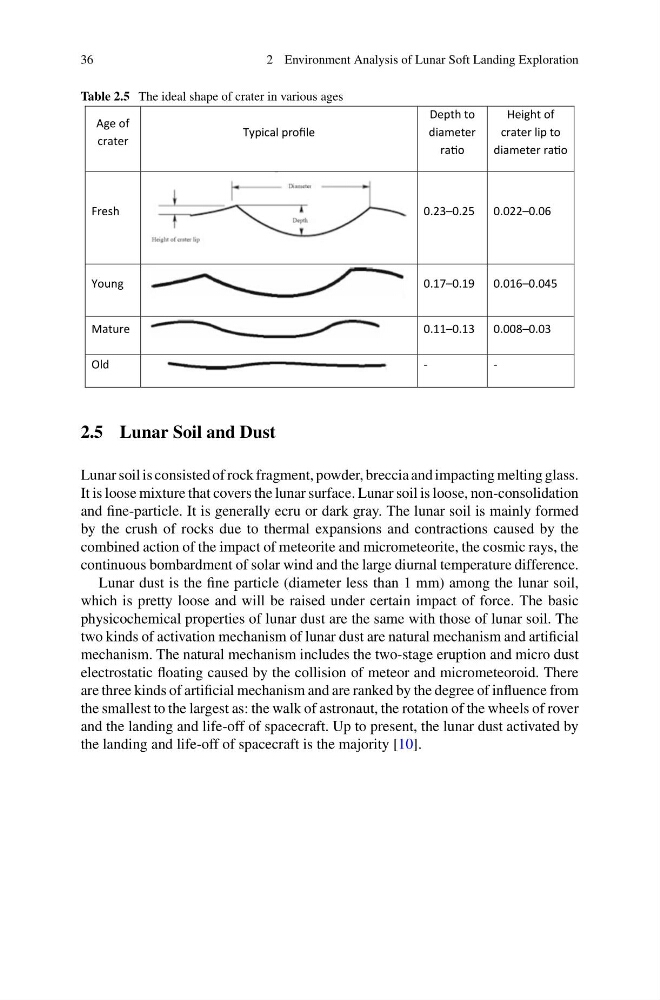
Table 2.5 The ideal shape of crater in various ages
Age of
crater
Typical profile
Depth to
diameter
raƟo
Height of
crater lip to
diameter raƟo
Fresh
0.23–0.25 0.022–0.06
Young
0.17–0.19 0.016–0.045
Mature
0.11–0.13 0.008–0.03
Old
-
-
2.5 Lunar Soil and Dust
Lunar soil is consisted of rock fragment, powder, breccia and impacting melting glass.
It is loose mixture that covers the lunar surface. Lunar soil is loose, non-consolidation
and fine-particle. It is generally ecru or dark gray. The lunar soil is mainly formed
by the crush of rocks due to thermal expansions and contractions caused by the
combined action of the impact of meteorite and micrometeorite, the cosmic rays, the
continuous bombardment of solar wind and the large diurnal temperature difference.
Lunar dust is the fine particle (diameter less than 1 mm) among the lunar soil,
which is pretty loose and will be raised under certain impact of force. The basic
physicochemical properties of lunar dust are the same with those of lunar soil. The
two kinds of activation mechanism of lunar dust are natural mechanism and artificial
mechanism. The natural mechanism includes the two-stage eruption and micro dust
electrostatic floating caused by the collision of meteor and micrometeoroid. There
are three kinds of artificial mechanism and are ranked by the degree of influence from
the smallest to the largest as: the walk of astronaut, the rotation of the wheels of rover
and the landing and life-off of spacecraft. Up to present, the lunar dust activated by
the landing and life-off of spacecraft is the majority [10].
2 Environment Analysis of Lunar Soft Landing Exploration
Table 2.5 The ideal shape of crater in various ages
Age of
crater
Typical profile
Depth to
diameter
raƟo
Height of
crater lip to
diameter raƟo
Fresh
0.23–0.25 0.022–0.06
Young
0.17–0.19 0.016–0.045
Mature
0.11–0.13 0.008–0.03
Old
-
-
2.5 Lunar Soil and Dust
Lunar soil is consisted of rock fragment, powder, breccia and impacting melting glass.
It is loose mixture that covers the lunar surface. Lunar soil is loose, non-consolidation
and fine-particle. It is generally ecru or dark gray. The lunar soil is mainly formed
by the crush of rocks due to thermal expansions and contractions caused by the
combined action of the impact of meteorite and micrometeorite, the cosmic rays, the
continuous bombardment of solar wind and the large diurnal temperature difference.
Lunar dust is the fine particle (diameter less than 1 mm) among the lunar soil,
which is pretty loose and will be raised under certain impact of force. The basic
physicochemical properties of lunar dust are the same with those of lunar soil. The
two kinds of activation mechanism of lunar dust are natural mechanism and artificial
mechanism. The natural mechanism includes the two-stage eruption and micro dust
electrostatic floating caused by the collision of meteor and micrometeoroid. There
are three kinds of artificial mechanism and are ranked by the degree of influence from
the smallest to the largest as: the walk of astronaut, the rotation of the wheels of rover
and the landing and life-off of spacecraft. Up to present, the lunar dust activated by
the landing and life-off of spacecraft is the majority [10].