

528
16 Scientific Instrument Technology of Lunar Lander
16.4 Design Principles
16.4.1 Scientific Instrument Configuration
According to the requirements for scientific objectives, current instrument technology, system resource constraints and target features, after proposal and deliberately analyzing, it was determined that there would be scientific instruments on
the lunar lander as follows. One descent camera was installed inside a module of the
lunar lander, which was applied for imaging of landing site during powered descent.
One morphology camera was installed on a mast for imaging surrounding lunar
surface in high resolution after landing. One lunar-based ultraviolet telescope (LUT)
was installed in a module of the lunar lander for optical observation of interested
area after landing. One extreme ultraviolet (EUV) camera was installed on the top
plate of the lunar lander for imaging of Earth plasmasphere. The scientific instrument
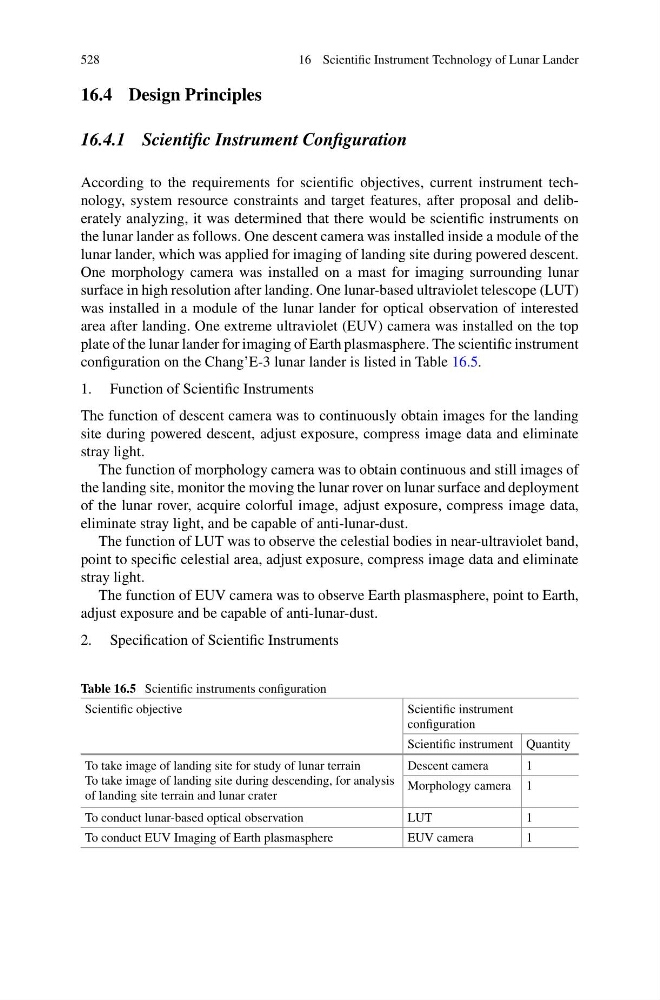
configuration on the Chang’E-3 lunar lander is listed in Table 16.5.
1. Function of Scientific Instruments
The function of descent camera was to continuously obtain images for the landing
site during powered descent, adjust exposure, compress image data and eliminate
stray light.
The function of morphology camera was to obtain continuous and still images of
the landing site, monitor the moving the lunar rover on lunar surface and deployment
of the lunar rover, acquire colorful image, adjust exposure, compress image data,
eliminate stray light, and be capable of anti-lunar-dust.
The function of LUT was to observe the celestial bodies in near-ultraviolet band,
point to specific celestial area, adjust exposure, compress image data and eliminate
stray light.
The function of EUV camera was to observe Earth plasmasphere, point to Earth,
adjust exposure and be capable of anti-lunar-dust.
2. Specification of Scientific Instruments
Table 16.5 Scientific instruments configuration
Scientific objective
Scientific instrument
configuration
Scientific instrument Quantity
To take image of landing site for study of lunar terrain
To take image of landing site during descending, for analysis
of landing site terrain and lunar crater
Descent camera
1
Morphology camera 1
To conduct lunar-based optical observation
LUT
1
To conduct EUV Imaging of Earth plasmasphere
EUV camera
1
16 Scientific Instrument Technology of Lunar Lander
16.4 Design Principles
16.4.1 Scientific Instrument Configuration
According to the requirements for scientific objectives, current instrument technology, system resource constraints and target features, after proposal and deliberately analyzing, it was determined that there would be scientific instruments on
the lunar lander as follows. One descent camera was installed inside a module of the
lunar lander, which was applied for imaging of landing site during powered descent.
One morphology camera was installed on a mast for imaging surrounding lunar
surface in high resolution after landing. One lunar-based ultraviolet telescope (LUT)
was installed in a module of the lunar lander for optical observation of interested
area after landing. One extreme ultraviolet (EUV) camera was installed on the top
plate of the lunar lander for imaging of Earth plasmasphere. The scientific instrument
configuration on the Chang’E-3 lunar lander is listed in Table 16.5.
1. Function of Scientific Instruments
The function of descent camera was to continuously obtain images for the landing
site during powered descent, adjust exposure, compress image data and eliminate
stray light.
The function of morphology camera was to obtain continuous and still images of
the landing site, monitor the moving the lunar rover on lunar surface and deployment
of the lunar rover, acquire colorful image, adjust exposure, compress image data,
eliminate stray light, and be capable of anti-lunar-dust.
The function of LUT was to observe the celestial bodies in near-ultraviolet band,
point to specific celestial area, adjust exposure, compress image data and eliminate
stray light.
The function of EUV camera was to observe Earth plasmasphere, point to Earth,
adjust exposure and be capable of anti-lunar-dust.
2. Specification of Scientific Instruments
Table 16.5 Scientific instruments configuration
Scientific objective
Scientific instrument
configuration
Scientific instrument Quantity
To take image of landing site for study of lunar terrain
To take image of landing site during descending, for analysis
of landing site terrain and lunar crater
Descent camera
1
Morphology camera 1
To conduct lunar-based optical observation
LUT
1
To conduct EUV Imaging of Earth plasmasphere
EUV camera
1