

522
16 Scientific Instrument Technology of Lunar Lander
Table 16.1 Scientific exploration tasks
Scientific objective
Task
Measurement parameter or
data
Survey on the morphology and
geological structure of the
landing area
To in situ take image of lunar
surface
To investigate lunar crater in
high resolution
Lunar surface image of
landing site
Environment exploration of
Earth- Moon space and
lunar-based optical astronomy
observation
To take extreme ultraviolet
image of Earth plasmasphere
To perform optical astronomy
observation on lunar surface
Extreme ultraviolet image of
Earth plasmasphere
Optical image of interested
celestial area
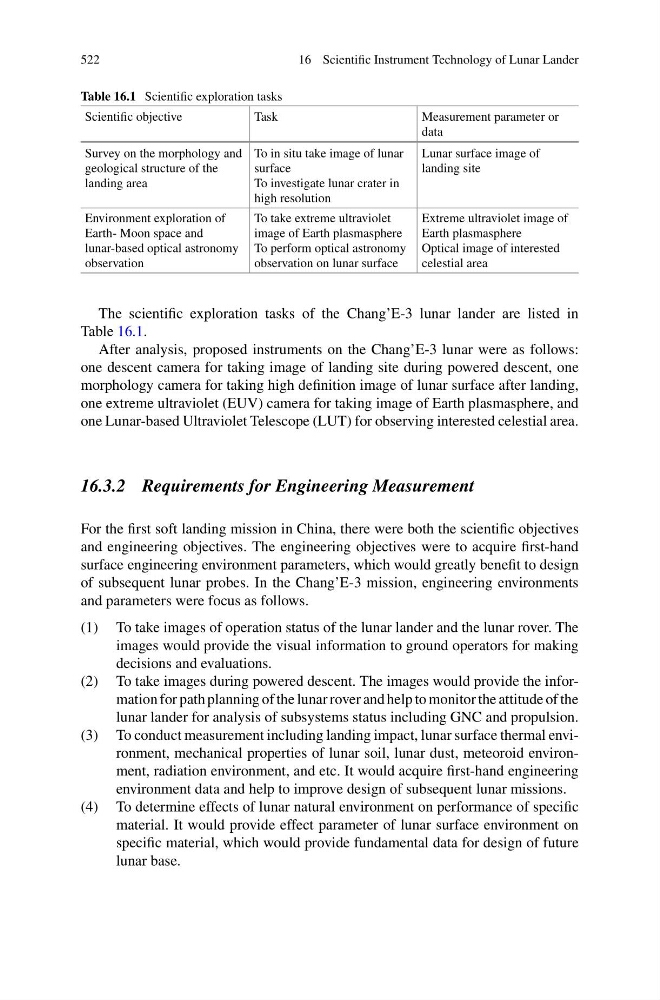
The scientific exploration tasks of the Chang’E-3 lunar lander are listed in
Table 16.1.
After analysis, proposed instruments on the Chang’E-3 lunar were as follows:
one descent camera for taking image of landing site during powered descent, one
morphology camera for taking high definition image of lunar surface after landing,
one extreme ultraviolet (EUV) camera for taking image of Earth plasmasphere, and
one Lunar-based Ultraviolet Telescope (LUT) for observing interested celestial area.
16.3.2 Requirements for Engineering Measurement
For the first soft landing mission in China, there were both the scientific objectives
and engineering objectives. The engineering objectives were to acquire first-hand
surface engineering environment parameters, which would greatly benefit to design
of subsequent lunar probes. In the Chang’E-3 mission, engineering environments
and parameters were focus as follows.
(1) To take images of operation status of the lunar lander and the lunar rover. The
images would provide the visual information to ground operators for making
decisions and evaluations.
(2) To take images during powered descent. The images would provide the information for path planning of the lunar rover and help to monitor the attitude of the
lunar lander for analysis of subsystems status including GNC and propulsion.
(3) To conduct measurement including landing impact, lunar surface thermal environment, mechanical properties of lunar soil, lunar dust, meteoroid environment, radiation environment, and etc. It would acquire first-hand engineering
environment data and help to improve design of subsequent lunar missions.
(4) To determine effects of lunar natural environment on performance of specific
material. It would provide effect parameter of lunar surface environment on
specific material, which would provide fundamental data for design of future
lunar base.
16 Scientific Instrument Technology of Lunar Lander
Table 16.1 Scientific exploration tasks
Scientific objective
Task
Measurement parameter or
data
Survey on the morphology and
geological structure of the
landing area
To in situ take image of lunar
surface
To investigate lunar crater in
high resolution
Lunar surface image of
landing site
Environment exploration of
Earth- Moon space and
lunar-based optical astronomy
observation
To take extreme ultraviolet
image of Earth plasmasphere
To perform optical astronomy
observation on lunar surface
Extreme ultraviolet image of
Earth plasmasphere
Optical image of interested
celestial area
The scientific exploration tasks of the Chang’E-3 lunar lander are listed in
Table 16.1.
After analysis, proposed instruments on the Chang’E-3 lunar were as follows:
one descent camera for taking image of landing site during powered descent, one
morphology camera for taking high definition image of lunar surface after landing,
one extreme ultraviolet (EUV) camera for taking image of Earth plasmasphere, and
one Lunar-based Ultraviolet Telescope (LUT) for observing interested celestial area.
16.3.2 Requirements for Engineering Measurement
For the first soft landing mission in China, there were both the scientific objectives
and engineering objectives. The engineering objectives were to acquire first-hand
surface engineering environment parameters, which would greatly benefit to design
of subsequent lunar probes. In the Chang’E-3 mission, engineering environments
and parameters were focus as follows.
(1) To take images of operation status of the lunar lander and the lunar rover. The
images would provide the visual information to ground operators for making
decisions and evaluations.
(2) To take images during powered descent. The images would provide the information for path planning of the lunar rover and help to monitor the attitude of the
lunar lander for analysis of subsystems status including GNC and propulsion.
(3) To conduct measurement including landing impact, lunar surface thermal environment, mechanical properties of lunar soil, lunar dust, meteoroid environment, radiation environment, and etc. It would acquire first-hand engineering
environment data and help to improve design of subsequent lunar missions.
(4) To determine effects of lunar natural environment on performance of specific
material. It would provide effect parameter of lunar surface environment on
specific material, which would provide fundamental data for design of future
lunar base.