

504
15 System Testing and Validation Technology of Lunar Lander
15.6.3 Design of Test System
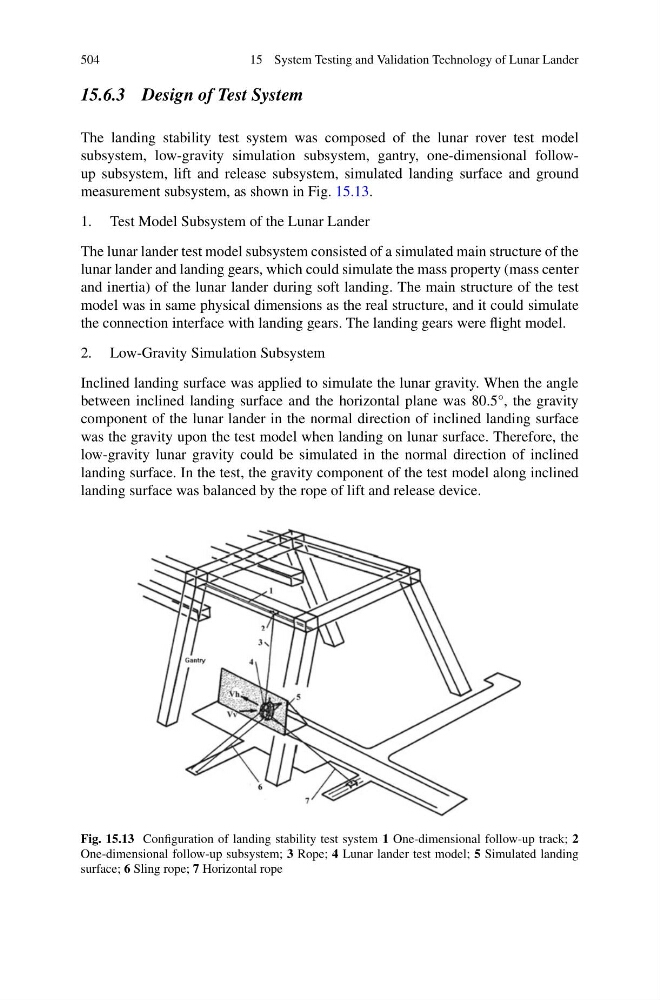
The landing stability test system was composed of the lunar rover test model
subsystem, low-gravity simulation subsystem, gantry, one-dimensional followup subsystem, lift and release subsystem, simulated landing surface and ground
measurement subsystem, as shown in Fig. 15.13.
1. Test Model Subsystem of the Lunar Lander
The lunar lander test model subsystem consisted of a simulated main structure of the
lunar lander and landing gears, which could simulate the mass property (mass center
and inertia) of the lunar lander during soft landing. The main structure of the test
model was in same physical dimensions as the real structure, and it could simulate
the connection interface with landing gears. The landing gears were flight model.
2. Low-Gravity Simulation Subsystem
Inclined landing surface was applied to simulate the lunar gravity. When the angle
between inclined landing surface and the horizontal plane was 80.5°, the gravity
component of the lunar lander in the normal direction of inclined landing surface
was the gravity upon the test model when landing on lunar surface. Therefore, the
low-gravity lunar gravity could be simulated in the normal direction of inclined
landing surface. In the test, the gravity component of the test model along inclined
landing surface was balanced by the rope of lift and release device.
Fig. 15.13 Configuration of landing stability test system 1 One-dimensional follow-up track; 2
One-dimensional follow-up subsystem; 3 Rope; 4 Lunar lander test model; 5 Simulated landing
surface; 6 Sling rope; 7 Horizontal rope
15 System Testing and Validation Technology of Lunar Lander
15.6.3 Design of Test System
The landing stability test system was composed of the lunar rover test model
subsystem, low-gravity simulation subsystem, gantry, one-dimensional followup subsystem, lift and release subsystem, simulated landing surface and ground
measurement subsystem, as shown in Fig. 15.13.
1. Test Model Subsystem of the Lunar Lander
The lunar lander test model subsystem consisted of a simulated main structure of the
lunar lander and landing gears, which could simulate the mass property (mass center
and inertia) of the lunar lander during soft landing. The main structure of the test
model was in same physical dimensions as the real structure, and it could simulate
the connection interface with landing gears. The landing gears were flight model.
2. Low-Gravity Simulation Subsystem
Inclined landing surface was applied to simulate the lunar gravity. When the angle
between inclined landing surface and the horizontal plane was 80.5°, the gravity
component of the lunar lander in the normal direction of inclined landing surface
was the gravity upon the test model when landing on lunar surface. Therefore, the
low-gravity lunar gravity could be simulated in the normal direction of inclined
landing surface. In the test, the gravity component of the test model along inclined
landing surface was balanced by the rope of lift and release device.
Fig. 15.13 Configuration of landing stability test system 1 One-dimensional follow-up track; 2
One-dimensional follow-up subsystem; 3 Rope; 4 Lunar lander test model; 5 Simulated landing
surface; 6 Sling rope; 7 Horizontal rope