

15.4 Hovering, Obstacle Avoidance and Slow Descent Tests
499
3. Simulation of Lunar Terrain and Reflection Characteristics of Lunar Surface
In order to simulate lunar terrain and reflection characteristics of lunar surface, the
simulated lunar surface system should be built. The material with similar reflectivity
as lunar surface could be painted on the test site, which could simulate lunar surface
reflection characteristics of laser and microwave so as to satisfy operation conditions
of GNC navigation sensors and implement ranging and velocity measurement in the
test.
4. Test Control
In the test, the lunar lander test model and the follow-up system of the test gantry
system were all controlled by ground control equipment. The respective ground
control equipment was managed and controlled by the main control center of the
test system. In the test, the main control center of the test system could collect the
data information generated by the lunar lander test model and the gantry system and
external measurement data by ground equipment, so that the test results could be
comprehensively analyzed.
15.4.4 Test Example
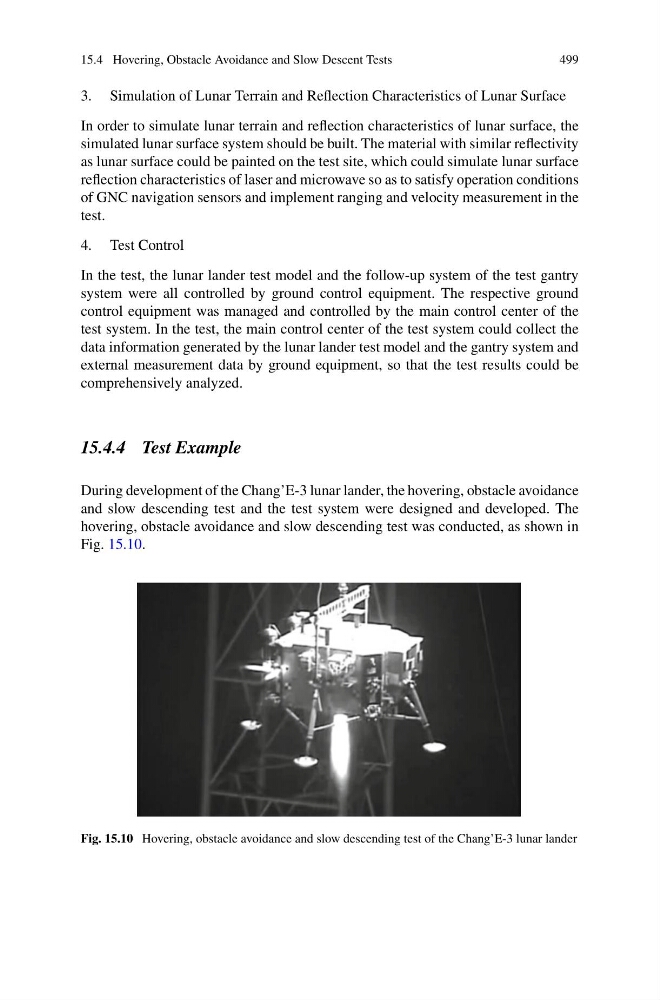
During development of the Chang’E-3 lunar lander, the hovering, obstacle avoidance
and slow descending test and the test system were designed and developed. The
hovering, obstacle avoidance and slow descending test was conducted, as shown in
Fig. 15.10.
Fig. 15.10 Hovering, obstacle avoidance and slow descending test of the Chang’E-3 lunar lander
499
3. Simulation of Lunar Terrain and Reflection Characteristics of Lunar Surface
In order to simulate lunar terrain and reflection characteristics of lunar surface, the
simulated lunar surface system should be built. The material with similar reflectivity
as lunar surface could be painted on the test site, which could simulate lunar surface
reflection characteristics of laser and microwave so as to satisfy operation conditions
of GNC navigation sensors and implement ranging and velocity measurement in the
test.
4. Test Control
In the test, the lunar lander test model and the follow-up system of the test gantry
system were all controlled by ground control equipment. The respective ground
control equipment was managed and controlled by the main control center of the
test system. In the test, the main control center of the test system could collect the
data information generated by the lunar lander test model and the gantry system and
external measurement data by ground equipment, so that the test results could be
comprehensively analyzed.
15.4.4 Test Example
During development of the Chang’E-3 lunar lander, the hovering, obstacle avoidance
and slow descending test and the test system were designed and developed. The
hovering, obstacle avoidance and slow descending test was conducted, as shown in
Fig. 15.10.
Fig. 15.10 Hovering, obstacle avoidance and slow descending test of the Chang’E-3 lunar lander