

13.4 Application of Special Measurement Technology
459
For the lunar lander to be landed on lunar surface, a great many propellant
was necessary to be load. When the launch mass was certain, application of integrated mass center parameter correction technology by propellant and ballast was an
effective approach to increase the load of propellant as far as possible.
At the same time, the 4 parallel propellant tanks of the lunar lander were distributed
horizontally, which was different from other spacecraft. Therefore, it was possible
to apply the integrated mass center parameter correction technology by propellant
and ballast.
2. Technical Design and Principle
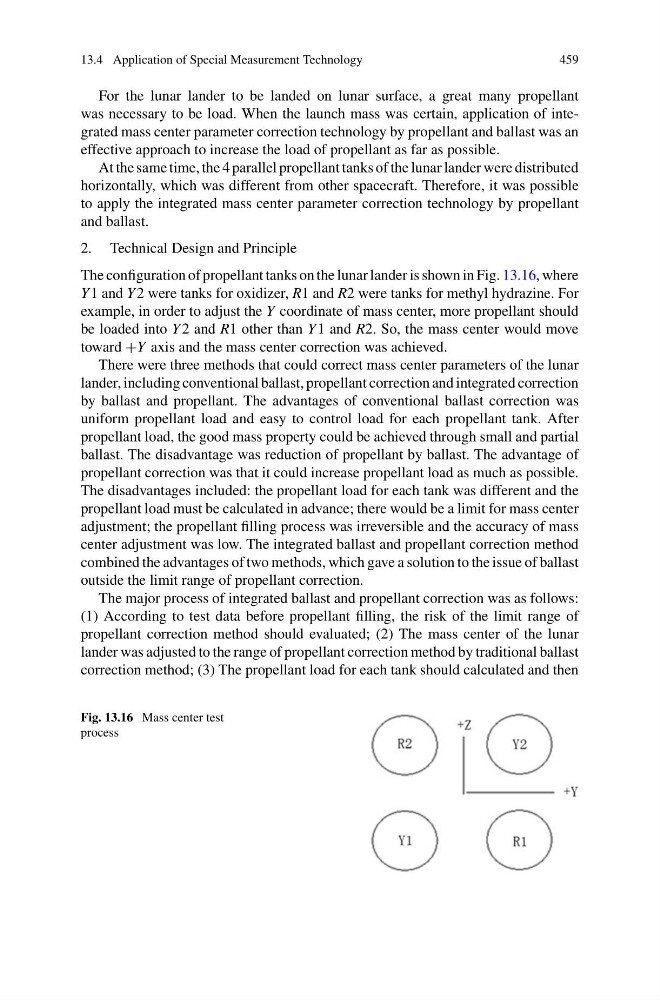
The configuration of propellant tanks on the lunar lander is shown in Fig. 13.16, where
Y 1 and Y 2 were tanks for oxidizer, R1 and R2 were tanks for methyl hydrazine. For
example, in order to adjust the Y coordinate of mass center, more propellant should
be loaded into Y 2 and R1 other than Y 1 and R2. So, the mass center would move
toward +Y axis and the mass center correction was achieved.
There were three methods that could correct mass center parameters of the lunar
lander, including conventional ballast, propellant correction and integrated correction
by ballast and propellant. The advantages of conventional ballast correction was
uniform propellant load and easy to control load for each propellant tank. After
propellant load, the good mass property could be achieved through small and partial
ballast. The disadvantage was reduction of propellant by ballast. The advantage of
propellant correction was that it could increase propellant load as much as possible.
The disadvantages included: the propellant load for each tank was different and the
propellant load must be calculated in advance; there would be a limit for mass center
adjustment; the propellant filling process was irreversible and the accuracy of mass
center adjustment was low. The integrated ballast and propellant correction method
combined the advantages of two methods, which gave a solution to the issue of ballast
outside the limit range of propellant correction.
The major process of integrated ballast and propellant correction was as follows:
(1) According to test data before propellant filling, the risk of the limit range of
propellant correction method should evaluated; (2) The mass center of the lunar
lander was adjusted to the range of propellant correction method by traditional ballast
correction method; (3) The propellant load for each tank should calculated and then
Fig. 13.16 Mass center test
process
459
For the lunar lander to be landed on lunar surface, a great many propellant
was necessary to be load. When the launch mass was certain, application of integrated mass center parameter correction technology by propellant and ballast was an
effective approach to increase the load of propellant as far as possible.
At the same time, the 4 parallel propellant tanks of the lunar lander were distributed
horizontally, which was different from other spacecraft. Therefore, it was possible
to apply the integrated mass center parameter correction technology by propellant
and ballast.
2. Technical Design and Principle
The configuration of propellant tanks on the lunar lander is shown in Fig. 13.16, where
Y 1 and Y 2 were tanks for oxidizer, R1 and R2 were tanks for methyl hydrazine. For
example, in order to adjust the Y coordinate of mass center, more propellant should
be loaded into Y 2 and R1 other than Y 1 and R2. So, the mass center would move
toward +Y axis and the mass center correction was achieved.
There were three methods that could correct mass center parameters of the lunar
lander, including conventional ballast, propellant correction and integrated correction
by ballast and propellant. The advantages of conventional ballast correction was
uniform propellant load and easy to control load for each propellant tank. After
propellant load, the good mass property could be achieved through small and partial
ballast. The disadvantage was reduction of propellant by ballast. The advantage of
propellant correction was that it could increase propellant load as much as possible.
The disadvantages included: the propellant load for each tank was different and the
propellant load must be calculated in advance; there would be a limit for mass center
adjustment; the propellant filling process was irreversible and the accuracy of mass
center adjustment was low. The integrated ballast and propellant correction method
combined the advantages of two methods, which gave a solution to the issue of ballast
outside the limit range of propellant correction.
The major process of integrated ballast and propellant correction was as follows:
(1) According to test data before propellant filling, the risk of the limit range of
propellant correction method should evaluated; (2) The mass center of the lunar
lander was adjusted to the range of propellant correction method by traditional ballast
correction method; (3) The propellant load for each tank should calculated and then
Fig. 13.16 Mass center test
process