

458
13 Metrology Technology of Lunar Lander
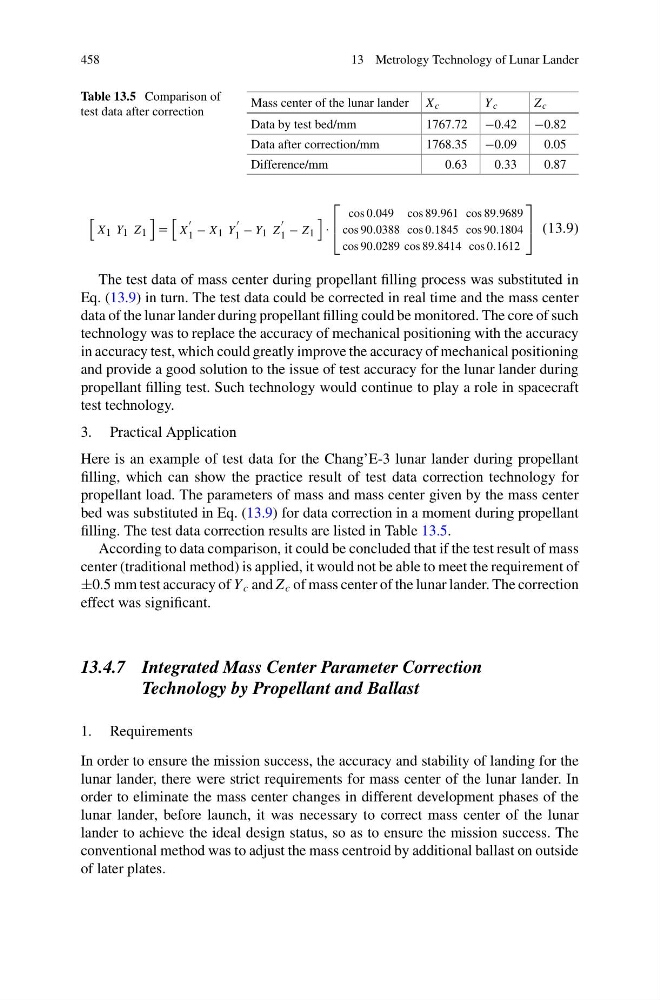
Table 13.5 Comparison of
test data after correction
Mass center of the lunar lander X c
Y c
Z c
Data by test bed/mm
1767.72 −0.42 −0.82
Data after correction/mm
1768.35 −0.09
0.05
Difference/mm
0.63
0.33
0.87
X 1 Y 1 Z 1
=
X
1 − X 1 Y
1 − Y 1 Z
1 − Z 1
·
⎡
⎢
⎣
cos 0.049 cos 89.961 cos 89.9689
cos 90.0388 cos 0.1845 cos 90.1804
cos 90.0289 cos 89.8414 cos 0.1612
⎤
⎥
⎦ (13.9)
The test data of mass center during propellant filling process was substituted in
Eq. (13.9) in turn. The test data could be corrected in real time and the mass center
data of the lunar lander during propellant filling could be monitored. The core of such
technology was to replace the accuracy of mechanical positioning with the accuracy
in accuracy test, which could greatly improve the accuracy of mechanical positioning
and provide a good solution to the issue of test accuracy for the lunar lander during
propellant filling test. Such technology would continue to play a role in spacecraft
test technology.
3. Practical Application
Here is an example of test data for the Chang’E-3 lunar lander during propellant
filling, which can show the practice result of test data correction technology for
propellant load. The parameters of mass and mass center given by the mass center
bed was substituted in Eq. (13.9) for data correction in a moment during propellant
filling. The test data correction results are listed in Table 13.5.
According to data comparison, it could be concluded that if the test result of mass
center (traditional method) is applied, it would not be able to meet the requirement of
±0.5 mm test accuracy of Y c and Z c of mass center of the lunar lander. The correction
effect was significant.
13.4.7 Integrated Mass Center Parameter Correction
Technology by Propellant and Ballast
1. Requirements
In order to ensure the mission success, the accuracy and stability of landing for the
lunar lander, there were strict requirements for mass center of the lunar lander. In
order to eliminate the mass center changes in different development phases of the
lunar lander, before launch, it was necessary to correct mass center of the lunar
lander to achieve the ideal design status, so as to ensure the mission success. The
conventional method was to adjust the mass centroid by additional ballast on outside
of later plates.
13 Metrology Technology of Lunar Lander
Table 13.5 Comparison of
test data after correction
Mass center of the lunar lander X c
Y c
Z c
Data by test bed/mm
1767.72 −0.42 −0.82
Data after correction/mm
1768.35 −0.09
0.05
Difference/mm
0.63
0.33
0.87
X 1 Y 1 Z 1
=
X
1 − X 1 Y
1 − Y 1 Z
1 − Z 1
·
⎡
⎢
⎣
cos 0.049 cos 89.961 cos 89.9689
cos 90.0388 cos 0.1845 cos 90.1804
cos 90.0289 cos 89.8414 cos 0.1612
⎤
⎥
⎦ (13.9)
The test data of mass center during propellant filling process was substituted in
Eq. (13.9) in turn. The test data could be corrected in real time and the mass center
data of the lunar lander during propellant filling could be monitored. The core of such
technology was to replace the accuracy of mechanical positioning with the accuracy
in accuracy test, which could greatly improve the accuracy of mechanical positioning
and provide a good solution to the issue of test accuracy for the lunar lander during
propellant filling test. Such technology would continue to play a role in spacecraft
test technology.
3. Practical Application
Here is an example of test data for the Chang’E-3 lunar lander during propellant
filling, which can show the practice result of test data correction technology for
propellant load. The parameters of mass and mass center given by the mass center
bed was substituted in Eq. (13.9) for data correction in a moment during propellant
filling. The test data correction results are listed in Table 13.5.
According to data comparison, it could be concluded that if the test result of mass
center (traditional method) is applied, it would not be able to meet the requirement of
±0.5 mm test accuracy of Y c and Z c of mass center of the lunar lander. The correction
effect was significant.
13.4.7 Integrated Mass Center Parameter Correction
Technology by Propellant and Ballast
1. Requirements
In order to ensure the mission success, the accuracy and stability of landing for the
lunar lander, there were strict requirements for mass center of the lunar lander. In
order to eliminate the mass center changes in different development phases of the
lunar lander, before launch, it was necessary to correct mass center of the lunar
lander to achieve the ideal design status, so as to ensure the mission success. The
conventional method was to adjust the mass centroid by additional ballast on outside
of later plates.