

12.5 Typical Application of System Integration and Assembly
425
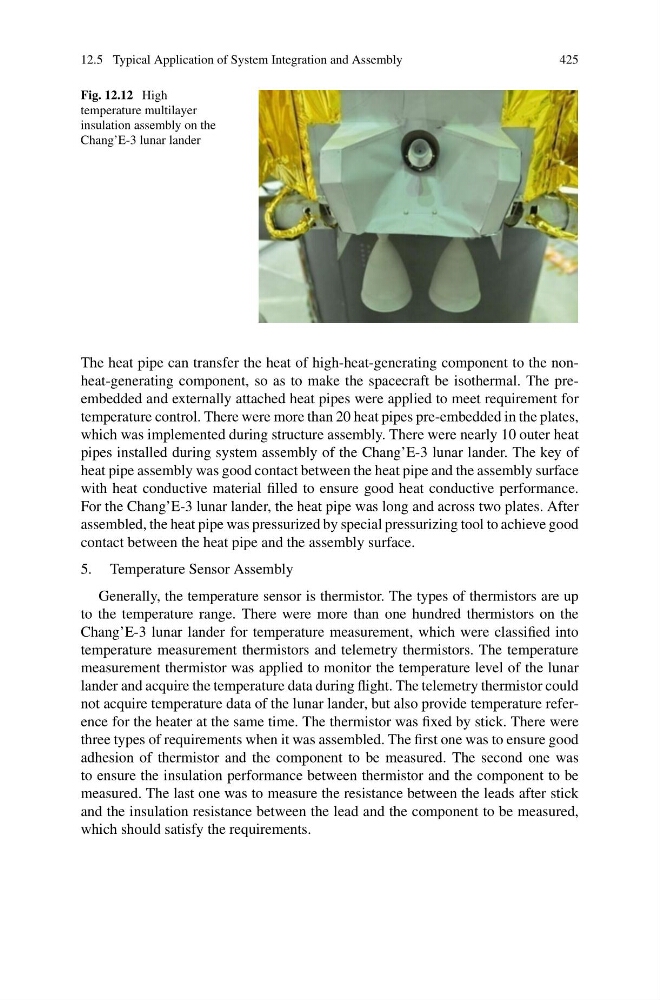
Fig. 12.12 High
temperature multilayer
insulation assembly on the
Chang’E-3 lunar lander
The heat pipe can transfer the heat of high-heat-generating component to the nonheat-generating component, so as to make the spacecraft be isothermal. The preembedded and externally attached heat pipes were applied to meet requirement for
temperature control. There were more than 20 heat pipes pre-embedded in the plates,
which was implemented during structure assembly. There were nearly 10 outer heat
pipes installed during system assembly of the Chang’E-3 lunar lander. The key of
heat pipe assembly was good contact between the heat pipe and the assembly surface
with heat conductive material filled to ensure good heat conductive performance.
For the Chang’E-3 lunar lander, the heat pipe was long and across two plates. After
assembled, the heat pipe was pressurized by special pressurizing tool to achieve good
contact between the heat pipe and the assembly surface.
5. Temperature Sensor Assembly
Generally, the temperature sensor is thermistor. The types of thermistors are up
to the temperature range. There were more than one hundred thermistors on the
Chang’E-3 lunar lander for temperature measurement, which were classified into
temperature measurement thermistors and telemetry thermistors. The temperature
measurement thermistor was applied to monitor the temperature level of the lunar
lander and acquire the temperature data during flight. The telemetry thermistor could
not acquire temperature data of the lunar lander, but also provide temperature reference for the heater at the same time. The thermistor was fixed by stick. There were
three types of requirements when it was assembled. The first one was to ensure good
adhesion of thermistor and the component to be measured. The second one was
to ensure the insulation performance between thermistor and the component to be
measured. The last one was to measure the resistance between the leads after stick
and the insulation resistance between the lead and the component to be measured,
which should satisfy the requirements.
425
Fig. 12.12 High
temperature multilayer
insulation assembly on the
Chang’E-3 lunar lander
The heat pipe can transfer the heat of high-heat-generating component to the nonheat-generating component, so as to make the spacecraft be isothermal. The preembedded and externally attached heat pipes were applied to meet requirement for
temperature control. There were more than 20 heat pipes pre-embedded in the plates,
which was implemented during structure assembly. There were nearly 10 outer heat
pipes installed during system assembly of the Chang’E-3 lunar lander. The key of
heat pipe assembly was good contact between the heat pipe and the assembly surface
with heat conductive material filled to ensure good heat conductive performance.
For the Chang’E-3 lunar lander, the heat pipe was long and across two plates. After
assembled, the heat pipe was pressurized by special pressurizing tool to achieve good
contact between the heat pipe and the assembly surface.
5. Temperature Sensor Assembly
Generally, the temperature sensor is thermistor. The types of thermistors are up
to the temperature range. There were more than one hundred thermistors on the
Chang’E-3 lunar lander for temperature measurement, which were classified into
temperature measurement thermistors and telemetry thermistors. The temperature
measurement thermistor was applied to monitor the temperature level of the lunar
lander and acquire the temperature data during flight. The telemetry thermistor could
not acquire temperature data of the lunar lander, but also provide temperature reference for the heater at the same time. The thermistor was fixed by stick. There were
three types of requirements when it was assembled. The first one was to ensure good
adhesion of thermistor and the component to be measured. The second one was
to ensure the insulation performance between thermistor and the component to be
measured. The last one was to measure the resistance between the leads after stick
and the insulation resistance between the lead and the component to be measured,
which should satisfy the requirements.