

398
11 Landing Gear Technology of Lunar Lander
11.6.5 Simulation Verification of Combined Cushion
Performance for Landing Gear Subsystem
The simulation test was conducted to verify combined cushion performance of
landing gear subsystem by four set of landing gear mechanism on a simulated structure of the lunar lander. Because the test system was complex and the test is long
term and highly costly, only a few tests for typical conditions were conducted.
Generally, the simulation test of combined cushion performance of landing gear
subsystem was conducted in Earth gravity with equivalent method. The principle of
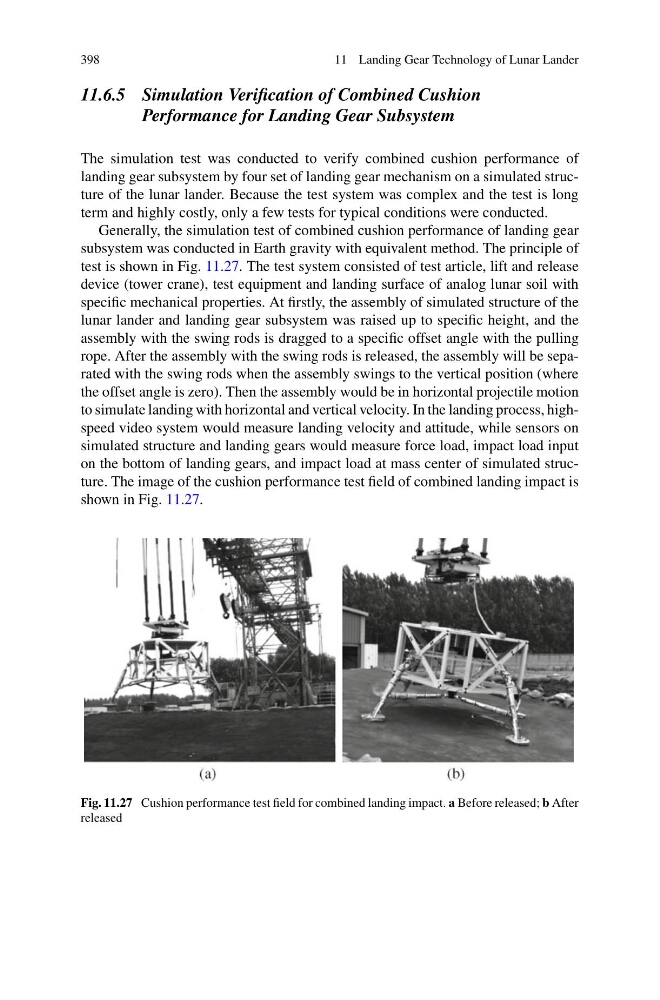
test is shown in Fig. 11.27. The test system consisted of test article, lift and release
device (tower crane), test equipment and landing surface of analog lunar soil with
specific mechanical properties. At firstly, the assembly of simulated structure of the
lunar lander and landing gear subsystem was raised up to specific height, and the
assembly with the swing rods is dragged to a specific offset angle with the pulling
rope. After the assembly with the swing rods is released, the assembly will be separated with the swing rods when the assembly swings to the vertical position (where
the offset angle is zero). Then the assembly would be in horizontal projectile motion
to simulate landing with horizontal and vertical velocity. In the landing process, highspeed video system would measure landing velocity and attitude, while sensors on
simulated structure and landing gears would measure force load, impact load input
on the bottom of landing gears, and impact load at mass center of simulated structure. The image of the cushion performance test field of combined landing impact is
shown in Fig. 11.27.
Fig. 11.27 Cushion performance test field for combined landing impact. a Before released; b After
released
11 Landing Gear Technology of Lunar Lander
11.6.5 Simulation Verification of Combined Cushion
Performance for Landing Gear Subsystem
The simulation test was conducted to verify combined cushion performance of
landing gear subsystem by four set of landing gear mechanism on a simulated structure of the lunar lander. Because the test system was complex and the test is long
term and highly costly, only a few tests for typical conditions were conducted.
Generally, the simulation test of combined cushion performance of landing gear
subsystem was conducted in Earth gravity with equivalent method. The principle of
test is shown in Fig. 11.27. The test system consisted of test article, lift and release
device (tower crane), test equipment and landing surface of analog lunar soil with
specific mechanical properties. At firstly, the assembly of simulated structure of the
lunar lander and landing gear subsystem was raised up to specific height, and the
assembly with the swing rods is dragged to a specific offset angle with the pulling
rope. After the assembly with the swing rods is released, the assembly will be separated with the swing rods when the assembly swings to the vertical position (where
the offset angle is zero). Then the assembly would be in horizontal projectile motion
to simulate landing with horizontal and vertical velocity. In the landing process, highspeed video system would measure landing velocity and attitude, while sensors on
simulated structure and landing gears would measure force load, impact load input
on the bottom of landing gears, and impact load at mass center of simulated structure. The image of the cushion performance test field of combined landing impact is
shown in Fig. 11.27.
Fig. 11.27 Cushion performance test field for combined landing impact. a Before released; b After
released