

392
11 Landing Gear Technology of Lunar Lander
to specific height and release to get expected impact input. Accelerometers attached
to the ballast could acquire the impact response after cushion and record the curve
of acceleration versus time, and then the cushion load could be calculated.
11.6.2 Friction Test of Deployment and Cushion
Friction between joint surfaces would affect on deployment process and cushion
performances. Therefore, friction test of joint surfaces played an important role in
design and performance evaluation of landing gear mechanism.
1. Deployment Friction Test
The objective of deployment friction test was to acquire friction of joint surfaces
related to deployment, so as to evaluate the static torque margin of deployment [11].
For example, when the landing gear mechanism in Sect. 11.5.2 was deployed, the
deployment spring in one of the two secondary struts, i.e. the multi-function strut,
pushed out the inner tube to bring forward primary strut and the other secondary
strut to specific deployed position. Friction on this process included friction during
stretching out of the multi-function secondary strut, and friction of all joints. It was
very difficult to acquire precise friction data at assembly level because the deployment
of landing gear mechanism was spatial movement. Therefore, the test should be
conducted in several steps.
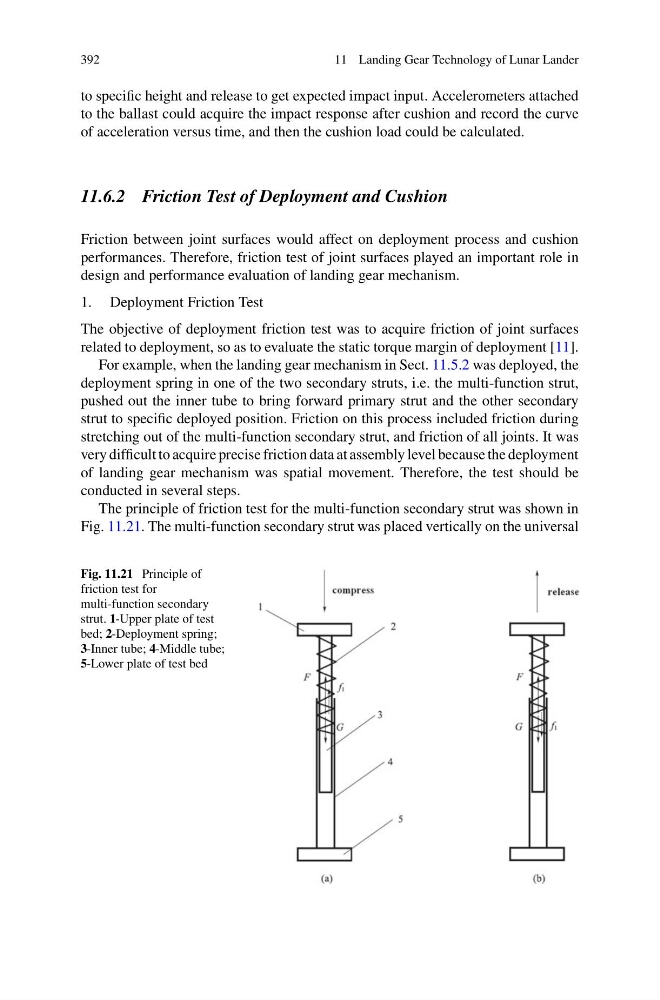
The principle of friction test for the multi-function secondary strut was shown in
Fig. 11.21. The multi-function secondary strut was placed vertically on the universal
Fig. 11.21 Principle of
friction test for
multi-function secondary
strut. 1-Upper plate of test
bed; 2-Deployment spring;
3-Inner tube; 4-Middle tube;
5-Lower plate of test bed
11 Landing Gear Technology of Lunar Lander
to specific height and release to get expected impact input. Accelerometers attached
to the ballast could acquire the impact response after cushion and record the curve
of acceleration versus time, and then the cushion load could be calculated.
11.6.2 Friction Test of Deployment and Cushion
Friction between joint surfaces would affect on deployment process and cushion
performances. Therefore, friction test of joint surfaces played an important role in
design and performance evaluation of landing gear mechanism.
1. Deployment Friction Test
The objective of deployment friction test was to acquire friction of joint surfaces
related to deployment, so as to evaluate the static torque margin of deployment [11].
For example, when the landing gear mechanism in Sect. 11.5.2 was deployed, the
deployment spring in one of the two secondary struts, i.e. the multi-function strut,
pushed out the inner tube to bring forward primary strut and the other secondary
strut to specific deployed position. Friction on this process included friction during
stretching out of the multi-function secondary strut, and friction of all joints. It was
very difficult to acquire precise friction data at assembly level because the deployment
of landing gear mechanism was spatial movement. Therefore, the test should be
conducted in several steps.
The principle of friction test for the multi-function secondary strut was shown in
Fig. 11.21. The multi-function secondary strut was placed vertically on the universal
Fig. 11.21 Principle of
friction test for
multi-function secondary
strut. 1-Upper plate of test
bed; 2-Deployment spring;
3-Inner tube; 4-Middle tube;
5-Lower plate of test bed