

14
1 Introduction
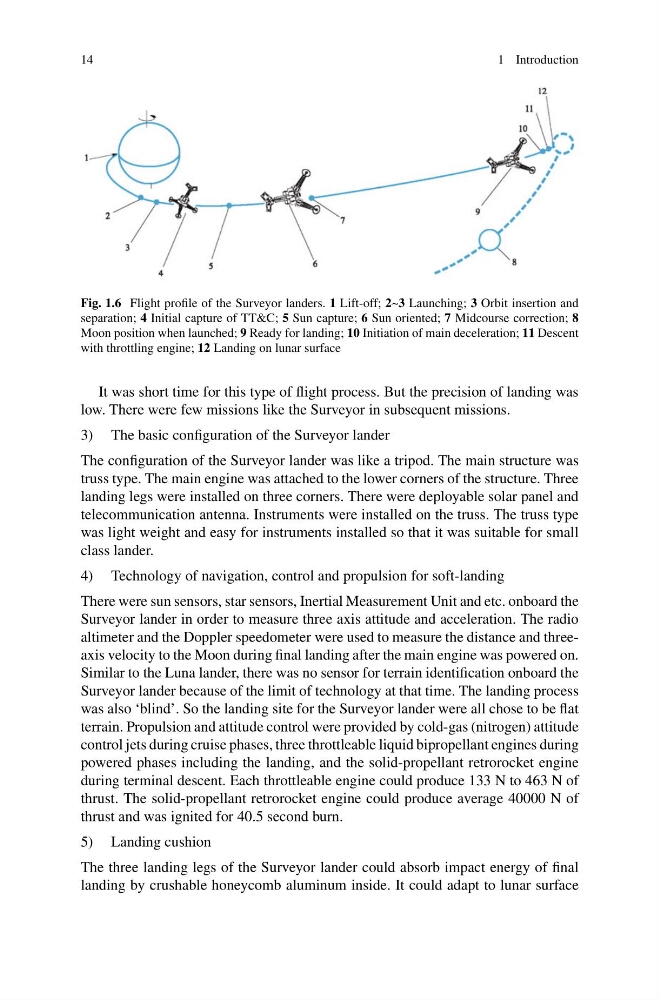
Fig. 1.6 Flight profile of the Surveyor landers. 1 Lift-off; 2~3 Launching; 3 Orbit insertion and
separation; 4 Initial capture of TT&C; 5 Sun capture; 6 Sun oriented; 7 Midcourse correction; 8
Moon position when launched; 9 Ready for landing; 10 Initiation of main deceleration; 11 Descent
with throttling engine; 12 Landing on lunar surface
It was short time for this type of flight process. But the precision of landing was
low. There were few missions like the Surveyor in subsequent missions.
3) The basic configuration of the Surveyor lander
The configuration of the Surveyor lander was like a tripod. The main structure was
truss type. The main engine was attached to the lower corners of the structure. Three
landing legs were installed on three corners. There were deployable solar panel and
telecommunication antenna. Instruments were installed on the truss. The truss type
was light weight and easy for instruments installed so that it was suitable for small
class lander.
4) Technology of navigation, control and propulsion for soft-landing
There were sun sensors, star sensors, Inertial Measurement Unit and etc. onboard the
Surveyor lander in order to measure three axis attitude and acceleration. The radio
altimeter and the Doppler speedometer were used to measure the distance and threeaxis velocity to the Moon during final landing after the main engine was powered on.
Similar to the Luna lander, there was no sensor for terrain identification onboard the
Surveyor lander because of the limit of technology at that time. The landing process
was also ‘blind’. So the landing site for the Surveyor lander were all chose to be flat
terrain. Propulsion and attitude control were provided by cold-gas (nitrogen) attitude
control jets during cruise phases, three throttleable liquid bipropellant engines during
powered phases including the landing, and the solid-propellant retrorocket engine
during terminal descent. Each throttleable engine could produce 133 N to 463 N of
thrust. The solid-propellant retrorocket engine could produce average 40000 N of
thrust and was ignited for 40.5 second burn.
5) Landing cushion
The three landing legs of the Surveyor lander could absorb impact energy of final
landing by crushable honeycomb aluminum inside. It could adapt to lunar surface
1 Introduction
Fig. 1.6 Flight profile of the Surveyor landers. 1 Lift-off; 2~3 Launching; 3 Orbit insertion and
separation; 4 Initial capture of TT&C; 5 Sun capture; 6 Sun oriented; 7 Midcourse correction; 8
Moon position when launched; 9 Ready for landing; 10 Initiation of main deceleration; 11 Descent
with throttling engine; 12 Landing on lunar surface
It was short time for this type of flight process. But the precision of landing was
low. There were few missions like the Surveyor in subsequent missions.
3) The basic configuration of the Surveyor lander
The configuration of the Surveyor lander was like a tripod. The main structure was
truss type. The main engine was attached to the lower corners of the structure. Three
landing legs were installed on three corners. There were deployable solar panel and
telecommunication antenna. Instruments were installed on the truss. The truss type
was light weight and easy for instruments installed so that it was suitable for small
class lander.
4) Technology of navigation, control and propulsion for soft-landing
There were sun sensors, star sensors, Inertial Measurement Unit and etc. onboard the
Surveyor lander in order to measure three axis attitude and acceleration. The radio
altimeter and the Doppler speedometer were used to measure the distance and threeaxis velocity to the Moon during final landing after the main engine was powered on.
Similar to the Luna lander, there was no sensor for terrain identification onboard the
Surveyor lander because of the limit of technology at that time. The landing process
was also ‘blind’. So the landing site for the Surveyor lander were all chose to be flat
terrain. Propulsion and attitude control were provided by cold-gas (nitrogen) attitude
control jets during cruise phases, three throttleable liquid bipropellant engines during
powered phases including the landing, and the solid-propellant retrorocket engine
during terminal descent. Each throttleable engine could produce 133 N to 463 N of
thrust. The solid-propellant retrorocket engine could produce average 40000 N of
thrust and was ignited for 40.5 second burn.
5) Landing cushion
The three landing legs of the Surveyor lander could absorb impact energy of final
landing by crushable honeycomb aluminum inside. It could adapt to lunar surface