

11.2 Development Status
369
was landed on Mars surface with the sky crane, which was a brand-new method of
soft-landing. Recently along with the booming development of space exploration,
deep space exploration became the focus of all space countries and organizations.
Landing missions to the Moon, Mars and asteroids are implemented or planed by
the United States, Russia, European Space Agency (ESA), Japan and India.
Development of landing cushion technology was initiated relatively lately in
China. As CLEP was implemented, research and development of landing cushion
technology was conducted by many academies and universities in China. Since
the 1990s, the seat cushion mechanism for astronaut was studied and applied in
ShenZhou series manned spacecraft. On the basis, the landing gear system for the
Chang’E-3 lunar lander was developed successfully. During past years, technologies
were developed including several cushion methods, design and analysis of landing
cushion mechanism, ground tests and evaluation technology. Above research and
development provides solid basis for engineering implementation of landing cushion
technology for spacecraft in China.
11.3 Configuration and Technical Features of Landing
Gear System
Generally, there are more than one set of landing gears in the lunar lander to absorb
landing impact. The landing gears were symmetrically installed on the bottom of the
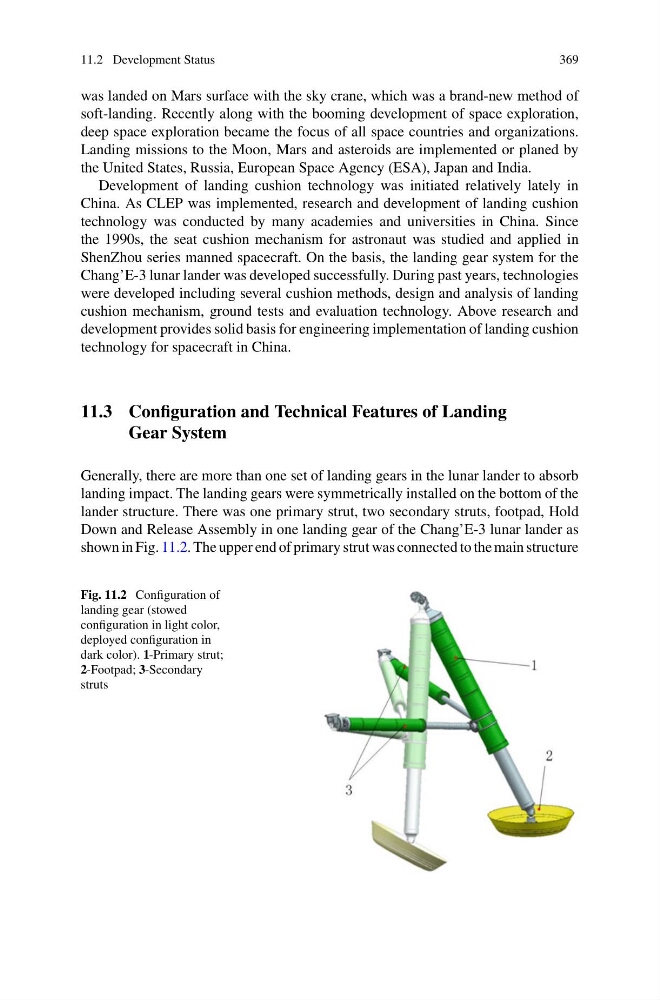
lander structure. There was one primary strut, two secondary struts, footpad, Hold
Down and Release Assembly in one landing gear of the Chang’E-3 lunar lander as
shown in Fig. 11.2. The upper end of primary strut was connected to the main structure
Fig. 11.2 Configuration of
landing gear (stowed
configuration in light color,
deployed configuration in
dark color). 1-Primary strut;
2-Footpad; 3-Secondary
struts
369
was landed on Mars surface with the sky crane, which was a brand-new method of
soft-landing. Recently along with the booming development of space exploration,
deep space exploration became the focus of all space countries and organizations.
Landing missions to the Moon, Mars and asteroids are implemented or planed by
the United States, Russia, European Space Agency (ESA), Japan and India.
Development of landing cushion technology was initiated relatively lately in
China. As CLEP was implemented, research and development of landing cushion
technology was conducted by many academies and universities in China. Since
the 1990s, the seat cushion mechanism for astronaut was studied and applied in
ShenZhou series manned spacecraft. On the basis, the landing gear system for the
Chang’E-3 lunar lander was developed successfully. During past years, technologies
were developed including several cushion methods, design and analysis of landing
cushion mechanism, ground tests and evaluation technology. Above research and
development provides solid basis for engineering implementation of landing cushion
technology for spacecraft in China.
11.3 Configuration and Technical Features of Landing
Gear System
Generally, there are more than one set of landing gears in the lunar lander to absorb
landing impact. The landing gears were symmetrically installed on the bottom of the
lander structure. There was one primary strut, two secondary struts, footpad, Hold
Down and Release Assembly in one landing gear of the Chang’E-3 lunar lander as
shown in Fig. 11.2. The upper end of primary strut was connected to the main structure
Fig. 11.2 Configuration of
landing gear (stowed
configuration in light color,
deployed configuration in
dark color). 1-Primary strut;
2-Footpad; 3-Secondary
struts