

350
10 TT&C and Telecommunication Technology …
and spacecraft instruments of telemetry/telecommand and telecommunication, the
power amplifier should be higher in output power, efficiency, reliability and linearity
in wider frequency band. In recent years, the development and progress of solid
state power amplifier (SSPA) were prompted. Remarkable progress had been made
in microwave power devices, power amplifier design, microwave circuit design and
process.
SSPA had many advantages, such as small size, low operation voltage, good
stability, high reliability, long life and good repeatability. It was widely used in the
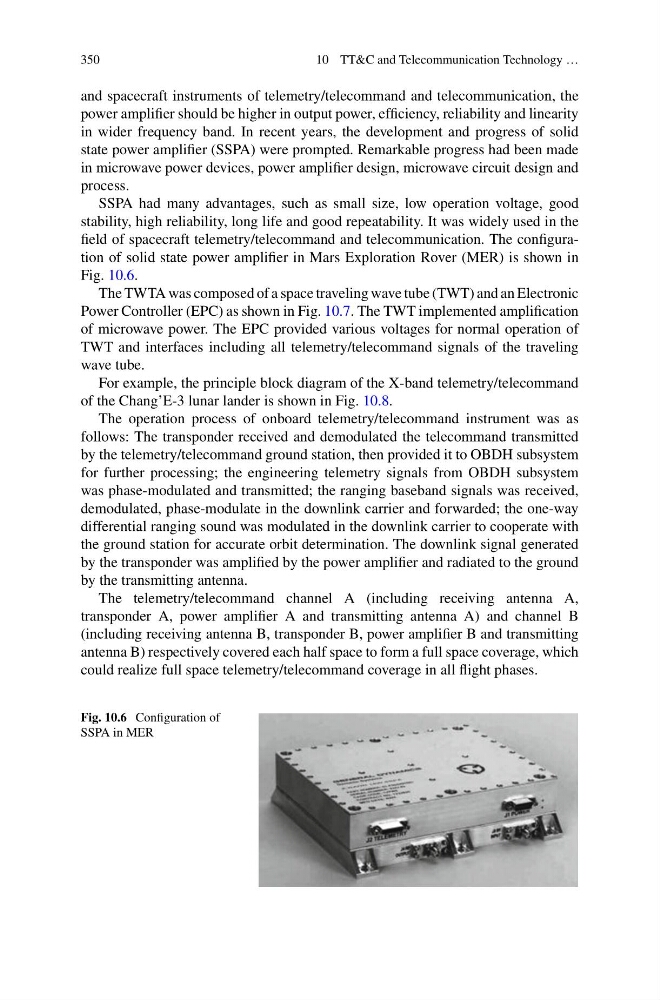
field of spacecraft telemetry/telecommand and telecommunication. The configuration of solid state power amplifier in Mars Exploration Rover (MER) is shown in
Fig. 10.6.
The TWTA was composed of a space traveling wave tube (TWT) and an Electronic
Power Controller (EPC) as shown in Fig. 10.7. The TWT implemented amplification
of microwave power. The EPC provided various voltages for normal operation of
TWT and interfaces including all telemetry/telecommand signals of the traveling
wave tube.
For example, the principle block diagram of the X-band telemetry/telecommand
of the Chang’E-3 lunar lander is shown in Fig. 10.8.
The operation process of onboard telemetry/telecommand instrument was as
follows: The transponder received and demodulated the telecommand transmitted
by the telemetry/telecommand ground station, then provided it to OBDH subsystem
for further processing; the engineering telemetry signals from OBDH subsystem
was phase-modulated and transmitted; the ranging baseband signals was received,
demodulated, phase-modulate in the downlink carrier and forwarded; the one-way
differential ranging sound was modulated in the downlink carrier to cooperate with
the ground station for accurate orbit determination. The downlink signal generated
by the transponder was amplified by the power amplifier and radiated to the ground
by the transmitting antenna.
The telemetry/telecommand channel A (including receiving antenna A,
transponder A, power amplifier A and transmitting antenna A) and channel B
(including receiving antenna B, transponder B, power amplifier B and transmitting
antenna B) respectively covered each half space to form a full space coverage, which
could realize full space telemetry/telecommand coverage in all flight phases.
Fig. 10.6 Configuration of
SSPA in MER
10 TT&C and Telecommunication Technology …
and spacecraft instruments of telemetry/telecommand and telecommunication, the
power amplifier should be higher in output power, efficiency, reliability and linearity
in wider frequency band. In recent years, the development and progress of solid
state power amplifier (SSPA) were prompted. Remarkable progress had been made
in microwave power devices, power amplifier design, microwave circuit design and
process.
SSPA had many advantages, such as small size, low operation voltage, good
stability, high reliability, long life and good repeatability. It was widely used in the
field of spacecraft telemetry/telecommand and telecommunication. The configuration of solid state power amplifier in Mars Exploration Rover (MER) is shown in
Fig. 10.6.
The TWTA was composed of a space traveling wave tube (TWT) and an Electronic
Power Controller (EPC) as shown in Fig. 10.7. The TWT implemented amplification
of microwave power. The EPC provided various voltages for normal operation of
TWT and interfaces including all telemetry/telecommand signals of the traveling
wave tube.
For example, the principle block diagram of the X-band telemetry/telecommand
of the Chang’E-3 lunar lander is shown in Fig. 10.8.
The operation process of onboard telemetry/telecommand instrument was as
follows: The transponder received and demodulated the telecommand transmitted
by the telemetry/telecommand ground station, then provided it to OBDH subsystem
for further processing; the engineering telemetry signals from OBDH subsystem
was phase-modulated and transmitted; the ranging baseband signals was received,
demodulated, phase-modulate in the downlink carrier and forwarded; the one-way
differential ranging sound was modulated in the downlink carrier to cooperate with
the ground station for accurate orbit determination. The downlink signal generated
by the transponder was amplified by the power amplifier and radiated to the ground
by the transmitting antenna.
The telemetry/telecommand channel A (including receiving antenna A,
transponder A, power amplifier A and transmitting antenna A) and channel B
(including receiving antenna B, transponder B, power amplifier B and transmitting
antenna B) respectively covered each half space to form a full space coverage, which
could realize full space telemetry/telecommand coverage in all flight phases.
Fig. 10.6 Configuration of
SSPA in MER