

348
10 TT&C and Telecommunication Technology …
The phase of receiving and emitting signals in the coherent transponder was
coherent, i.e., the frequency of receiving and emitting signals was designed according
to the specified coherent forwarding ratio. The carrier tracking phase locked loop
and coherent demodulation technology was applied in the receiver which has
high receiving sensitivity. The coherent forwarding method could ensure that the
frequency stability of the transponder transmitting signal was consistent with the
ground frequency source and achieved higher measurement accuracy. The phase
of receiving and emitting signals in the incoherent transponder was incoherent.
The frequency conversion receiver was applied in receiving channel of the incoherent transponder and the emitting channel was based on the onboard frequency
source, while the receiving frequency and emitting frequency were incoherent. Such
method would lead to large Doppler shift in the intermediate frequency channel
and introduce large ranging error. The hybrid transponder was a combination of
coherent transponder and incoherent transponder. In deep space mission, the coherent
transponder was generally applied.
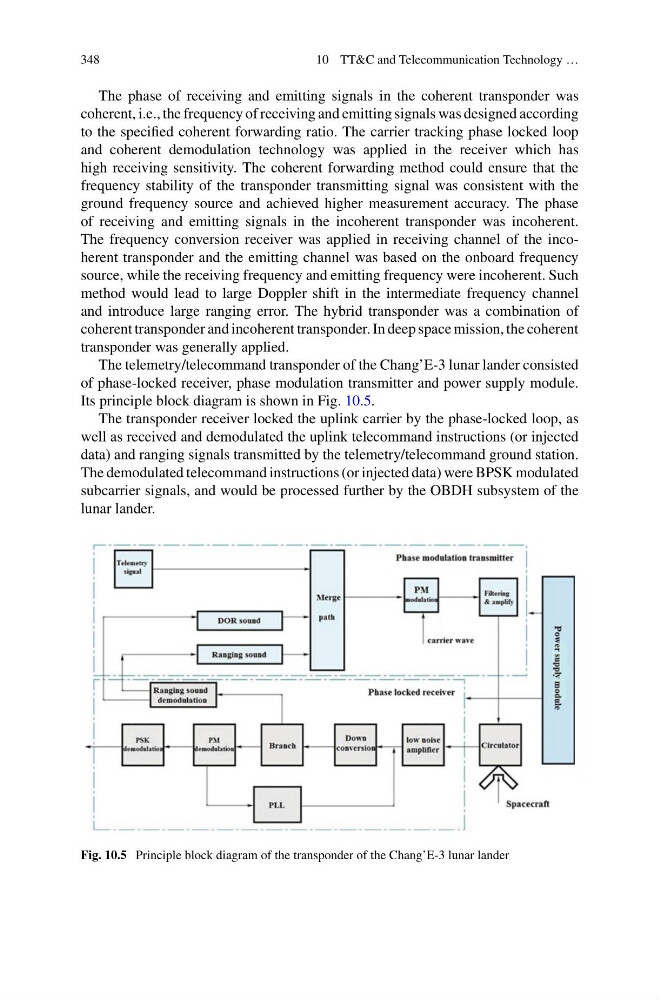
The telemetry/telecommand transponder of the Chang’E-3 lunar lander consisted
of phase-locked receiver, phase modulation transmitter and power supply module.
Its principle block diagram is shown in Fig. 10.5.
The transponder receiver locked the uplink carrier by the phase-locked loop, as
well as received and demodulated the uplink telecommand instructions (or injected
data) and ranging signals transmitted by the telemetry/telecommand ground station.
The demodulated telecommand instructions (or injected data) were BPSK modulated
subcarrier signals, and would be processed further by the OBDH subsystem of the
lunar lander.
Fig. 10.5 Principle block diagram of the transponder of the Chang’E-3 lunar lander
10 TT&C and Telecommunication Technology …
The phase of receiving and emitting signals in the coherent transponder was
coherent, i.e., the frequency of receiving and emitting signals was designed according
to the specified coherent forwarding ratio. The carrier tracking phase locked loop
and coherent demodulation technology was applied in the receiver which has
high receiving sensitivity. The coherent forwarding method could ensure that the
frequency stability of the transponder transmitting signal was consistent with the
ground frequency source and achieved higher measurement accuracy. The phase
of receiving and emitting signals in the incoherent transponder was incoherent.
The frequency conversion receiver was applied in receiving channel of the incoherent transponder and the emitting channel was based on the onboard frequency
source, while the receiving frequency and emitting frequency were incoherent. Such
method would lead to large Doppler shift in the intermediate frequency channel
and introduce large ranging error. The hybrid transponder was a combination of
coherent transponder and incoherent transponder. In deep space mission, the coherent
transponder was generally applied.
The telemetry/telecommand transponder of the Chang’E-3 lunar lander consisted
of phase-locked receiver, phase modulation transmitter and power supply module.
Its principle block diagram is shown in Fig. 10.5.
The transponder receiver locked the uplink carrier by the phase-locked loop, as
well as received and demodulated the uplink telecommand instructions (or injected
data) and ranging signals transmitted by the telemetry/telecommand ground station.
The demodulated telecommand instructions (or injected data) were BPSK modulated
subcarrier signals, and would be processed further by the OBDH subsystem of the
lunar lander.
Fig. 10.5 Principle block diagram of the transponder of the Chang’E-3 lunar lander