

316
9 OBDH Technology of Lunar Lander
packaging service and multiplexing service. The payload data was streamed in the
form of high-speed downlink, and bit-stream services were often used. Since the
data channel was not always open and the antenna was directional, while the ground
operation should often monitor the telemetry of the lander, sometimes the S-band
low-speed telemetry and the PCM TT&C system should be reserved. The telemetry
of X-band and S-band could be mutually backed up.
There were two channels for the Chang’E-3 lunar lander: low speed TT&C channel
and high-speed data transmission channel. The management of the lander data stream
by OBDH subsystem included:
(1) Uplink command and data processing on the T&T channel.
(2) Management and transmission of downlink data on the T&T channel.
(3) Management and transmission of downlink data on the data transmission
channel.
(4) Storage management of platform and payload data.
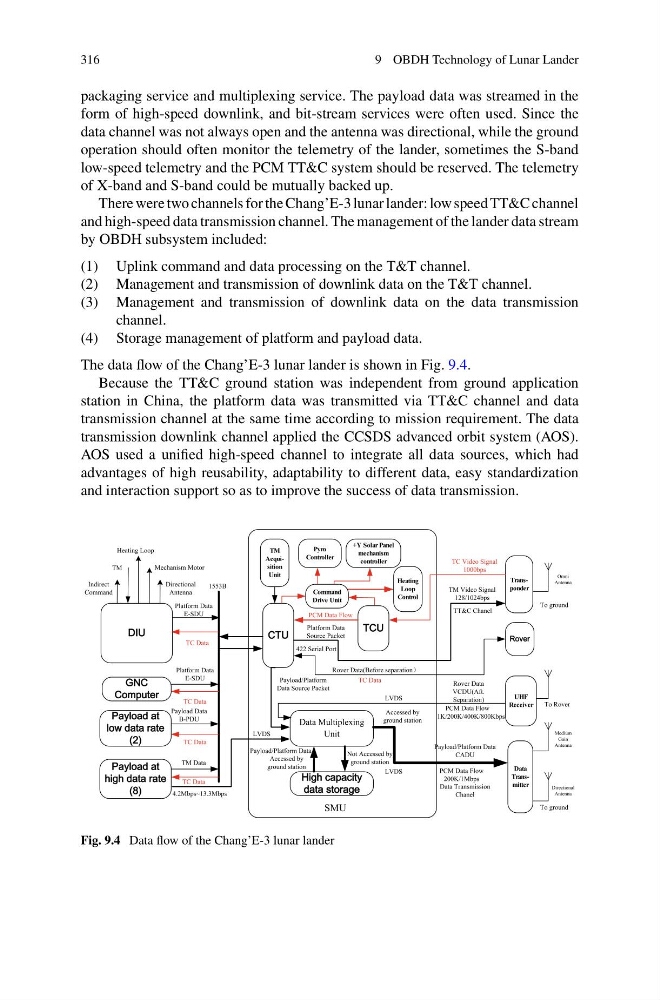
The data flow of the Chang’E-3 lunar lander is shown in Fig. 9.4.
Because the TT&C ground station was independent from ground application
station in China, the platform data was transmitted via TT&C channel and data
transmission channel at the same time according to mission requirement. The data
transmission downlink channel applied the CCSDS advanced orbit system (AOS).
AOS used a unified high-speed channel to integrate all data sources, which had
advantages of high reusability, adaptability to different data, easy standardization
and interaction support so as to improve the success of data transmission.
Fig. 9.4 Data flow of the Chang’E-3 lunar lander
9 OBDH Technology of Lunar Lander
packaging service and multiplexing service. The payload data was streamed in the
form of high-speed downlink, and bit-stream services were often used. Since the
data channel was not always open and the antenna was directional, while the ground
operation should often monitor the telemetry of the lander, sometimes the S-band
low-speed telemetry and the PCM TT&C system should be reserved. The telemetry
of X-band and S-band could be mutually backed up.
There were two channels for the Chang’E-3 lunar lander: low speed TT&C channel
and high-speed data transmission channel. The management of the lander data stream
by OBDH subsystem included:
(1) Uplink command and data processing on the T&T channel.
(2) Management and transmission of downlink data on the T&T channel.
(3) Management and transmission of downlink data on the data transmission
channel.
(4) Storage management of platform and payload data.
The data flow of the Chang’E-3 lunar lander is shown in Fig. 9.4.
Because the TT&C ground station was independent from ground application
station in China, the platform data was transmitted via TT&C channel and data
transmission channel at the same time according to mission requirement. The data
transmission downlink channel applied the CCSDS advanced orbit system (AOS).
AOS used a unified high-speed channel to integrate all data sources, which had
advantages of high reusability, adaptability to different data, easy standardization
and interaction support so as to improve the success of data transmission.
Fig. 9.4 Data flow of the Chang’E-3 lunar lander