

284
8 Propulsion Technology of Lunar Lander
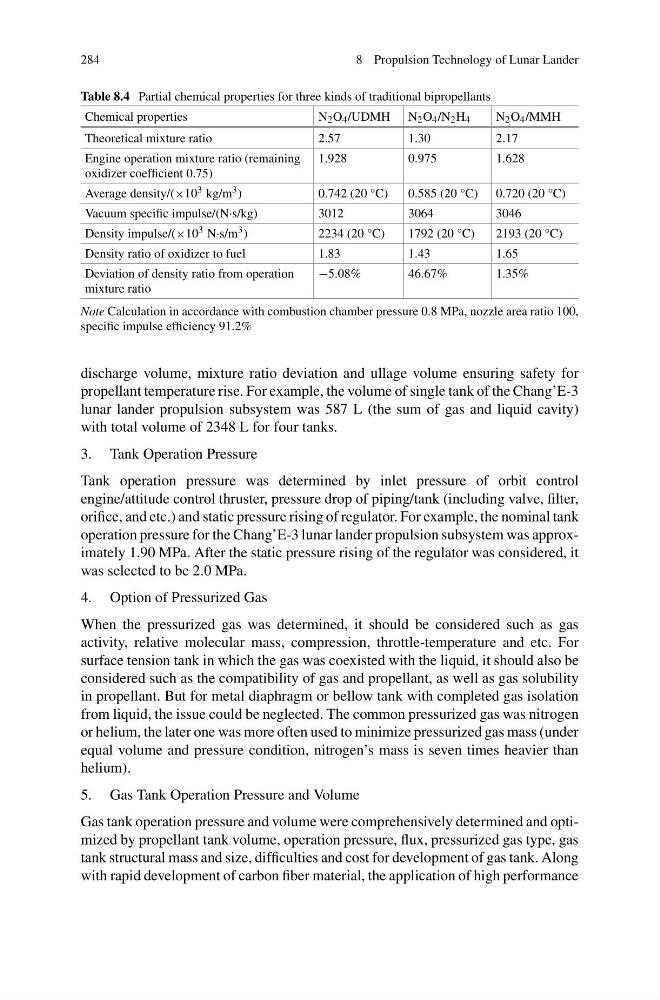
Table 8.4 Partial chemical properties for three kinds of traditional bipropellants
Chemical properties
N 2 O 4 /UDMH N 2 O 4 /N 2 H 4
N 2 O 4 /MMH
Theoretical mixture ratio
2.57
1.30
2.17
Engine operation mixture ratio (remaining
oxidizer coefficient 0.75)
1.928
0.975
1.628
Average density/(×10 3 kg/m 3 )
0.742 (20 °C)
0.585 (20 °C) 0.720 (20 °C)
Vacuum specific impulse/(N·s/kg)
3012
3064
3046
Density impulse/(×10 3 N·s/m 3 )
2234 (20 °C)
1792 (20 °C)
2193 (20 °C)
Density ratio of oxidizer to fuel
1.83
1.43
1.65
Deviation of density ratio from operation
mixture ratio
−5.08%
46.67%
1.35%
Note Calculation in accordance with combustion chamber pressure 0.8 MPa, nozzle area ratio 100,
specific impulse efficiency 91.2%
discharge volume, mixture ratio deviation and ullage volume ensuring safety for
propellant temperature rise. For example, the volume of single tank of the Chang’E-3
lunar lander propulsion subsystem was 587 L (the sum of gas and liquid cavity)
with total volume of 2348 L for four tanks.
3. Tank Operation Pressure
Tank operation pressure was determined by inlet pressure of orbit control
engine/attitude control thruster, pressure drop of piping/tank (including valve, filter,
orifice, and etc.) and static pressure rising of regulator. For example, the nominal tank
operation pressure for the Chang’E-3 lunar lander propulsion subsystem was approximately 1.90 MPa. After the static pressure rising of the regulator was considered, it
was selected to be 2.0 MPa.
4. Option of Pressurized Gas
When the pressurized gas was determined, it should be considered such as gas
activity, relative molecular mass, compression, throttle-temperature and etc. For
surface tension tank in which the gas was coexisted with the liquid, it should also be
considered such as the compatibility of gas and propellant, as well as gas solubility
in propellant. But for metal diaphragm or bellow tank with completed gas isolation
from liquid, the issue could be neglected. The common pressurized gas was nitrogen
or helium, the later one was more often used to minimize pressurized gas mass (under
equal volume and pressure condition, nitrogen’s mass is seven times heavier than
helium).
5. Gas Tank Operation Pressure and Volume
Gas tank operation pressure and volume were comprehensively determined and optimized by propellant tank volume, operation pressure, flux, pressurized gas type, gas
tank structural mass and size, difficulties and cost for development of gas tank. Along
with rapid development of carbon fiber material, the application of high performance
8 Propulsion Technology of Lunar Lander
Table 8.4 Partial chemical properties for three kinds of traditional bipropellants
Chemical properties
N 2 O 4 /UDMH N 2 O 4 /N 2 H 4
N 2 O 4 /MMH
Theoretical mixture ratio
2.57
1.30
2.17
Engine operation mixture ratio (remaining
oxidizer coefficient 0.75)
1.928
0.975
1.628
Average density/(×10 3 kg/m 3 )
0.742 (20 °C)
0.585 (20 °C) 0.720 (20 °C)
Vacuum specific impulse/(N·s/kg)
3012
3064
3046
Density impulse/(×10 3 N·s/m 3 )
2234 (20 °C)
1792 (20 °C)
2193 (20 °C)
Density ratio of oxidizer to fuel
1.83
1.43
1.65
Deviation of density ratio from operation
mixture ratio
−5.08%
46.67%
1.35%
Note Calculation in accordance with combustion chamber pressure 0.8 MPa, nozzle area ratio 100,
specific impulse efficiency 91.2%
discharge volume, mixture ratio deviation and ullage volume ensuring safety for
propellant temperature rise. For example, the volume of single tank of the Chang’E-3
lunar lander propulsion subsystem was 587 L (the sum of gas and liquid cavity)
with total volume of 2348 L for four tanks.
3. Tank Operation Pressure
Tank operation pressure was determined by inlet pressure of orbit control
engine/attitude control thruster, pressure drop of piping/tank (including valve, filter,
orifice, and etc.) and static pressure rising of regulator. For example, the nominal tank
operation pressure for the Chang’E-3 lunar lander propulsion subsystem was approximately 1.90 MPa. After the static pressure rising of the regulator was considered, it
was selected to be 2.0 MPa.
4. Option of Pressurized Gas
When the pressurized gas was determined, it should be considered such as gas
activity, relative molecular mass, compression, throttle-temperature and etc. For
surface tension tank in which the gas was coexisted with the liquid, it should also be
considered such as the compatibility of gas and propellant, as well as gas solubility
in propellant. But for metal diaphragm or bellow tank with completed gas isolation
from liquid, the issue could be neglected. The common pressurized gas was nitrogen
or helium, the later one was more often used to minimize pressurized gas mass (under
equal volume and pressure condition, nitrogen’s mass is seven times heavier than
helium).
5. Gas Tank Operation Pressure and Volume
Gas tank operation pressure and volume were comprehensively determined and optimized by propellant tank volume, operation pressure, flux, pressurized gas type, gas
tank structural mass and size, difficulties and cost for development of gas tank. Along
with rapid development of carbon fiber material, the application of high performance