

8.4 Propulsion Subsystem Design [5–7]
283
For bi-propellant radiation-cooled engine, due to combustion temperature as higher
as 3000 °C, the available metal could not withstand such high temperature. Therefore, small amount of propellant diverted from injector was sprayed directly onto the
chamber internal wall to cool it, which was called liquid film cooling for boundary
layer with 20–30% of total propellant flux. As liquid film coolant, fuel was usually
used to dilute oxidant content near chamber wall and prevent oxidation of metals
and coatings in high temperature. When fuel film coolant was selected, better physical characteristics such as broad liquid phase, large latent heat of vaporization,
large heat capacity, small high temperature self-decomposition and high density
should be considered preferentially. With comparison of three kinds of hydrazine
fuel like N 2 H 4 , MMH and UDMH, the MMH had best cooling effect. Partial physical
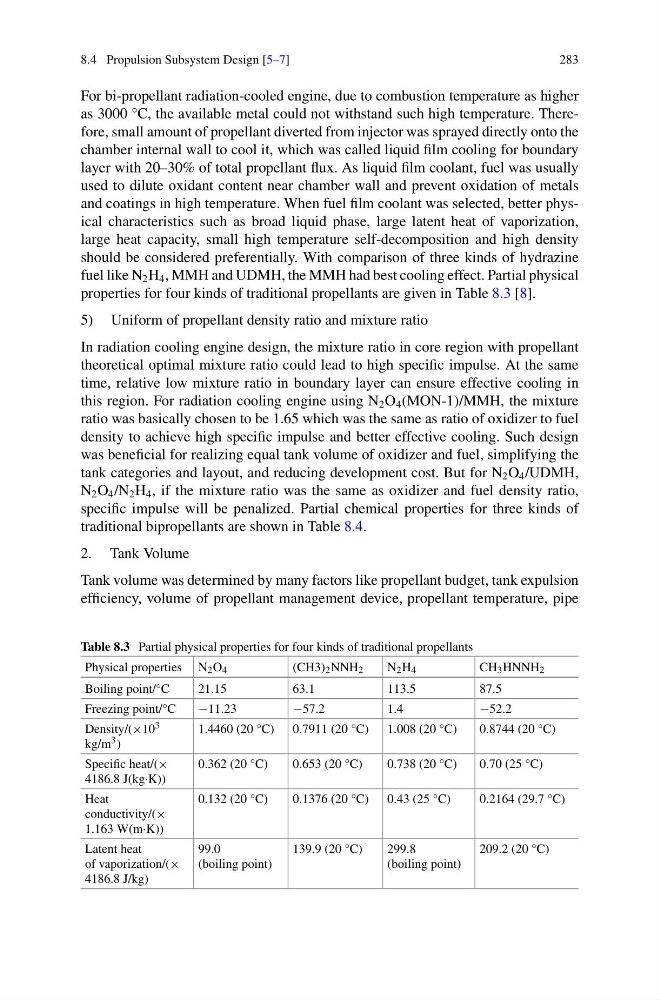
properties for four kinds of traditional propellants are given in Table 8.3 [8].
5) Uniform of propellant density ratio and mixture ratio
In radiation cooling engine design, the mixture ratio in core region with propellant
theoretical optimal mixture ratio could lead to high specific impulse. At the same
time, relative low mixture ratio in boundary layer can ensure effective cooling in
this region. For radiation cooling engine using N 2 O 4 (MON-1)/MMH, the mixture
ratio was basically chosen to be 1.65 which was the same as ratio of oxidizer to fuel
density to achieve high specific impulse and better effective cooling. Such design
was beneficial for realizing equal tank volume of oxidizer and fuel, simplifying the
tank categories and layout, and reducing development cost. But for N 2 O 4 /UDMH,
N 2 O 4 /N 2 H 4 , if the mixture ratio was the same as oxidizer and fuel density ratio,
specific impulse will be penalized. Partial chemical properties for three kinds of
traditional bipropellants are shown in Table 8.4.
2. Tank Volume
Tank volume was determined by many factors like propellant budget, tank expulsion
efficiency, volume of propellant management device, propellant temperature, pipe
Table 8.3 Partial physical properties for four kinds of traditional propellants
Physical properties N 2 O 4
(CH3) 2 NNH 2
N 2 H 4
CH 3 HNNH 2
Boiling point/°C
21.15
63.1
113.5
87.5
Freezing point/°C
−11.23
−57.2
1.4
−52.2
Density/(×10 3
kg/m 3 )
1.4460 (20 °C) 0.7911 (20 °C) 1.008 (20 °C)
0.8744 (20 °C)
Specific heat/(×
4186.8 J(kg·K))
0.362 (20 °C)
0.653 (20 °C)
0.738 (20 °C)
0.70 (25 °C)
Heat
conductivity/(×
1.163 W(m·K))
0.132 (20 °C)
0.1376 (20 °C) 0.43 (25 °C)
0.2164 (29.7 °C)
Latent heat
of vaporization/(×
4186.8 J/kg)
99.0
(boiling point)
139.9 (20 °C)
299.8
(boiling point)
209.2 (20 °C)
283
For bi-propellant radiation-cooled engine, due to combustion temperature as higher
as 3000 °C, the available metal could not withstand such high temperature. Therefore, small amount of propellant diverted from injector was sprayed directly onto the
chamber internal wall to cool it, which was called liquid film cooling for boundary
layer with 20–30% of total propellant flux. As liquid film coolant, fuel was usually
used to dilute oxidant content near chamber wall and prevent oxidation of metals
and coatings in high temperature. When fuel film coolant was selected, better physical characteristics such as broad liquid phase, large latent heat of vaporization,
large heat capacity, small high temperature self-decomposition and high density
should be considered preferentially. With comparison of three kinds of hydrazine
fuel like N 2 H 4 , MMH and UDMH, the MMH had best cooling effect. Partial physical
properties for four kinds of traditional propellants are given in Table 8.3 [8].
5) Uniform of propellant density ratio and mixture ratio
In radiation cooling engine design, the mixture ratio in core region with propellant
theoretical optimal mixture ratio could lead to high specific impulse. At the same
time, relative low mixture ratio in boundary layer can ensure effective cooling in
this region. For radiation cooling engine using N 2 O 4 (MON-1)/MMH, the mixture
ratio was basically chosen to be 1.65 which was the same as ratio of oxidizer to fuel
density to achieve high specific impulse and better effective cooling. Such design
was beneficial for realizing equal tank volume of oxidizer and fuel, simplifying the
tank categories and layout, and reducing development cost. But for N 2 O 4 /UDMH,
N 2 O 4 /N 2 H 4 , if the mixture ratio was the same as oxidizer and fuel density ratio,
specific impulse will be penalized. Partial chemical properties for three kinds of
traditional bipropellants are shown in Table 8.4.
2. Tank Volume
Tank volume was determined by many factors like propellant budget, tank expulsion
efficiency, volume of propellant management device, propellant temperature, pipe
Table 8.3 Partial physical properties for four kinds of traditional propellants
Physical properties N 2 O 4
(CH3) 2 NNH 2
N 2 H 4
CH 3 HNNH 2
Boiling point/°C
21.15
63.1
113.5
87.5
Freezing point/°C
−11.23
−57.2
1.4
−52.2
Density/(×10 3
kg/m 3 )
1.4460 (20 °C) 0.7911 (20 °C) 1.008 (20 °C)
0.8744 (20 °C)
Specific heat/(×
4186.8 J(kg·K))
0.362 (20 °C)
0.653 (20 °C)
0.738 (20 °C)
0.70 (25 °C)
Heat
conductivity/(×
1.163 W(m·K))
0.132 (20 °C)
0.1376 (20 °C) 0.43 (25 °C)
0.2164 (29.7 °C)
Latent heat
of vaporization/(×
4186.8 J/kg)
99.0
(boiling point)
139.9 (20 °C)
299.8
(boiling point)
209.2 (20 °C)