

8.2 Development Status [2, 3]
269
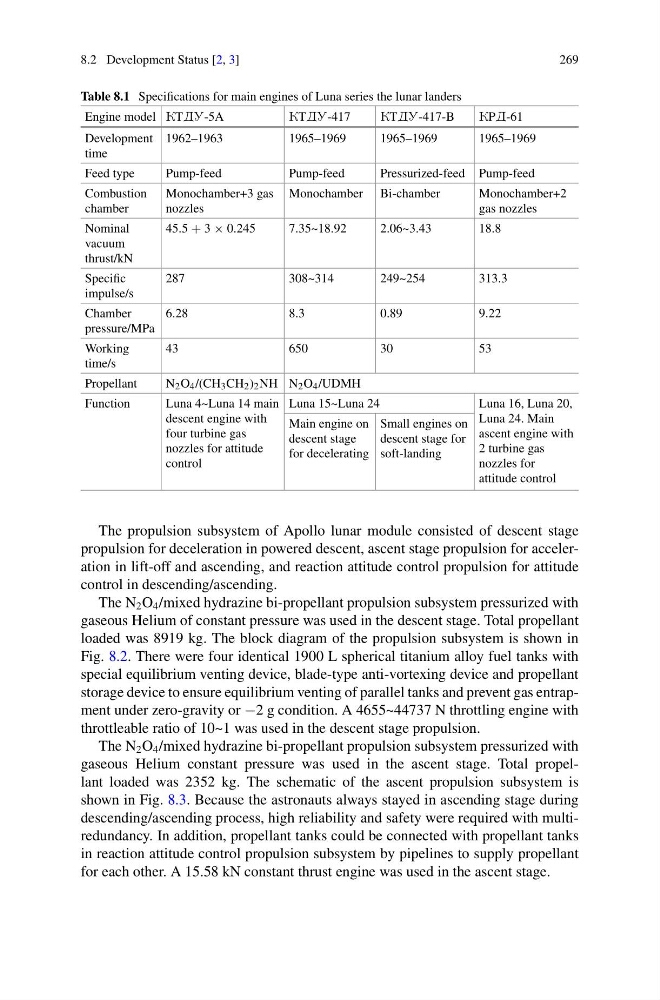
Table 8.1 Specifications for main engines of Luna series the lunar landers
Engine model KTDU-5A
KTDU-417
KTDU-417-B
KPD-61
Development
time
1962–1963
1965–1969
1965–1969
1965–1969
Feed type
Pump-feed
Pump-feed
Pressurized-feed Pump-feed
Combustion
chamber
Monochamber+3 gas
nozzles
Monochamber Bi-chamber
Monochamber+2
gas nozzles
Nominal
vacuum
thrust/kN
45.5 + 3 × 0.245
7.35~18.92
2.06~3.43
18.8
Specific
impulse/s
287
308~314
249~254
313.3
Chamber
pressure/MPa
6.28
8.3
0.89
9.22
Working
time/s
43
650
30
53
Propellant
N 2 O 4 /(CH 3 CH 2 ) 2 NH N 2 O 4 /UDMH
Function
Luna 4~Luna 14 main
descent engine with
four turbine gas
nozzles for attitude
control
Luna 15~Luna 24
Luna 16, Luna 20,
Luna 24. Main
ascent engine with
2 turbine gas
nozzles for
attitude control
Main engine on
descent stage
for decelerating
Small engines on
descent stage for
soft-landing
The propulsion subsystem of Apollo lunar module consisted of descent stage
propulsion for deceleration in powered descent, ascent stage propulsion for acceleration in lift-off and ascending, and reaction attitude control propulsion for attitude
control in descending/ascending.
The N 2 O 4 /mixed hydrazine bi-propellant propulsion subsystem pressurized with
gaseous Helium of constant pressure was used in the descent stage. Total propellant
loaded was 8919 kg. The block diagram of the propulsion subsystem is shown in
Fig. 8.2. There were four identical 1900 L spherical titanium alloy fuel tanks with
special equilibrium venting device, blade-type anti-vortexing device and propellant
storage device to ensure equilibrium venting of parallel tanks and prevent gas entrapment under zero-gravity or −2 g condition. A 4655~44737 N throttling engine with
throttleable ratio of 10~1 was used in the descent stage propulsion.
The N 2 O 4 /mixed hydrazine bi-propellant propulsion subsystem pressurized with
gaseous Helium constant pressure was used in the ascent stage. Total propellant loaded was 2352 kg. The schematic of the ascent propulsion subsystem is
shown in Fig. 8.3. Because the astronauts always stayed in ascending stage during
descending/ascending process, high reliability and safety were required with multiredundancy. In addition, propellant tanks could be connected with propellant tanks
in reaction attitude control propulsion subsystem by pipelines to supply propellant
for each other. A 15.58 kN constant thrust engine was used in the ascent stage.
269
Table 8.1 Specifications for main engines of Luna series the lunar landers
Engine model KTDU-5A
KTDU-417
KTDU-417-B
KPD-61
Development
time
1962–1963
1965–1969
1965–1969
1965–1969
Feed type
Pump-feed
Pump-feed
Pressurized-feed Pump-feed
Combustion
chamber
Monochamber+3 gas
nozzles
Monochamber Bi-chamber
Monochamber+2
gas nozzles
Nominal
vacuum
thrust/kN
45.5 + 3 × 0.245
7.35~18.92
2.06~3.43
18.8
Specific
impulse/s
287
308~314
249~254
313.3
Chamber
pressure/MPa
6.28
8.3
0.89
9.22
Working
time/s
43
650
30
53
Propellant
N 2 O 4 /(CH 3 CH 2 ) 2 NH N 2 O 4 /UDMH
Function
Luna 4~Luna 14 main
descent engine with
four turbine gas
nozzles for attitude
control
Luna 15~Luna 24
Luna 16, Luna 20,
Luna 24. Main
ascent engine with
2 turbine gas
nozzles for
attitude control
Main engine on
descent stage
for decelerating
Small engines on
descent stage for
soft-landing
The propulsion subsystem of Apollo lunar module consisted of descent stage
propulsion for deceleration in powered descent, ascent stage propulsion for acceleration in lift-off and ascending, and reaction attitude control propulsion for attitude
control in descending/ascending.
The N 2 O 4 /mixed hydrazine bi-propellant propulsion subsystem pressurized with
gaseous Helium of constant pressure was used in the descent stage. Total propellant
loaded was 8919 kg. The block diagram of the propulsion subsystem is shown in
Fig. 8.2. There were four identical 1900 L spherical titanium alloy fuel tanks with
special equilibrium venting device, blade-type anti-vortexing device and propellant
storage device to ensure equilibrium venting of parallel tanks and prevent gas entrapment under zero-gravity or −2 g condition. A 4655~44737 N throttling engine with
throttleable ratio of 10~1 was used in the descent stage propulsion.
The N 2 O 4 /mixed hydrazine bi-propellant propulsion subsystem pressurized with
gaseous Helium constant pressure was used in the ascent stage. Total propellant loaded was 2352 kg. The schematic of the ascent propulsion subsystem is
shown in Fig. 8.3. Because the astronauts always stayed in ascending stage during
descending/ascending process, high reliability and safety were required with multiredundancy. In addition, propellant tanks could be connected with propellant tanks
in reaction attitude control propulsion subsystem by pipelines to supply propellant
for each other. A 15.58 kN constant thrust engine was used in the ascent stage.