

268
8 Propulsion Technology of Lunar Lander
8.2 Development Status [2, 3]
Since the 1960s, the world’s leading space powers in succession conducted lunar
exploration and developed various the lunar landers. Till now, only Luna series of
the Soviet Union, Surveyor and Apollo series of the United States and Chinese the
Chang’E-3 lunar lander successfully implemented lunar soft-landing exploration.
N 2 O 4 /Ethylamine bi-propellant propulsion subsystem was used in Luna 9 lander
of the Soviet Union with a 45.5 kN pump-feed constant thrust main engine for orbit
correction in LTO, braking and decelerating in descent and landing with second
reigniting capability and 3 sets of 0.245 kN turbine gas nozzles for attitude control.
The propulsion for attitude and orbit control was independent in the descent stage
of Luna 9 lander of the Soviet Union. A 7.35~18.92 kN throttling pump-feed engine
and two sets of 2.06~3.43 kN throttling pressurized engines with N 2 O 4 /UDMH
bi-propellant were used for orbit control. Gas pressurized monopropellant engines
were used for attitude control. An 18.8 kN pump-feed constant thrust engine with
N 2 O 4 /UDMH bi-propellant was used in the ascent stage for orbit control.
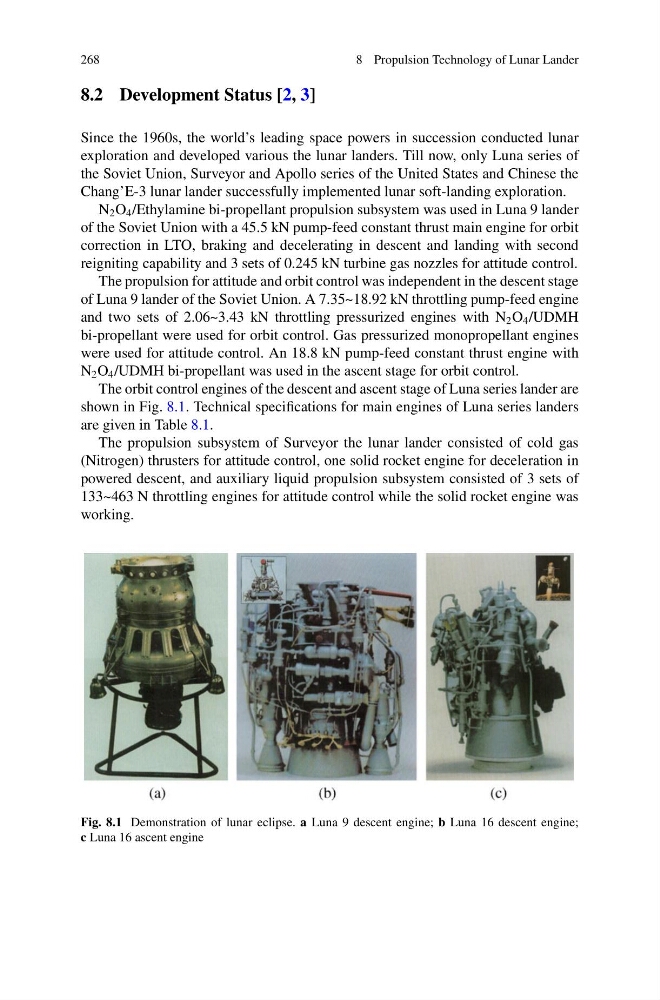
The orbit control engines of the descent and ascent stage of Luna series lander are
shown in Fig. 8.1. Technical specifications for main engines of Luna series landers
are given in Table 8.1.
The propulsion subsystem of Surveyor the lunar lander consisted of cold gas
(Nitrogen) thrusters for attitude control, one solid rocket engine for deceleration in
powered descent, and auxiliary liquid propulsion subsystem consisted of 3 sets of
133~463 N throttling engines for attitude control while the solid rocket engine was
working.
Fig. 8.1 Demonstration of lunar eclipse. a Luna 9 descent engine; b Luna 16 descent engine;
c Luna 16 ascent engine
8 Propulsion Technology of Lunar Lander
8.2 Development Status [2, 3]
Since the 1960s, the world’s leading space powers in succession conducted lunar
exploration and developed various the lunar landers. Till now, only Luna series of
the Soviet Union, Surveyor and Apollo series of the United States and Chinese the
Chang’E-3 lunar lander successfully implemented lunar soft-landing exploration.
N 2 O 4 /Ethylamine bi-propellant propulsion subsystem was used in Luna 9 lander
of the Soviet Union with a 45.5 kN pump-feed constant thrust main engine for orbit
correction in LTO, braking and decelerating in descent and landing with second
reigniting capability and 3 sets of 0.245 kN turbine gas nozzles for attitude control.
The propulsion for attitude and orbit control was independent in the descent stage
of Luna 9 lander of the Soviet Union. A 7.35~18.92 kN throttling pump-feed engine
and two sets of 2.06~3.43 kN throttling pressurized engines with N 2 O 4 /UDMH
bi-propellant were used for orbit control. Gas pressurized monopropellant engines
were used for attitude control. An 18.8 kN pump-feed constant thrust engine with
N 2 O 4 /UDMH bi-propellant was used in the ascent stage for orbit control.
The orbit control engines of the descent and ascent stage of Luna series lander are
shown in Fig. 8.1. Technical specifications for main engines of Luna series landers
are given in Table 8.1.
The propulsion subsystem of Surveyor the lunar lander consisted of cold gas
(Nitrogen) thrusters for attitude control, one solid rocket engine for deceleration in
powered descent, and auxiliary liquid propulsion subsystem consisted of 3 sets of
133~463 N throttling engines for attitude control while the solid rocket engine was
working.
Fig. 8.1 Demonstration of lunar eclipse. a Luna 9 descent engine; b Luna 16 descent engine;
c Luna 16 ascent engine