

6.6 Testing and Verification
223
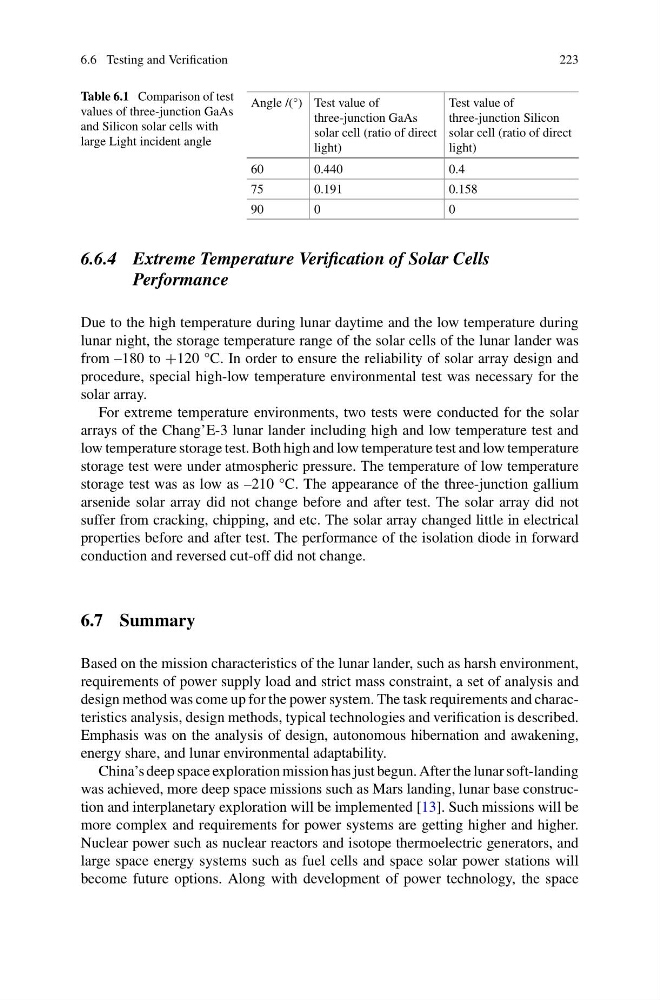
Table 6.1 Comparison of test
values of three-junction GaAs
and Silicon solar cells with
large Light incident angle
Angle /(°) Test value of
three-junction GaAs
solar cell (ratio of direct
light)
Test value of
three-junction Silicon
solar cell (ratio of direct
light)
60
0.440
0.4
75
0.191
0.158
90
0
0
6.6.4 Extreme Temperature Verification of Solar Cells
Performance
Due to the high temperature during lunar daytime and the low temperature during
lunar night, the storage temperature range of the solar cells of the lunar lander was
from –180 to +120 °C. In order to ensure the reliability of solar array design and
procedure, special high-low temperature environmental test was necessary for the
solar array.
For extreme temperature environments, two tests were conducted for the solar
arrays of the Chang’E-3 lunar lander including high and low temperature test and
low temperature storage test. Both high and low temperature test and low temperature
storage test were under atmospheric pressure. The temperature of low temperature
storage test was as low as –210 °C. The appearance of the three-junction gallium
arsenide solar array did not change before and after test. The solar array did not
suffer from cracking, chipping, and etc. The solar array changed little in electrical
properties before and after test. The performance of the isolation diode in forward
conduction and reversed cut-off did not change.
6.7 Summary
Based on the mission characteristics of the lunar lander, such as harsh environment,
requirements of power supply load and strict mass constraint, a set of analysis and
design method was come up for the power system. The task requirements and characteristics analysis, design methods, typical technologies and verification is described.
Emphasis was on the analysis of design, autonomous hibernation and awakening,
energy share, and lunar environmental adaptability.
China’s deep space exploration mission has just begun. After the lunar soft-landing
was achieved, more deep space missions such as Mars landing, lunar base construction and interplanetary exploration will be implemented [13]. Such missions will be
more complex and requirements for power systems are getting higher and higher.
Nuclear power such as nuclear reactors and isotope thermoelectric generators, and
large space energy systems such as fuel cells and space solar power stations will
become future options. Along with development of power technology, the space
223
Table 6.1 Comparison of test
values of three-junction GaAs
and Silicon solar cells with
large Light incident angle
Angle /(°) Test value of
three-junction GaAs
solar cell (ratio of direct
light)
Test value of
three-junction Silicon
solar cell (ratio of direct
light)
60
0.440
0.4
75
0.191
0.158
90
0
0
6.6.4 Extreme Temperature Verification of Solar Cells
Performance
Due to the high temperature during lunar daytime and the low temperature during
lunar night, the storage temperature range of the solar cells of the lunar lander was
from –180 to +120 °C. In order to ensure the reliability of solar array design and
procedure, special high-low temperature environmental test was necessary for the
solar array.
For extreme temperature environments, two tests were conducted for the solar
arrays of the Chang’E-3 lunar lander including high and low temperature test and
low temperature storage test. Both high and low temperature test and low temperature
storage test were under atmospheric pressure. The temperature of low temperature
storage test was as low as –210 °C. The appearance of the three-junction gallium
arsenide solar array did not change before and after test. The solar array did not
suffer from cracking, chipping, and etc. The solar array changed little in electrical
properties before and after test. The performance of the isolation diode in forward
conduction and reversed cut-off did not change.
6.7 Summary
Based on the mission characteristics of the lunar lander, such as harsh environment,
requirements of power supply load and strict mass constraint, a set of analysis and
design method was come up for the power system. The task requirements and characteristics analysis, design methods, typical technologies and verification is described.
Emphasis was on the analysis of design, autonomous hibernation and awakening,
energy share, and lunar environmental adaptability.
China’s deep space exploration mission has just begun. After the lunar soft-landing
was achieved, more deep space missions such as Mars landing, lunar base construction and interplanetary exploration will be implemented [13]. Such missions will be
more complex and requirements for power systems are getting higher and higher.
Nuclear power such as nuclear reactors and isotope thermoelectric generators, and
large space energy systems such as fuel cells and space solar power stations will
become future options. Along with development of power technology, the space