

222
6 Power Technology of Lunar Lander
temperature conditions to ensure the consistency of the operation status at awakening
time.
6.6.3 Verification of Large Incident Angle for Solar Cells
Similar to condition on Earth, the intensity of sun light is changed during on lunar
daytime. For the Chang’E-3 lunar lander, landing site was about 44 degrees north
latitude, and the local solar elevation angle was always less than 45 degrees. The
solar array incident angle was greater than 60 degrees during the alternation of lunar
daytime and night. The incident angle has a great influence on the power generation
of the solar array, so it was necessary to verify the power generation of the solar array
at a large incident angle.
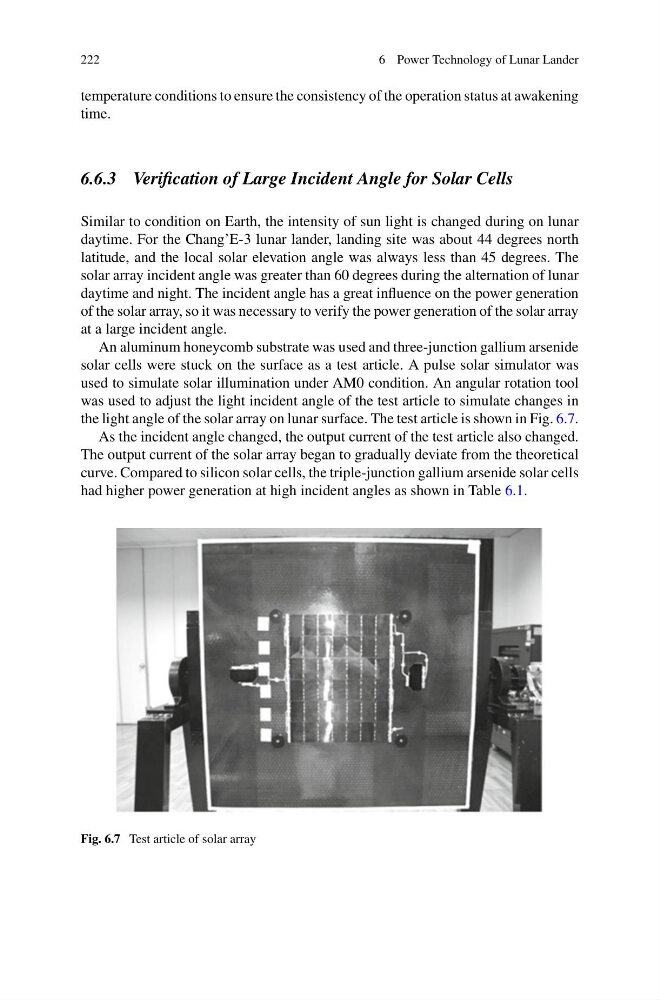
An aluminum honeycomb substrate was used and three-junction gallium arsenide
solar cells were stuck on the surface as a test article. A pulse solar simulator was
used to simulate solar illumination under AM0 condition. An angular rotation tool
was used to adjust the light incident angle of the test article to simulate changes in
the light angle of the solar array on lunar surface. The test article is shown in Fig. 6.7.
As the incident angle changed, the output current of the test article also changed.
The output current of the solar array began to gradually deviate from the theoretical
curve. Compared to silicon solar cells, the triple-junction gallium arsenide solar cells
had higher power generation at high incident angles as shown in Table 6.1.
Fig. 6.7 Test article of solar array
6 Power Technology of Lunar Lander
temperature conditions to ensure the consistency of the operation status at awakening
time.
6.6.3 Verification of Large Incident Angle for Solar Cells
Similar to condition on Earth, the intensity of sun light is changed during on lunar
daytime. For the Chang’E-3 lunar lander, landing site was about 44 degrees north
latitude, and the local solar elevation angle was always less than 45 degrees. The
solar array incident angle was greater than 60 degrees during the alternation of lunar
daytime and night. The incident angle has a great influence on the power generation
of the solar array, so it was necessary to verify the power generation of the solar array
at a large incident angle.
An aluminum honeycomb substrate was used and three-junction gallium arsenide
solar cells were stuck on the surface as a test article. A pulse solar simulator was
used to simulate solar illumination under AM0 condition. An angular rotation tool
was used to adjust the light incident angle of the test article to simulate changes in
the light angle of the solar array on lunar surface. The test article is shown in Fig. 6.7.
As the incident angle changed, the output current of the test article also changed.
The output current of the solar array began to gradually deviate from the theoretical
curve. Compared to silicon solar cells, the triple-junction gallium arsenide solar cells
had higher power generation at high incident angles as shown in Table 6.1.
Fig. 6.7 Test article of solar array