

178
5 Thermal Control Technology of Lunar Lander
(1) It shall be α nuclear source which is easy for radiation protection.
(2) Its mass specific power shall be high to reduce the mass as much as possible.
(3) Its radioactive half-life shall be longer enough for long-term application.
According to above requirements, the
238 Pu with long radioactive half-life
(87.7 years), high mass specific power (0.55 W/g), α nuclear source, heat power
decay rate (0.8% per year), is preferred for space application among over 3000
isotopes available. Because
238 Pu is radioactive and highly toxic, the most important
issue was radiation protection when RHU is developed to ensure personnel health and
environment safety by isolation protection measures in AIT (Assembly, Integration
and Test) according to international treaty for space application.
The RHU of the Chang’E-3 lunar lander was connected with heat transfer devices,
which were turned on to transfer the heat into instrument modules to maintain the
temperature within allowable range during hibernation in lunar night. After the lunar
lander was awakened, the heat transfer devices were shut off by ground commands
to stop transferring heat into the module to avoid that instruments in the module
was overheated resulting temperature arising or even higher than requirement. The
temperature of RHU would arise after the heat transfer devices stopped to transfer
heat in lunar daytime. Therefore, it was necessary to take thermal control measures
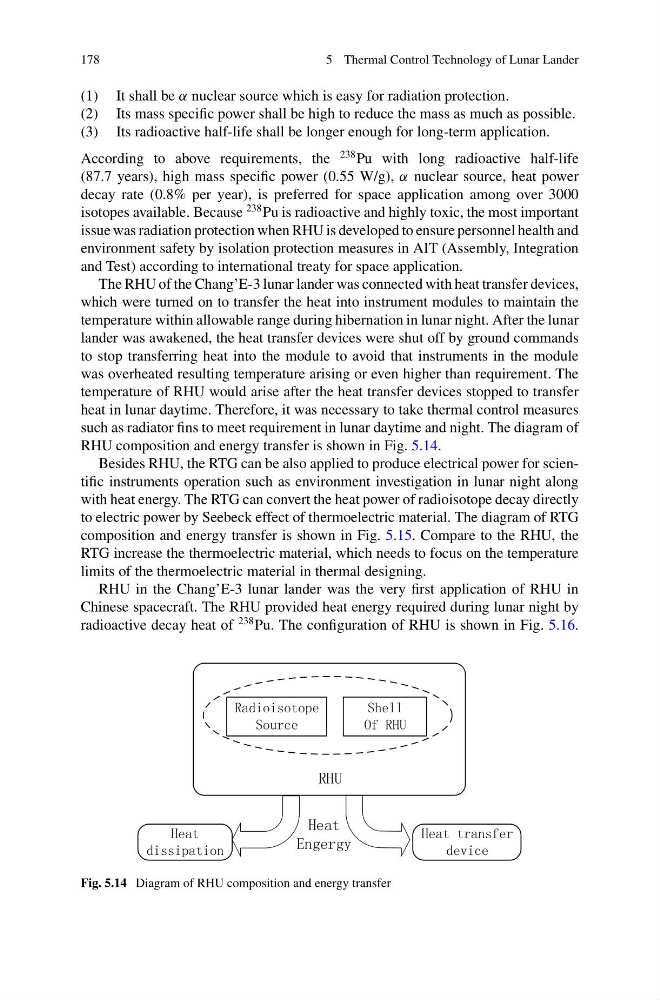
such as radiator fins to meet requirement in lunar daytime and night. The diagram of
RHU composition and energy transfer is shown in Fig. 5.14.
Besides RHU, the RTG can be also applied to produce electrical power for scientific instruments operation such as environment investigation in lunar night along
with heat energy. The RTG can convert the heat power of radioisotope decay directly
to electric power by Seebeck effect of thermoelectric material. The diagram of RTG
composition and energy transfer is shown in Fig. 5.15. Compare to the RHU, the
RTG increase the thermoelectric material, which needs to focus on the temperature
limits of the thermoelectric material in thermal designing.
RHU in the Chang’E-3 lunar lander was the very first application of RHU in
Chinese spacecraft. The RHU provided heat energy required during lunar night by
radioactive decay heat of
238 Pu. The configuration of RHU is shown in Fig. 5.16.
Fig. 5.14 Diagram of RHU composition and energy transfer
5 Thermal Control Technology of Lunar Lander
(1) It shall be α nuclear source which is easy for radiation protection.
(2) Its mass specific power shall be high to reduce the mass as much as possible.
(3) Its radioactive half-life shall be longer enough for long-term application.
According to above requirements, the
238 Pu with long radioactive half-life
(87.7 years), high mass specific power (0.55 W/g), α nuclear source, heat power
decay rate (0.8% per year), is preferred for space application among over 3000
isotopes available. Because
238 Pu is radioactive and highly toxic, the most important
issue was radiation protection when RHU is developed to ensure personnel health and
environment safety by isolation protection measures in AIT (Assembly, Integration
and Test) according to international treaty for space application.
The RHU of the Chang’E-3 lunar lander was connected with heat transfer devices,
which were turned on to transfer the heat into instrument modules to maintain the
temperature within allowable range during hibernation in lunar night. After the lunar
lander was awakened, the heat transfer devices were shut off by ground commands
to stop transferring heat into the module to avoid that instruments in the module
was overheated resulting temperature arising or even higher than requirement. The
temperature of RHU would arise after the heat transfer devices stopped to transfer
heat in lunar daytime. Therefore, it was necessary to take thermal control measures
such as radiator fins to meet requirement in lunar daytime and night. The diagram of
RHU composition and energy transfer is shown in Fig. 5.14.
Besides RHU, the RTG can be also applied to produce electrical power for scientific instruments operation such as environment investigation in lunar night along
with heat energy. The RTG can convert the heat power of radioisotope decay directly
to electric power by Seebeck effect of thermoelectric material. The diagram of RTG
composition and energy transfer is shown in Fig. 5.15. Compare to the RHU, the
RTG increase the thermoelectric material, which needs to focus on the temperature
limits of the thermoelectric material in thermal designing.
RHU in the Chang’E-3 lunar lander was the very first application of RHU in
Chinese spacecraft. The RHU provided heat energy required during lunar night by
radioactive decay heat of
238 Pu. The configuration of RHU is shown in Fig. 5.16.
Fig. 5.14 Diagram of RHU composition and energy transfer