

156
5 Thermal Control Technology of Lunar Lander
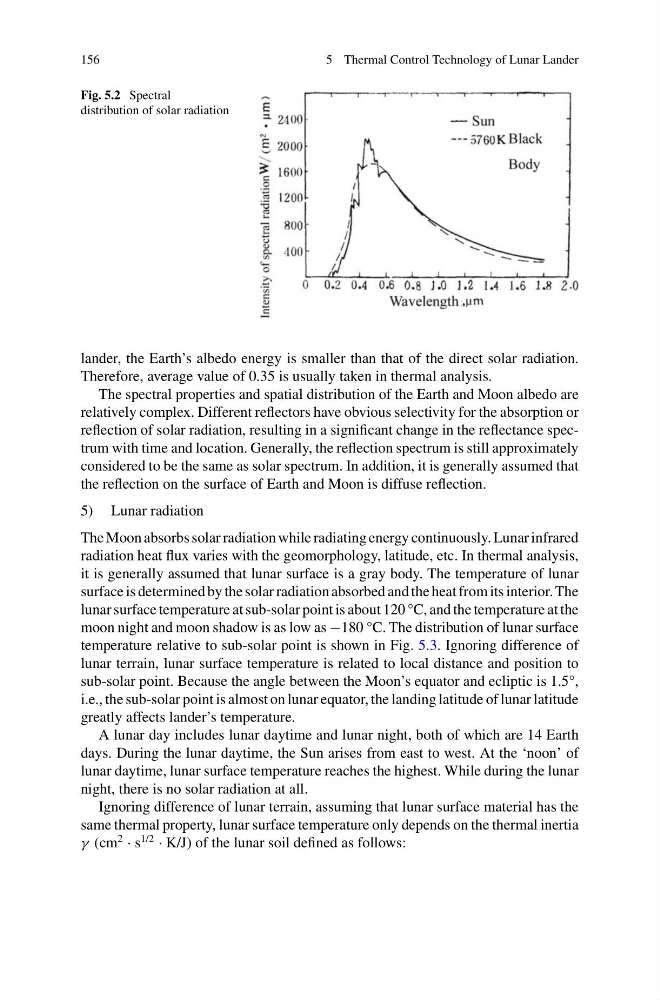
Fig. 5.2 Spectral
distribution of solar radiation
lander, the Earth’s albedo energy is smaller than that of the direct solar radiation.
Therefore, average value of 0.35 is usually taken in thermal analysis.
The spectral properties and spatial distribution of the Earth and Moon albedo are
relatively complex. Different reflectors have obvious selectivity for the absorption or
reflection of solar radiation, resulting in a significant change in the reflectance spectrum with time and location. Generally, the reflection spectrum is still approximately
considered to be the same as solar spectrum. In addition, it is generally assumed that
the reflection on the surface of Earth and Moon is diffuse reflection.
5) Lunar radiation
The Moon absorbs solar radiation while radiating energy continuously. Lunar infrared
radiation heat flux varies with the geomorphology, latitude, etc. In thermal analysis,
it is generally assumed that lunar surface is a gray body. The temperature of lunar
surface is determined by the solar radiation absorbed and the heat from its interior. The
lunar surface temperature at sub-solar point is about 120 °C, and the temperature at the
moon night and moon shadow is as low as −180 °C. The distribution of lunar surface
temperature relative to sub-solar point is shown in Fig. 5.3. Ignoring difference of
lunar terrain, lunar surface temperature is related to local distance and position to
sub-solar point. Because the angle between the Moon’s equator and ecliptic is 1.5°,
i.e., the sub-solar point is almost on lunar equator, the landing latitude of lunar latitude
greatly affects lander’s temperature.
A lunar day includes lunar daytime and lunar night, both of which are 14 Earth
days. During the lunar daytime, the Sun arises from east to west. At the ‘noon’ of
lunar daytime, lunar surface temperature reaches the highest. While during the lunar
night, there is no solar radiation at all.
Ignoring difference of lunar terrain, assuming that lunar surface material has the
same thermal property, lunar surface temperature only depends on the thermal inertia
γ (cm
2 · s
1/2 · K/J) of the lunar soil defined as follows:
5 Thermal Control Technology of Lunar Lander
Fig. 5.2 Spectral
distribution of solar radiation
lander, the Earth’s albedo energy is smaller than that of the direct solar radiation.
Therefore, average value of 0.35 is usually taken in thermal analysis.
The spectral properties and spatial distribution of the Earth and Moon albedo are
relatively complex. Different reflectors have obvious selectivity for the absorption or
reflection of solar radiation, resulting in a significant change in the reflectance spectrum with time and location. Generally, the reflection spectrum is still approximately
considered to be the same as solar spectrum. In addition, it is generally assumed that
the reflection on the surface of Earth and Moon is diffuse reflection.
5) Lunar radiation
The Moon absorbs solar radiation while radiating energy continuously. Lunar infrared
radiation heat flux varies with the geomorphology, latitude, etc. In thermal analysis,
it is generally assumed that lunar surface is a gray body. The temperature of lunar
surface is determined by the solar radiation absorbed and the heat from its interior. The
lunar surface temperature at sub-solar point is about 120 °C, and the temperature at the
moon night and moon shadow is as low as −180 °C. The distribution of lunar surface
temperature relative to sub-solar point is shown in Fig. 5.3. Ignoring difference of
lunar terrain, lunar surface temperature is related to local distance and position to
sub-solar point. Because the angle between the Moon’s equator and ecliptic is 1.5°,
i.e., the sub-solar point is almost on lunar equator, the landing latitude of lunar latitude
greatly affects lander’s temperature.
A lunar day includes lunar daytime and lunar night, both of which are 14 Earth
days. During the lunar daytime, the Sun arises from east to west. At the ‘noon’ of
lunar daytime, lunar surface temperature reaches the highest. While during the lunar
night, there is no solar radiation at all.
Ignoring difference of lunar terrain, assuming that lunar surface material has the
same thermal property, lunar surface temperature only depends on the thermal inertia
γ (cm
2 · s
1/2 · K/J) of the lunar soil defined as follows: